How to Convert mL to L Without a Calculator (3-Second Decimal Trick)
Your recipe says 750 mL of milk, but your jug is marked in liters. You do not need a calculator here, and you do not need an app.
Once you learn how to convert ml to l the easy way, you can do it in your head in about three seconds. The trick is simple: move the decimal point three places to the left. That is it.
In this guide, we will walk through that trick, work through real examples, and show you where you will use it every day.
What Do mL and L Mean?
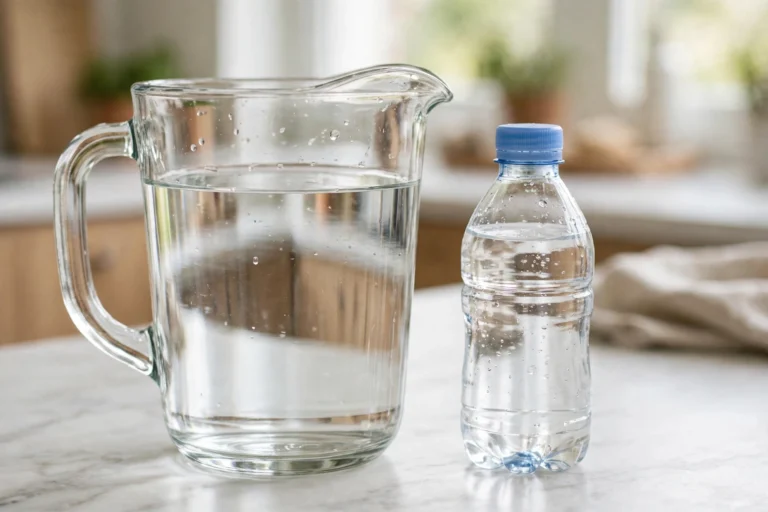
Both milliliters (mL) and liters (L) measure liquid volume. A liter is bigger; a milliliter is smaller.
Remember one fact:
1 liter = 1,000 milliliters
And the reverse:
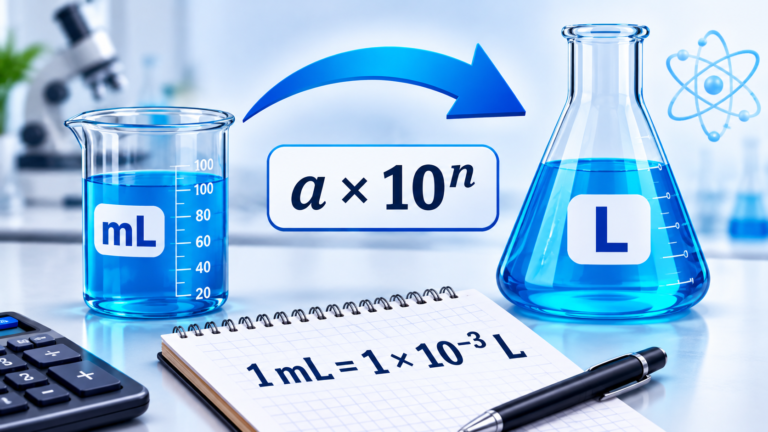
1 milliliter = 0.001 liters
That is the whole relationship. If you have 1,000 mL, you have exactly 1 L. If you have 500 mL, you have half a liter.
You will see mL on small things like medicine bottles, and L on bigger things like water bottles.
How to Convert mL to L: The 3-Second Decimal Trick
Here is the trick in one sentence:
To convert mL to L, move the decimal point three places to the left.
That works because dividing by 1,000 is the same as moving the decimal three places left. To go from mL to L, you divide by 1,000. Let us try it with 750 mL.
Step 1: Write down the number. Start with 750. If no decimal point is showing, imagine one at the end, so 750 is really 750.0.
Step 2: Move the decimal three places left. Move once and you get 75.0. Move twice and you get 7.50. Move three times and you get 0.750.
Step 3: Read the answer. 0.750 L is the same as 0.75 L. So 750 mL = 0.75 L. Three moves, three seconds, done.
The same rule works if the number already has a decimal point. Take 1250.5 mL — move it three places left and you get 1.2505 L.
What if the number is small?
What if you have only 25 mL? There are not three digits to move past. Just add zeros in front. Write 25 as 025, move the decimal three places left, and you get 0.025. So 25 mL = 0.025 L.
The same works for 5 mL. Write it as 005, move the decimal three places left, and you get 0.005 L. Those leading zeros are just placeholders. You always need three moves. If you run out of digits, add a zero.
The divide-by-1000 version
Some people prefer division: Liters = milliliters ÷ 1,000. So 750 ÷ 1,000 = 0.75 L. Use whichever feels easier.
Worked Examples
Examples make this stick far better than rules alone.
250 mL = 0.25 L. This is a quarter of a liter, common on small water bottles and juice boxes.
500 mL = 0.5 L. This is half a liter, and the most common size you will see. A standard small bottle of water or soda is often 500 mL.
750 mL = 0.75 L. Three-quarters of a liter. Many wine bottles and cooking oil bottles are 750 mL.
1,000 mL = 1 L. This is the anchor number. If you remember nothing else, remember this one.
1,250 mL = 1.25 L. One liter plus a quarter liter, often seen on large juice or milk bottles.
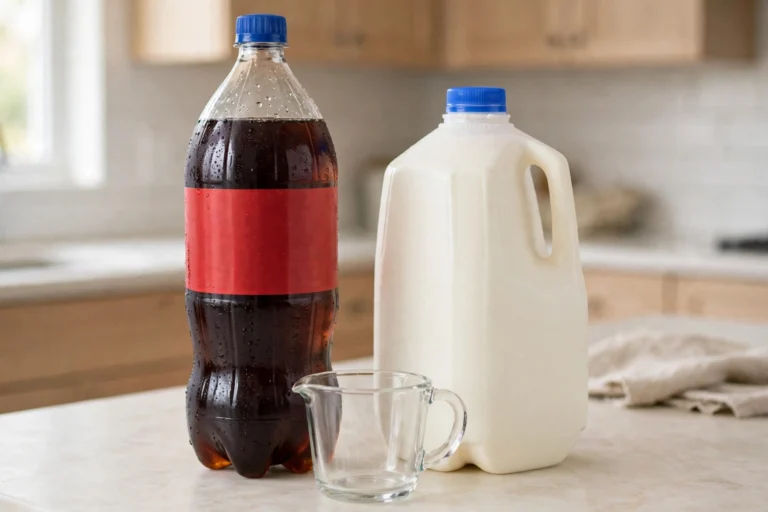
1,500 mL = 1.5 L. One and a half liters. Many soda and water bottles come in this size.
2,000 mL = 2 L. The size of a big soda bottle in the United States.
5,000 mL = 5 L. Five liters, often seen on large water or cooking oil containers.
Smaller numbers work the same way: 100 mL = 0.1 L, 50 mL = 0.05 L, and 5 mL = 0.005 L.
Quick Conversion Table
Keep this table handy.
| Milliliters (mL) | Liters (L) |
|---|---|
| 5 mL | 0.005 L |
| 10 mL | 0.01 L |
| 25 mL | 0.025 L |
| 50 mL | 0.05 L |
| 100 mL | 0.1 L |
| 250 mL | 0.25 L |
| 500 mL | 0.5 L |
| 750 mL | 0.75 L |
| 1,000 mL | 1 L |
| 1,250 mL | 1.25 L |
| 1,500 mL | 1.5 L |
| 2,000 mL | 2 L |
| 5,000 mL | 5 L |
Every number on the right is just the number on the left with the decimal moved three places. Once you see the pattern, it is hard to forget.
Everyday Examples
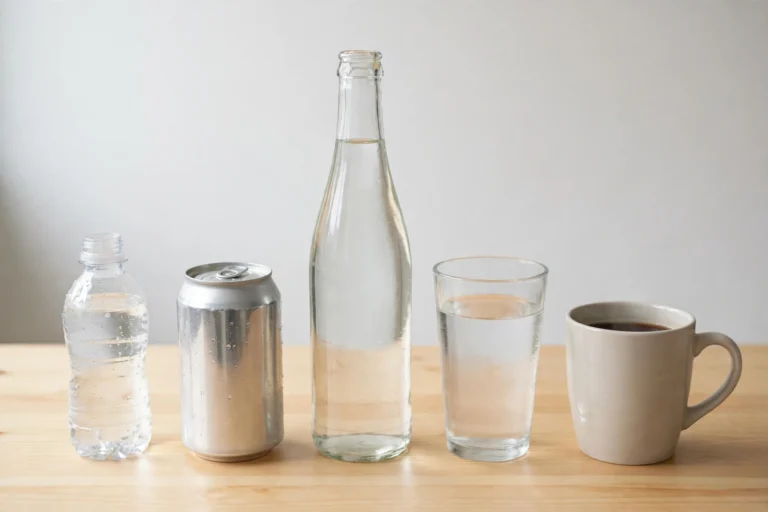
Water and drinks. A water bottle often says 500 mL, 750 mL, or 1 L. If you need 2 liters a day, that is four 500 mL bottles, because 500 mL is 0.5 L.
Cooking. A recipe might call for 250 mL of milk, while your jug shows liters. Knowing 250 mL is 0.25 L lets you pour the right amount.
Medicine. Liquid medicines are often measured in mL: 5 mL, 10 mL, 15 mL. A chart might record the same dose in liters, especially for IV fluids. For example, 500 mL of IV fluid is 0.5 L. Never guess a medicine dose, though. If you are unsure, ask a pharmacist or doctor.
Travel. The airport rule for carry-on liquids is 100 mL per container, which is 0.1 L. All your containers must fit in a 1-liter bag. That is why travel-size shampoo bottles are often marked 100 mL.
Cars and cleaning. Engine oil is measured in liters, often 4 to 5 L, but a top-up bottle might be marked 1,000 mL. Cleaning products often tell you to mix a set number of mL per liter of water.
Mistakes to Avoid
Moving the decimal the wrong way. This is the most common error. Moving right instead of left makes the answer 1,000 times too big. Remember: mL is small, L is big, so the number should get smaller. If your answer is bigger than the number you started with, you moved the wrong way.
Moving it two places instead of three. Moving only two places would turn 500 mL into 5 L, which is wrong. It has to be three places, because 1,000 has three zeros.
Forgetting the leading zero. For small amounts, write 0.025 L, not .025 L. The zero in front makes it clearer and easier to read.
Mixing up mL and L on labels. Labels are printed in small type. Take an extra second to check which unit you are looking at before you convert.
Rounding too early. If you are adding several amounts, add them first in mL, then convert once at the end. For example, 250 + 500 + 750 = 1,500 mL = 1.5 L.
Practice Questions
Cover the answers, try each one, then check.
1. Convert 350 mL to liters. Answer: 0.35 L.
2. Convert 2,750 mL to liters. Answer: 2.75 L.
3. Convert 80 mL to liters. Answer: 0.08 L.
4. Convert 4,000 mL to liters. Answer: 4 L.
5. You have three 500 mL bottles of water. How many liters is that? Answer: 1,500 mL = 1.5 L.
6. A recipe needs 0.6 L of cream. How many mL is that? Move the decimal three places right. Answer: 600 mL.
If you got them all right, you have the trick down. If you missed one, count the decimal moves slowly. Accuracy comes first.
Frequently Asked Questions
How do I convert mL to L without a calculator?
Move the decimal point three places to the left. For example, 750 mL becomes 0.75 L. That is the same as dividing by 1,000.
Is 100 mL the same as 0.1 L?
Yes. Move the decimal three places left and 100 becomes 0.100, which is 0.1 L. This is useful because 100 mL is a common size for travel bottles.
How many mL are in 1 liter?
There are 1,000 mL in 1 liter. So 1 L = 1,000 mL, 2 L = 2,000 mL, and 0.5 L = 500 mL.
What is 500 mL in liters?
500 mL is 0.5 L, or half a liter. This is one of the most common conversions, because so many water and soda bottles are 500 mL.
Why do we divide by 1,000?
Because there are 1,000 milliliters in one liter. The prefix “milli-” means one-thousandth, so one milliliter is one-thousandth of a liter.
Conclusion
Converting mL to L does not need a calculator or a complicated formula. It just needs one move: shift the decimal point three places to the left.
Remember the anchor: 1,000 mL equals 1 L. Everything else follows from that.
Next time a recipe or label gives you a number in mL, try the trick in your head first. Move the decimal, check that your answer is smaller than the number you started with, and you are done.