Why 1000 mL Doesn’t Always Equal 1 Kilogram (Volume vs. Mass)
Is 1000 ml equal to 1 kg? For water, yes — almost exactly. For almost everything else, no.
That surprises people, but the neat match is a special property of water, not a general rule: change the liquid, and the weight changes.
The confusion comes from mixing up volume and mass. Volume is how much space something takes up. Mass is how much stuff is in it — what we feel as weight on a kitchen scale. Millilitres and litres measure volume. Grams and kilograms measure mass. You cannot turn one into the other without one extra fact: how dense the substance is.
Volume vs. Mass: What Is the Difference?
Think of volume as the size of the container, and mass as how heavy the contents are. A litre measures space; a kilogram measures mass.
Picture two identical one-litre bottles. Fill one with water and the other with cooking oil. Both hold exactly the same volume, 1000 mL. But the water bottle feels slightly heavier. The oil is not lighter because it holds less — it holds exactly the same amount of space. It is lighter because oil is less dense than water, so the same volume contains less mass.
That is the whole idea: volume tells you the size, density tells you how much mass is squeezed into that size, and mass is volume multiplied by density.
Why Water Weighs 1 kg per Litre
Water is the reason this question exists at all. When the metric system was created, the kilogram was originally defined using water: one kilogram was the mass of one litre of water. That was a deliberate choice, so the units would line up neatly. And they do — for water.
Pure water has a density of about 1 gram per millilitre (1 g/mL), so every 1000 mL weighs about 1000 grams — exactly 1 kilogram.
But that match belongs to water alone: other substances have different densities, so the moment you swap water for something else, the match breaks.
The One Formula You Need
You do not need a separate conversion for every substance. You only need one formula:
Mass (g) = Volume (mL) × Density (g/mL)
Density, in grams per millilitre, tells you how many grams each millilitre weighs. Multiply by the millilitres you have to get grams, then divide by 1000 for kilograms.
Try it with water, at about 1 g/mL: 1000 × 1 = 1000 g, or 1 kg. With honey, at about 1.4 g/mL: 1000 × 1.4 = 1400 g, or 1.4 kg. With cooking oil, at about 0.92 g/mL: 1000 × 0.92 = 920 g, or 0.92 kg.
Without the density, you cannot convert volume to mass at all — which is why a measuring jug and a kitchen scale are not interchangeable.
A Kitchen Scale and a Measuring Jug Measure Different Things
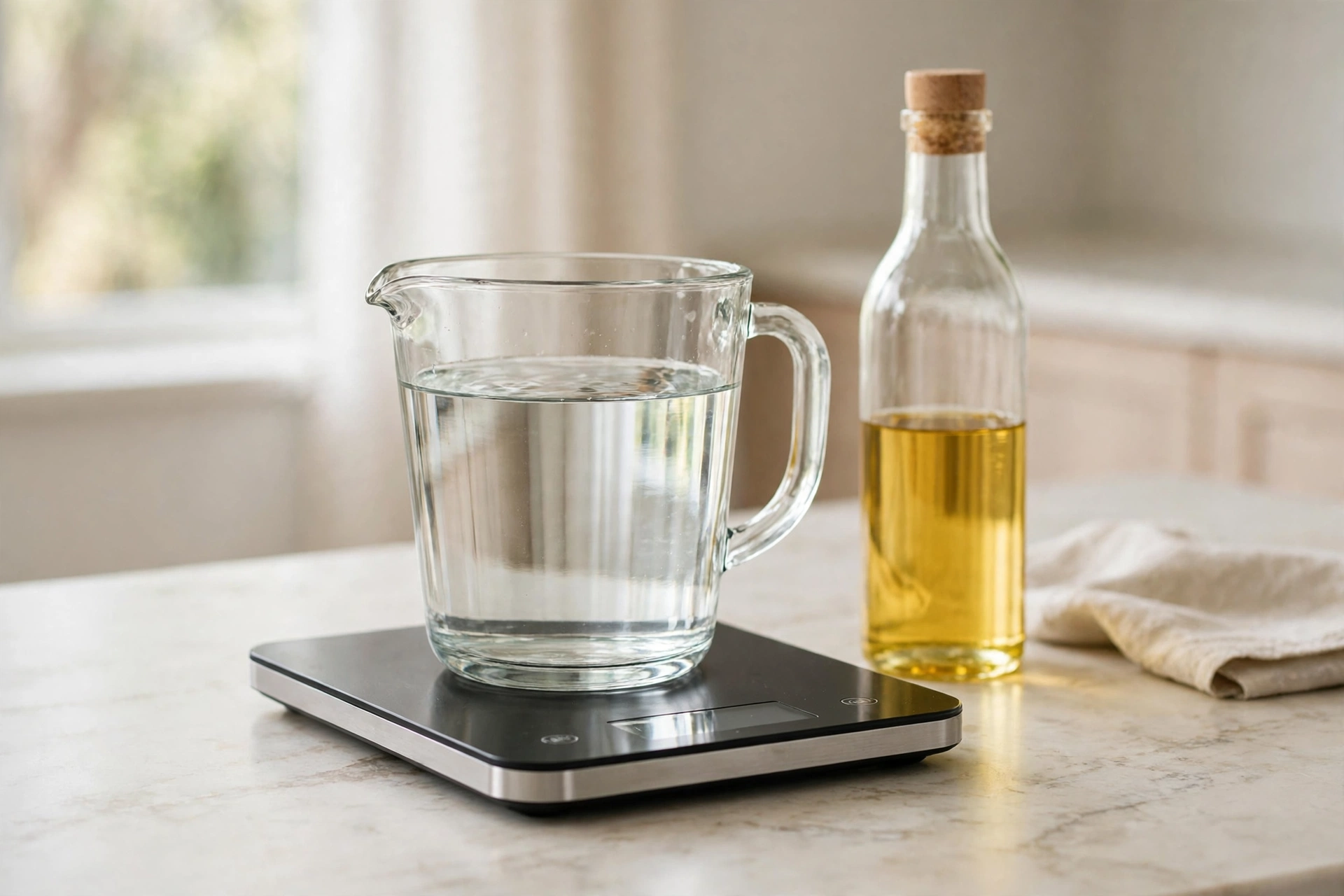
A measuring jug measures volume: how much space the liquid fills. A kitchen scale measures mass: how heavy it is. For water, the two agree, because 1 mL of water weighs 1 gram. For other ingredients, they do not.
Pour 250 mL of water into a jug and the scale reads about 250 grams. Pour 250 mL of honey into the same jug and it reads about 350 grams. Pour 250 mL of cooking oil and it reads about 230 grams. The jug gives the same reading every time, because the volume is the same. The scale gives a different reading every time, because the mass is different.
That is why bakers weigh ingredients: 200 grams of flour is always 200 grams, but a cup of flour can weigh very different amounts depending on how tightly it is packed.
How Much Does 1000 mL of Common Substances Weigh?
The table below shows the approximate weight of one litre (1000 mL) of several common substances. Densities are typical values at room temperature; natural products vary a little, so treat these as good working figures.
| Substance | Density (g/mL) | Weight of 1000 mL |
|---|---|---|
| Water | 1.00 | 1.00 kg |
| Milk | 1.03 | 1.03 kg |
| Cooking oil | 0.91–0.93 | 0.92 kg |
| Honey | 1.40 | 1.40 kg |
| Flour | 0.50–0.60 | 0.50–0.60 kg |
| Mercury | 13.6 | 13.6 kg |
One litre of flour weighs roughly half as much as one litre of water. One litre of honey weighs about 40 percent more. One litre of mercury weighs more than thirteen times as much. Milk is close to water, at about 1.03 kg per litre, because milk is mostly water.
Worked Examples
1000 mL of cooking oil. Density is about 0.92 g/mL. Multiply: 1000 × 0.92 = 920 g, which is 0.92 kg. A one-litre bottle of oil weighs about 0.92 kg, not 1 kg.
1000 mL of honey. Density is about 1.4 g/mL. Multiply: 1000 × 1.4 = 1400 g, which is 1.4 kg. A litre jar of honey weighs nearly half a kilogram more than the same volume of water.
250 mL of honey. A quarter of a litre. Multiply: 250 × 1.4 = 350 g, which is 0.35 kg.
1000 mL of flour. Flour is a powder, so its density depends on how it is packed, but a typical value is about 0.55 g/mL: 1000 × 0.55 = 550 g, or 0.55 kg.
When Does the Difference Actually Matter?
If you are measuring water or milk, treating 1000 mL as 1 kg is close enough. But there are three situations where it matters a lot.
Cooking and baking. Baking is chemistry, and the ratio of ingredients matters. If a cake recipe calls for 500 grams of honey and you measure out 500 mL instead, you will have added about 700 grams — 40 percent too much. The cake will be far too sweet and too wet.
Science and school experiments. Density is often the whole point of the experiment. If a student assumes that every liquid weighs 1 kg per litre, their results will be wrong for every liquid except water. Measuring both volume and mass, then dividing mass by volume, is a standard school experiment for exactly this reason.
Shipping and postage. Couriers charge by weight, so a one-litre bottle of honey costs more to ship than a one-litre bottle of oil — it weighs about half a kilogram more.
Common Mistakes to Avoid
Assuming 1000 mL always equals 1 kg. This is the big one. It is true for water, and close enough for milk and other watery liquids. It is wrong for oil, honey, syrup, flour, sugar, and almost everything else. The rule is: 1000 mL equals 1 litre, always. Whether that litre weighs 1 kg depends on what is in it.
Using a measuring jug when the recipe says grams. If a recipe says 200 g of flour, do not measure 200 mL of flour. That will give you only about 110 grams. Use a scale.
Mixing up mass and weight. In everyday speech we use the words interchangeably, and for kitchen purposes that is fine. Strictly speaking, mass is the amount of matter in something, while weight is the force of gravity acting on it.
Frequently Asked Questions
Is 1000 ml equal to 1 kg?
Only for water and liquids with a density very close to water, such as milk. For water, 1000 mL weighs about 1 kg — exactly 1 kg at 4°C and about 0.998 kg at room temperature. For oil it is about 0.92 kg, for honey about 1.4 kg, and for flour about 0.5–0.6 kg.
How many kg is 1000 mL of oil?
About 0.92 kg. Cooking oil has a density of roughly 0.91–0.93 g/mL, so 1000 mL × 0.92 g/mL = 920 g, or 0.92 kg. That is about 80 grams lighter than the same volume of water.
How many kg is 1000 mL of honey?
About 1.4 kg. Honey is dense, at about 1.4 g/mL, so 1000 mL × 1.4 g/mL = 1400 g, or 1.4 kg. A litre of honey is much heavier than a litre of water.
Why does 1 litre of water weigh 1 kg?
The kilogram was originally defined as the mass of one litre of water, so the two units line up exactly for water. It is a feature of the system, not a law of nature.
How do I convert mL to kg?
Use the formula: mass in grams = volume in mL × density in g/mL, then divide by 1000 to get kilograms. You need to know the density of the substance. Without it, you cannot convert volume to mass.
Conclusion
So, is 1000 ml equal to 1 kg? For water, yes. For everything else, the answer depends on density: a litre of oil weighs about 0.92 kg, a litre of honey about 1.4 kg, and a litre of flour only about 0.55 kg.
Millilitres measure how much space something fills, kilograms measure how heavy it is, and density is the bridge between them — so use a jug for volume, a scale for weight, and check which one your recipe asks for.