How to Convert mL to L in Scientific Notation
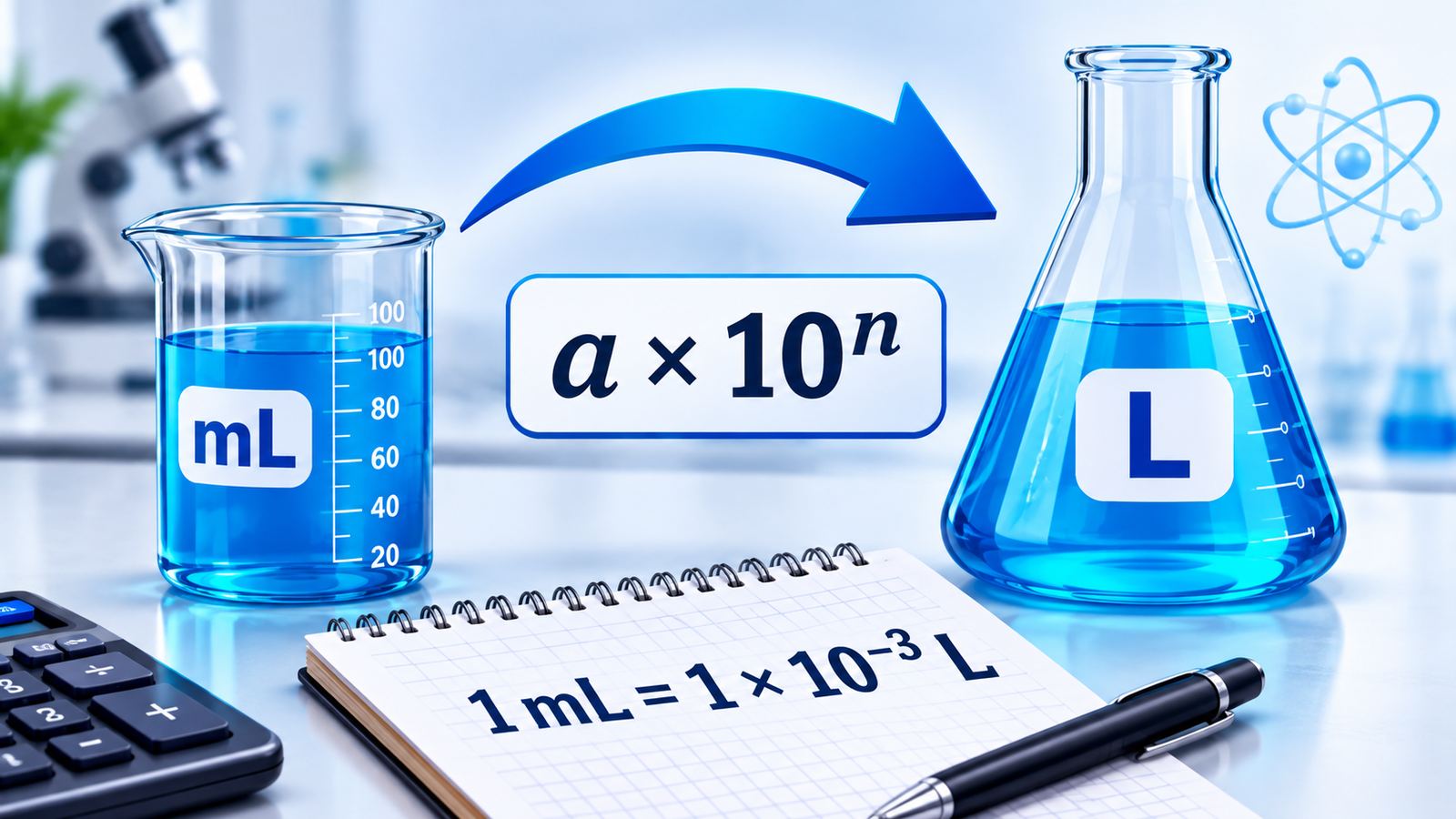
To convert milliliters (mL) to liters (L) in scientific notation, divide the mL value by 1,000 to get liters. Then write that result as a number between 1 and 10 multiplied by a power of 10. For example, 1 mL = 0.001 L = 1 × 10⁻³ L. The exponent is negative because the liter value is less than 1.
This guide walks through every step of the process. You will see solved examples for common values, a reference table, and practice questions to test your understanding.
What Is Scientific Notation?
Scientific notation is a way to write very large or very small numbers in a short, standard format. Instead of writing all the zeros, you express the number as a coefficient multiplied by a power of 10.
The format looks like this:
a × 10ⁿ
- a is the coefficient. It must be a number from 1 up to (but not including) 10.
- n is the exponent. It tells you how many places to move the decimal point.
For example, 5,000 written in scientific notation is 5 × 10³. The number 0.005 becomes 5 × 10⁻³.
The Two Parts of Scientific Notation
Every number in scientific notation has exactly two parts:
- The coefficient: A number between 1 and 9.999… You find it by moving the decimal point until only one non-zero digit sits to the left.
- The exponent (power of 10): This counts how many places you moved the decimal. It shows the size or scale of the number.
Positive and Negative Exponents Explained
The sign of the exponent tells you the direction the decimal moved:
- Positive exponent: The original number is 10 or greater. The decimal moved to the left. Example: 4,700 = 4.7 × 10³ (decimal moved 3 places left).
- Negative exponent: The original number is less than 1. The decimal moved to the right. Example: 0.047 = 4.7 × 10⁻² (decimal moved 2 places right).
- Zero exponent: The number is already between 1 and 10. Example: 4.7 = 4.7 × 10⁰.
When you convert mL to L, the liter values are almost always less than 1 (unless you start with 1,000 mL or more). That means you will usually see negative exponents.
How Are Milliliters and Liters Related?
Both milliliters and liters measure volume in the metric system. The prefix “milli” means one-thousandth. So one milliliter is exactly one-thousandth of a liter.
1 mL = 0.001 L
1 L = 1,000 mL
This means:
- To go from mL to L, you divide by 1,000 (or multiply by 0.001).
- To go from L to mL, you multiply by 1,000.
Dividing by 1,000 is the same as moving the decimal point three places to the left. This relationship exists because the metric system is built on powers of 10.
For a more detailed explanation of the basic mL to L conversion, visit the homepage.
How to Convert mL to L in Scientific Notation (Step by Step)
Follow these three steps for any mL value.
Step 1: Divide by 1,000 to Get Liters
Take your milliliter value and divide it by 1,000. This gives you the equivalent volume in liters as a decimal number.
Formula: L = mL ÷ 1,000
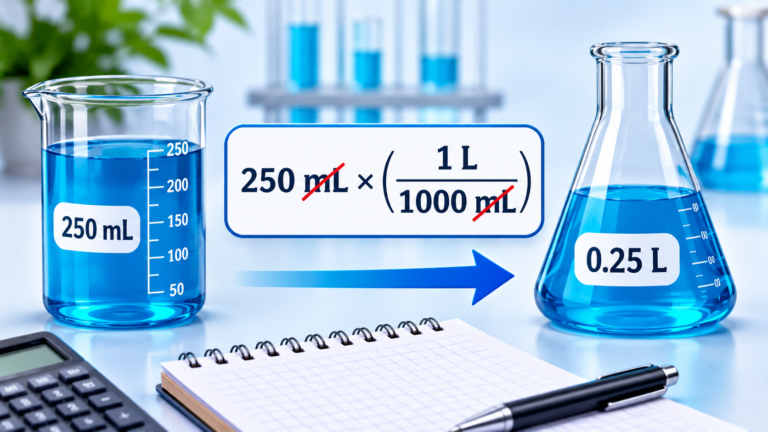
Example: 250 mL ÷ 1,000 = 0.25 L
Step 2: Write the Result in Scientific Notation
Take the decimal liter value from Step 1. Move the decimal point until you have a number between 1 and 10. Count how many places you moved it. That count becomes your exponent.
Since mL-to-L results smaller than 1 L require you to move the decimal to the right, the exponent will be negative.
Example: 0.25 → Move the decimal 1 place right → 2.5 × 10⁻¹
Step 3: Check Your Answer
Multiply the coefficient by the power of 10 to confirm you get the original decimal value.
Check: 2.5 × 10⁻¹ = 2.5 × 0.1 = 0.25 ✓
If the check matches your Step 1 result, your scientific notation is correct.
Solved Examples: Common mL to L Conversions in Scientific Notation
1 mL to L in Scientific Notation
Step 1: 1 mL ÷ 1,000 = 0.001 L
Step 2: Move the decimal in 0.001 three places to the right → 1.0
The decimal moved 3 places right, so the exponent is −3.
Answer: 1 mL = 1 × 10⁻³ L
Check: 1 × 10⁻³ = 1 × 0.001 = 0.001 ✓
10 mL to L in Scientific Notation
Step 1: 10 mL ÷ 1,000 = 0.01 L
Step 2: Move the decimal in 0.01 two places to the right → 1.0
The decimal moved 2 places right, so the exponent is −2.
Answer: 10 mL = 1 × 10⁻² L
Check: 1 × 10⁻² = 1 × 0.01 = 0.01 ✓
100 mL to L in Scientific Notation
Step 1: 100 mL ÷ 1,000 = 0.1 L
Step 2: Move the decimal in 0.1 one place to the right → 1.0
The decimal moved 1 place right, so the exponent is −1.
Answer: 100 mL = 1 × 10⁻¹ L
Check: 1 × 10⁻¹ = 1 × 0.1 = 0.1 ✓
500 mL to L in Scientific Notation
Step 1: 500 mL ÷ 1,000 = 0.5 L
Step 2: Move the decimal in 0.5 one place to the right → 5.0
The decimal moved 1 place right, so the exponent is −1.
Answer: 500 mL = 5 × 10⁻¹ L
Check: 5 × 10⁻¹ = 5 × 0.1 = 0.5 ✓
750 mL to L in Scientific Notation
Step 1: 750 mL ÷ 1,000 = 0.75 L
Step 2: Move the decimal in 0.75 one place to the right → 7.5
The decimal moved 1 place right, so the exponent is −1.
Answer: 750 mL = 7.5 × 10⁻¹ L
Check: 7.5 × 10⁻¹ = 7.5 × 0.1 = 0.75 ✓
1,000 mL to L in Scientific Notation
Step 1: 1,000 mL ÷ 1,000 = 1 L
Step 2: The value 1 is already between 1 and 10. No decimal movement is needed.
The exponent is 0.
Answer: 1,000 mL = 1 × 10⁰ L
Check: 1 × 10⁰ = 1 × 1 = 1 ✓
Note: 10⁰ equals 1. Any number raised to the power of zero equals 1. So 1 × 10⁰ is simply 1.
mL to L Scientific Notation Reference Table
| Milliliters (mL) | Liters (Decimal) | Liters (Scientific Notation) |
|---|---|---|
| 0.1 mL | 0.0001 L | 1 × 10⁻⁴ L |
| 0.5 mL | 0.0005 L | 5 × 10⁻⁴ L |
| 1 mL | 0.001 L | 1 × 10⁻³ L |
| 5 mL | 0.005 L | 5 × 10⁻³ L |
| 10 mL | 0.01 L | 1 × 10⁻² L |
| 25 mL | 0.025 L | 2.5 × 10⁻² L |
| 50 mL | 0.05 L | 5 × 10⁻² L |
| 100 mL | 0.1 L | 1 × 10⁻¹ L |
| 250 mL | 0.25 L | 2.5 × 10⁻¹ L |
| 500 mL | 0.5 L | 5 × 10⁻¹ L |
| 750 mL | 0.75 L | 7.5 × 10⁻¹ L |
| 1,000 mL | 1 L | 1 × 10⁰ L |
| 1,500 mL | 1.5 L | 1.5 × 10⁰ L |
| 2,000 mL | 2 L | 2 × 10⁰ L |
| 5,000 mL | 5 L | 5 × 10⁰ L |
Scientific Notation vs Standard Decimal Form
| Decimal Form | Scientific Notation | Why Notation Helps |
|---|---|---|
| 0.0001 L | 1 × 10⁻⁴ L | Fewer zeros to count |
| 0.001 L | 1 × 10⁻³ L | Clearly shows the scale (thousandths) |
| 0.01 L | 1 × 10⁻² L | Exponent reveals the magnitude |
| 0.1 L | 1 × 10⁻¹ L | Consistent format for lab records |
| 1 L | 1 × 10⁰ L | Keeps all values in the same format |
When is decimal form better? For everyday measurements like cooking or shopping, decimals are easier to read. You do not need scientific notation to say “0.5 L” of water.
When is scientific notation better? In science, medicine, and engineering, you often work with very small volumes. Writing 0.00001 L is harder to read than 1 × 10⁻⁵ L. Scientific notation also makes calculations with large and small numbers faster because you can work with the exponents separately.
Common Mistakes to Avoid
Mistake 1: Using a positive exponent for values less than 1. Wrong: 0.001 L = 1 × 10³ L Right: 0.001 L = 1 × 10⁻³ L Remember: if the original number is less than 1, the exponent must be negative.
Mistake 2: Forgetting to divide by 1,000. Wrong: 500 mL = 500 in scientific notation = 5 × 10² L Right: 500 mL ÷ 1,000 = 0.5 L = 5 × 10⁻¹ L Always convert to liters first, then write in scientific notation.
Mistake 3: Writing a coefficient of 10 or greater. Wrong: 0.05 L = 50 × 10⁻³ L Right: 0.05 L = 5 × 10⁻² L The coefficient must be at least 1 but less than 10.
Mistake 4: Confusing the conversion direction. mL to L: divide by 1,000 (number gets smaller). L to mL: multiply by 1,000 (number gets larger). If your liter answer is bigger than your mL starting value, you went the wrong direction.
Mistake 5: Losing significant figures. If a measurement is recorded as 5.00 mL (three significant figures), keep those figures: 5.00 × 10⁻³ L, not 5 × 10⁻³ L. Trailing zeros after the decimal indicate precision.
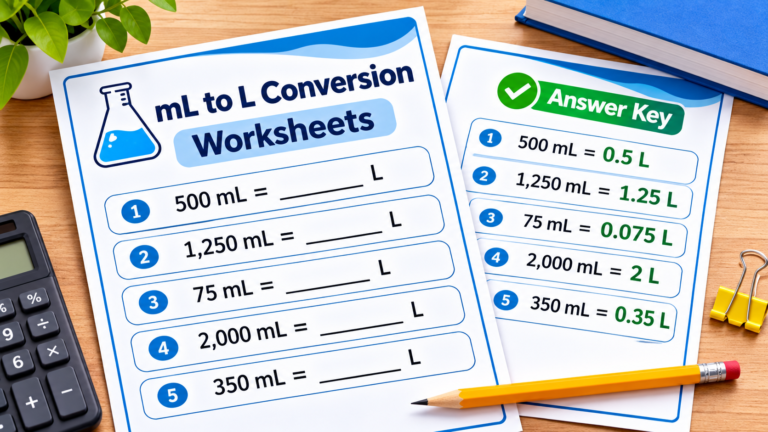
Practice Questions with Answers
Question 1: Convert 200 mL to liters in scientific notation.
Answer: 200 mL ÷ 1,000 = 0.2 L → Move decimal 1 place right → 2 × 10⁻¹ L
Question 2: Convert 75 mL to liters in scientific notation.
Answer: 75 mL ÷ 1,000 = 0.075 L → Move decimal 2 places right → 7.5 × 10⁻² L
Question 3: Convert 3,500 mL to liters in scientific notation.
Answer: 3,500 mL ÷ 1,000 = 3.5 L → Already between 1 and 10 → 3.5 × 10⁰ L
Question 4: Convert 0.5 mL to liters in scientific notation.
Answer: 0.5 mL ÷ 1,000 = 0.0005 L → Move decimal 4 places right → 5 × 10⁻⁴ L
Question 5: Convert 1,250 mL to liters in scientific notation.
Answer: 1,250 mL ÷ 1,000 = 1.25 L → Already between 1 and 10 → 1.25 × 10⁰ L
Question 6: A lab technician measures 45 mL of a solution. Express this in liters using scientific notation.
Answer: 45 mL ÷ 1,000 = 0.045 L → Move decimal 2 places right → 4.5 × 10⁻² L
Question 7: Convert 8 mL to liters in scientific notation.
Answer: 8 mL ÷ 1,000 = 0.008 L → Move decimal 3 places right → 8 × 10⁻³ L
Question 8: A student writes that 300 mL = 3 × 10² L. What did they do wrong?
Answer: The student forgot to divide by 1,000 before writing scientific notation. They converted 300 to notation (3 × 10²) but did not convert mL to L first. Correct: 300 mL ÷ 1,000 = 0.3 L = 3 × 10⁻¹ L
Frequently Asked Questions
How do you convert mL to L in scientific notation?
First, divide the mL value by 1,000 to get the volume in liters. Then express that decimal number in scientific notation by writing it as a coefficient between 1 and 10 multiplied by a power of 10. For example, 250 mL ÷ 1,000 = 0.25 L = 2.5 × 10⁻¹ L.
What is 1 mL in liters in scientific notation?
1 mL equals 0.001 L in decimal form. In scientific notation, this is written as 1 × 10⁻³ L. The exponent −3 reflects that a milliliter is one-thousandth of a liter.
What is 100 mL in scientific notation (in liters)?
100 mL equals 0.1 L. In scientific notation, 0.1 is written as 1 × 10⁻¹ L. You move the decimal one place to the right to get the coefficient of 1, giving a −1 exponent.
Why is the exponent negative when converting mL to L?
The exponent is negative because the liter value is less than 1 for any amount under 1,000 mL. In scientific notation, numbers smaller than 1 always use negative exponents. The negative sign shows that the decimal point has moved to the right from its position in the coefficient.
What is 500 mL to L in scientific notation?
500 mL ÷ 1,000 = 0.5 L. In scientific notation, this is 5 × 10⁻¹ L. The coefficient is 5 and the exponent is −1 because you move the decimal one place to the right.
Can you convert mL to L in scientific notation in one step?
Yes. Since 1 mL = 1 × 10⁻³ L, you can multiply any mL value by 10⁻³ to get liters directly. For instance, 50 mL × 10⁻³ = 50 × 10⁻³ L. Then adjust the coefficient: 5.0 × 10⁻² L. This shortcut works because the “milli” prefix already represents 10⁻³.
What does 10⁻³ mean in mL to L conversion?
10⁻³ means “one-thousandth” or 1/1,000, which equals 0.001. The metric prefix “milli” is defined as 10⁻³. So when you see that 1 mL = 10⁻³ L, it directly tells you that one milliliter is one-thousandth of a liter.
Is 1,000 mL equal to 1 × 10⁰ L or just 1 L?
Both are correct. 1,000 mL = 1 L, and 1 L written in scientific notation is 1 × 10⁰ L. Since 10⁰ = 1, the two expressions are identical. In most cases, you can simply write “1 L” unless your assignment requires scientific notation format.