mL to L Conversion Worksheets with Answers
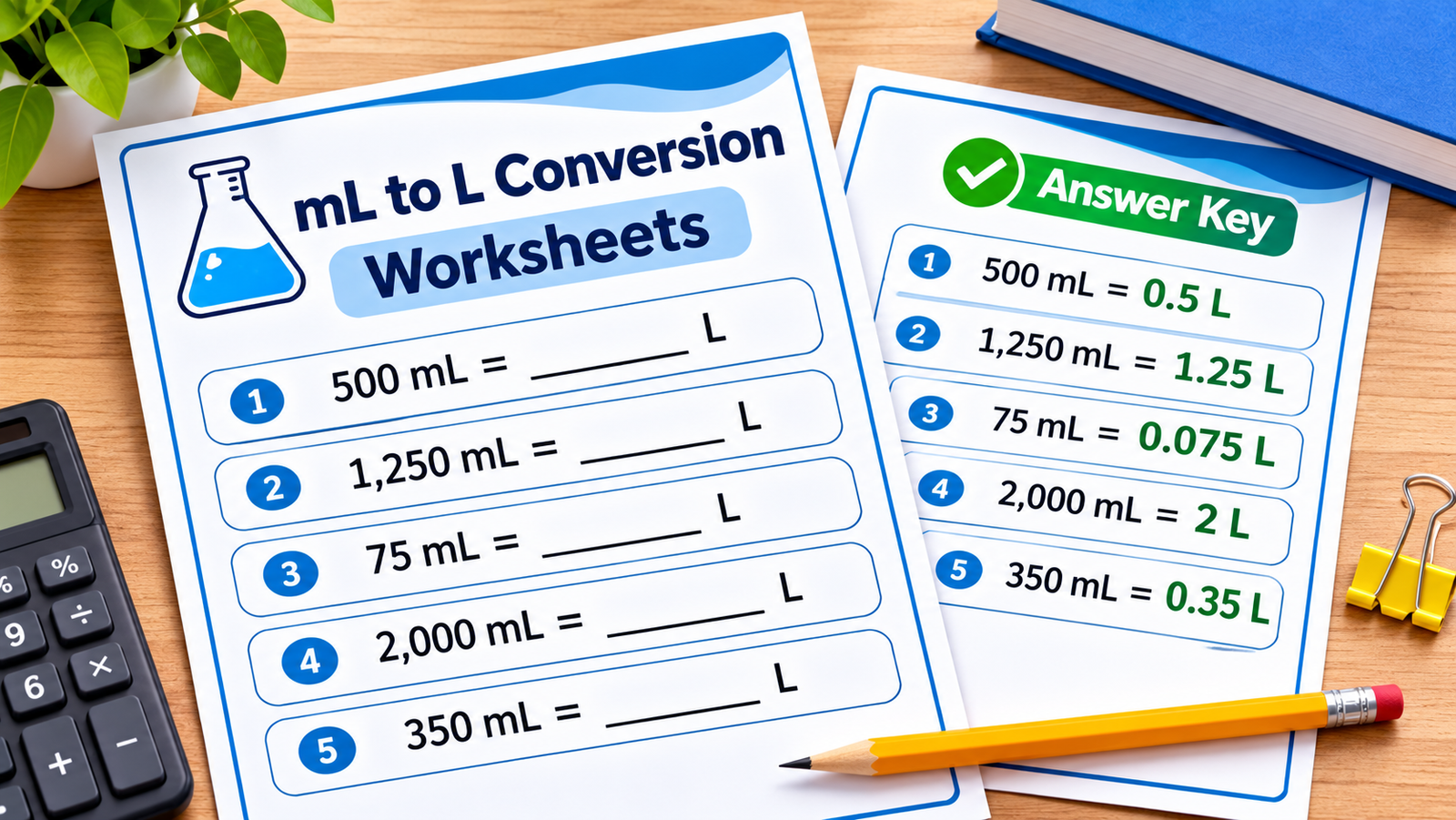
Practise converting milliliters (mL) to liters (L) with these free measurement worksheets. This resource includes beginner exercises, grade-based practice, mixed conversions, and real-life word problems.
Students can start with simple measurement questions and move towards decimal conversions and multi-step problems. Each worksheet has a separate answer key to make checking work easier.
What you will practise:
- Recognising milliliters and liters.
- Converting mL to L.
- Converting L to mL.
- Comparing liquid measurements.
- Solving measurement word problems.
- Working with whole numbers and decimals.
Choose a worksheet that matches your current skill level and complete the questions at your own pace.
Free Printable mL to L Conversion Worksheets
These five worksheets cover different parts of metric capacity measurement.
| Worksheet | Level | Main skills |
|---|---|---|
| Worksheet 1 | Beginner | Recognising units and simple conversions |
| Worksheet 2 | Grades 2–3 | Basic whole-number conversions |
| Worksheet 3 | Grade 4 | Decimal and mixed conversions |
| Worksheet 4 | Grade 5 | Reverse conversions and word problems |
| Worksheet 5 | Mixed practice | Comparisons and real-life problems |
Download Free mL to L Conversion Worksheets
Choose a worksheet based on your learning level. Each worksheet includes practice questions to help you improve your liquid measurement skills.
Beginner Liquid Measurement
Learn to recognise milliliters and liters, choose the correct units, and practise simple conversions.
↓ Download WorksheetBasic mL to L Conversions
Practise converting whole-number measurements from liters to milliliters and milliliters to liters.
↓ Download WorksheetDecimal and Mixed Conversions
Work with decimal measurements and practise both mL to L and L to mL conversions.
↓ Download WorksheetAdvanced Measurement Problems
Solve multi-step word problems, reverse conversions, and everyday liquid measurement questions.
↓ Download WorksheetMixed mL and L Conversion Practice
Test your skills with mixed conversions, measurement comparisons, and real-life practice questions.
↓ Download WorksheetComplete Worksheet Answer Keys
Finished the exercises? Download the complete answer key to check your calculations and review your answers.
Each worksheet can be used for independent practice, homework, revision, or classroom activities.
How to Use These mL and L Worksheets
Before starting, remember one important measurement rule:
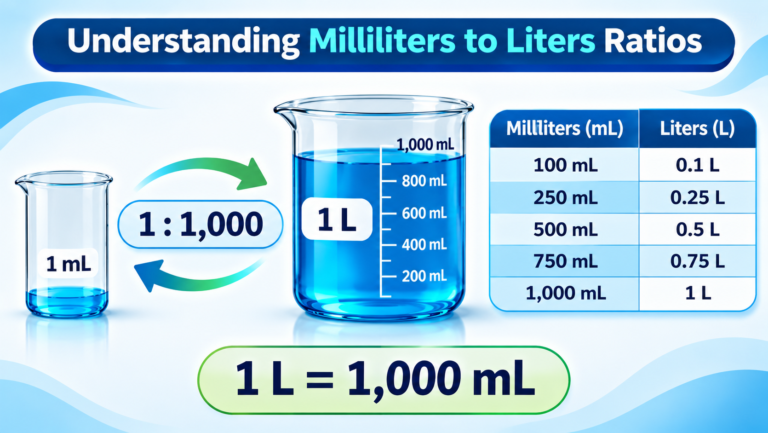
1 liter (L) = 1,000 milliliters (mL)
Milliliters are used for smaller amounts of liquid. Liters are used for larger amounts.
How to Convert mL to L
Divide the number of milliliters by 1,000.
Formula:
Liters = Milliliters ÷ 1,000
Example:
2,500 mL ÷ 1,000 = 2.5 L
Therefore, 2,500 mL equals 2.5 liters.
How to Convert L to mL
Multiply the number of liters by 1,000.
Formula:
Milliliters = Liters × 1,000
Example:
3 L × 1,000 = 3,000 mL
Therefore, 3 liters equals 3,000 milliliters.
Worksheet 1: Beginner Liquid Measurement Practice
Level: Beginner
Learning objective: Recognise milliliters and liters, identify suitable measurement units, and understand the basic relationship between them.
Instructions: Read each question carefully. Write your answers in the spaces provided.
Part A: Recognise the Measurement Units
- Which unit measures a small amount of liquid: mL or L?
- Which unit would you use to measure the water in a large bucket?
- Complete the statement: 1 L = ______ mL.
- Is a 250 mL juice box measured in milliliters or liters?
Part B: Choose the Correct Unit
Write mL or L for each item.
- A teaspoon of water: ______
- A large water bottle: ______
- A swimming pool: ______
- A small medicine bottle: ______
Part C: Complete the Basic Conversions
- 1,000 mL = ______ L.
- 2,000 mL = ______ L.
Worksheet 2: Grade 2 and 3 mL to L Conversion
Level: Basic
Learning objective: Practise whole-number conversions using the relationship between liters and milliliters.
Instructions: Convert each measurement into the requested unit.
Part A: Convert Liters to Milliliters
- 2 L = ______ mL.
- 4 L = ______ mL.
- 6 L = ______ mL.
- 8 L = ______ mL.
- 10 L = ______ mL.
Part B: Convert Milliliters to Liters
- 3,000 mL = ______ L.
- 5,000 mL = ______ L.
- 7,000 mL = ______ L.
- 9,000 mL = ______ L.
- 4,000 mL = ______ L.
Worksheet 3: Grade 4 Decimal and Mixed Conversions
Level: Intermediate
Learning objective: Convert measurements containing decimals and practise both conversion directions.
Instructions: Show your calculations and include the correct unit in every answer.
Part A: Convert mL to L
- 250 mL = ______ L.
- 450 mL = ______ L.
- 750 mL = ______ L.
- 1,250 mL = ______ L.
- 2,750 mL = ______ L.
Part B: Convert L to mL
- 0.5 L = ______ mL.
- 1.25 L = ______ mL.
- 2.75 L = ______ mL.
- 3.5 L = ______ mL.
- 4.125 L = ______ mL.
Worksheet 4: Grade 5 Advanced Measurement Problems
Level: Advanced
Learning objective: Apply metric conversion rules to everyday situations, reverse conversions, and multi-step problems.
Instructions: Read each situation, identify the required conversion, and show your working.
- A water tank contains 5.5 L of water. Convert this amount into milliliters.
- A juice factory fills bottles with 1,750 mL of juice. How many liters does each bottle contain?
- A container holds 3.25 L of milk. Express its capacity in milliliters.
- A water jug contains 2,400 mL. Another jug contains 1.8 L. Which jug contains more water, and by how many milliliters?
- Sarah drinks 500 mL of water in the morning and 750 mL in the afternoon. How many liters does she drink altogether?
- A shop has 6 bottles, each containing 1.5 L of juice. What is the total amount of juice in milliliters?
- A large container holds 4,500 mL of water. If 1.25 L is poured out, how many milliliters remain?
- A tank contains 7.5 L of water. Water is added until the total reaches 10 L. How many milliliters were added?
Worksheet 5: Mixed mL to L and L to mL Practice
Level: Mixed revision
Learning objective: Test understanding of both conversion directions, measurement comparisons, unit selection, and practical capacity questions.
Instructions: Complete each question. Remember to check the measurement unit before calculating.
Part A: Mixed Conversions
- 3,500 mL = ______ L.
- 6.25 L = ______ mL.
- 875 mL = ______ L.
- 0.75 L = ______ mL.
Part B: Compare the Measurements
Write greater than (>), less than (<), or equal to (=).
- 1,500 mL ______ 1.5 L.
- 2.5 L ______ 2,250 mL.
- 800 mL ______ 1 L.
Part C: Real-Life Measurement Questions
- A bottle contains 2 L of water. How many milliliters does it hold?
- A jug has 3,250 mL of milk. Express this amount in liters.
- A family buys 2 bottles of water. Each bottle contains 1.25 L. What is the total capacity in milliliters?
mL to L Worksheet Answer Keys
Use these answer keys after completing the exercises. Teachers can keep this section separate from the student worksheets.
Worksheet 1: Beginner Answers
| Question | Correct answer |
|---|---|
| 1 | mL |
| 2 | L |
| 3 | 1,000 mL |
| 4 | mL |
| 5 | mL |
| 6 | L |
| 7 | L |
| 8 | mL |
| 9 | 1 L |
| 10 | 2 L |
Worksheet 2: Grade 2 and 3 Answers
| Question | Correct answer |
|---|---|
| 1 | 2,000 mL |
| 2 | 4,000 mL |
| 3 | 6,000 mL |
| 4 | 8,000 mL |
| 5 | 10,000 mL |
| 6 | 3 L |
| 7 | 5 L |
| 8 | 7 L |
| 9 | 9 L |
| 10 | 4 L |
Worksheet 3: Grade 4 Answers
| Question | Correct answer |
|---|---|
| 1 | 0.25 L |
| 2 | 0.45 L |
| 3 | 0.75 L |
| 4 | 1.25 L |
| 5 | 2.75 L |
| 6 | 500 mL |
| 7 | 1,250 mL |
| 8 | 2,750 mL |
| 9 | 3,500 mL |
| 10 | 4,125 mL |
Worksheet 4: Grade 5 Answers
| Question | Correct answer |
|---|---|
| 1 | 5,500 mL |
| 2 | 1.75 L |
| 3 | 3,250 mL |
| 4 | First jug; 600 mL more |
| 5 | 1.25 L |
| 6 | 9,000 mL |
| 7 | 3,250 mL |
| 8 | 2,500 mL |
Worked solutions:
Question 4:
2,400 mL compared with 1.8 L.
1.8 × 1,000 = 1,800 mL.
2,400 − 1,800 = 600 mL.
Question 5:
500 + 750 = 1,250 mL.
1,250 ÷ 1,000 = 1.25 L.
Question 6:
6 × 1.5 = 9 L.
9 × 1,000 = 9,000 mL.
Question 7:
4,500 mL − 1,250 mL = 3,250 mL.
Question 8:
10 − 7.5 = 2.5 L.
2.5 × 1,000 = 2,500 mL.
Worksheet 5: Mixed Practice Answers
| Question | Correct answer |
|---|---|
| 1 | 3.5 L |
| 2 | 6,250 mL |
| 3 | 0.875 L |
| 4 | 750 mL |
| 5 | = |
| 6 | > |
| 7 | < |
| 8 | 2,000 mL |
| 9 | 3.25 L |
| 10 | 2,500 mL |
Tips for Learning Metric Capacity
Students can improve their measurement skills by following these simple tips:
- Remember the conversion rule: One liter always equals 1,000 milliliters.
- Check the starting unit: Decide whether the question begins with mL or L.
- Choose the right operation: Divide for mL to L and multiply for L to mL.
- Write the unit: Include mL or L after every final answer.
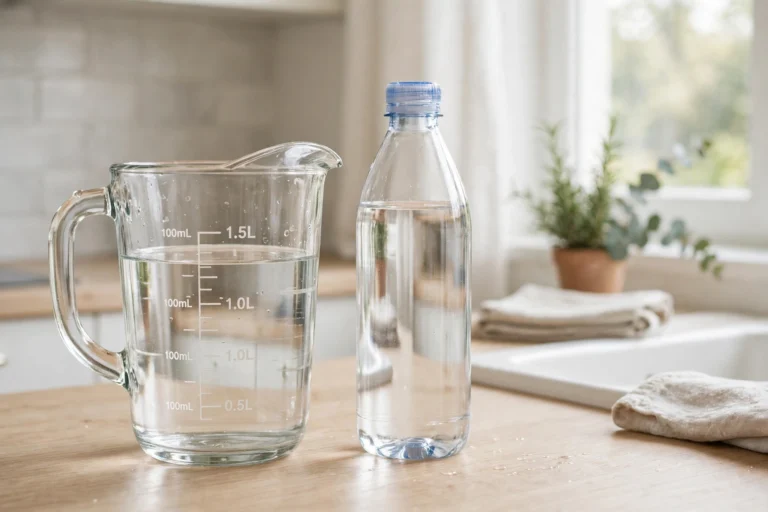
- Practise with real containers: Read the labels on water bottles, milk cartons, and measuring jugs.
- Check your result: Convert the answer back to the starting unit to check your calculation.
Frequently Asked Questions About mL to L Worksheets
How many milliliters are in one liter?
There are exactly 1,000 milliliters in one liter.
1 L = 1,000 mL.
How do students convert mL to L?
Students divide the number of milliliters by 1,000.
For example, 750 mL ÷ 1,000 = 0.75 L.
How do students convert L to mL?
Students multiply the number of liters by 1,000.
For example, 2.5 L × 1,000 = 2,500 mL.
What grade levels can use these worksheets?
These worksheets are designed for different skill levels commonly introduced across Grades 2 to 5. Beginners can practise recognising units, while more advanced students can work on decimals and word problems.
The suitable level depends on each student’s prior knowledge.
How can teachers use these worksheets?
Teachers can use these exercises for classroom practice, homework, revision, or short assessments. The separate answer keys make it easier to review student work.
What is the difference between mL and L?
Milliliters and liters are metric units used to measure liquid capacity. A liter is larger than a milliliter. One liter contains 1,000 milliliters.
Can students use these worksheets for homework?
Yes. Students can complete the questions independently and use the answer keys to check their work.
Are mL to L conversion worksheets useful for beginners?
Yes. Beginner worksheets help students recognise the units, understand their relationship, and practise simple conversions before attempting more difficult questions.
Practise More mL to L Conversions
Regular practice helps students become more confident with metric measurements.
For additional conversion help, visit our mL to L conversion calculator. You can enter any milliliter value and find its equivalent in liters.
Use the worksheets to practise the method, then use the calculator to check individual conversion results.