
Liters to Milliliters (L to mL): The Complete Reverse Conversion Guide
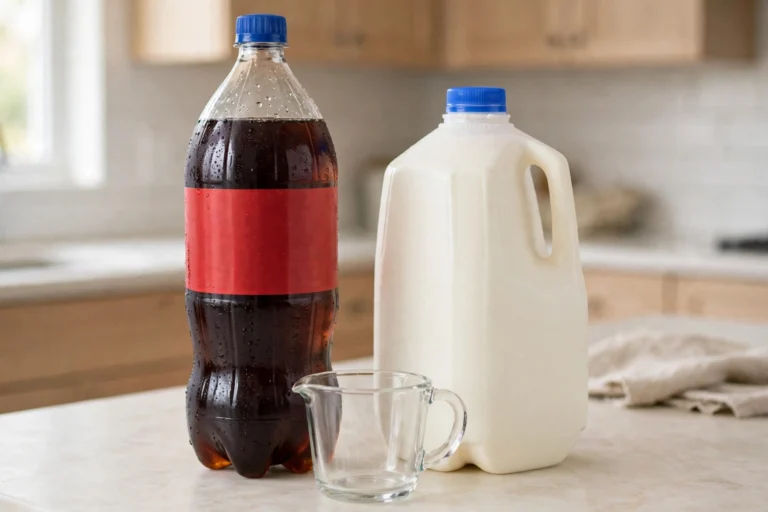
A 2-liter bottle of water, a recipe that calls for 750 milliliters of milk, a medicine cup marked in milliliters — they all measure liquid volume, just in different units.
Learning how to convert liters to ml is one of the easiest conversions in the metric system. There is only one number to remember, and the math takes a few seconds once you know it.
In this guide, you will learn the rule, see real examples, and find a quick table. You will also see everyday uses, how to check your answer, and which mistakes to avoid.
The One Rule: 1 Liter = 1,000 Milliliters
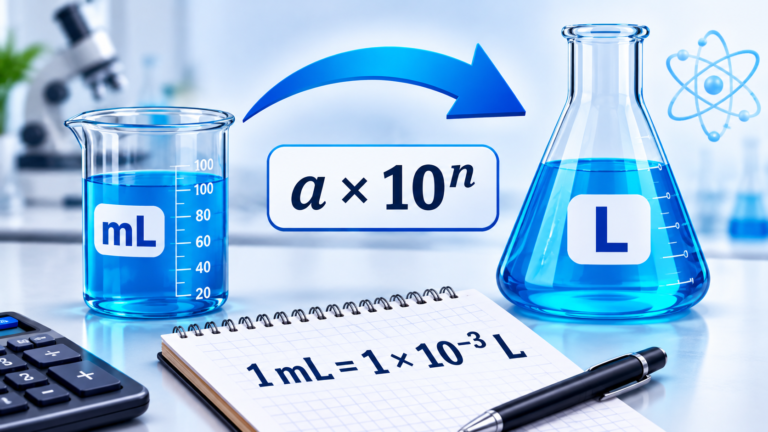
The liter and the milliliter are both metric units for volume. The prefix “milli-” means one-thousandth, so one milliliter is one-thousandth of a liter. Turn that around, and you get the key fact:
1 liter = 1,000 milliliters
That is true for water, milk, juice, oil, or medicine. A liter is always 1,000 milliliters, no matter what liquid you are measuring.
Liters suit larger amounts, and milliliters suit smaller, more precise amounts. A large bottle of soda is easier to describe as 2 liters than as 2,000 milliliters. A dose of cough syrup is easier to describe as 10 milliliters than as 0.01 liters.
How to Convert Liters to mL
To convert liters to milliliters, multiply the number of liters by 1,000.
Formula: milliliters = liters × 1,000
You can do the same thing by moving the decimal point three places to the right.
- Write down the number of liters.
- Multiply it by 1,000, or move the decimal point three places to the right.
- Add zeros where needed to fill the empty places.
- Write “mL” after your answer.
For example, 2 liters becomes 2,000 milliliters. For 1.5 liters, move the decimal point three places to the right and you get 1,500 milliliters. If the number is a whole number, just add three zeros.
Worked Examples
Try to answer each one in your head before you read the answer.
0.5 L to mL
Half a liter is the size of a small water bottle. 0.5 × 1,000 = 500. 0.5 L = 500 mL
1.25 L to mL
You will see 1.25 liters on many soda and juice bottles. 1.25 × 1,000 = 1,250. 1.25 L = 1,250 mL
2.5 L to mL
A large drink container might hold 2.5 liters. 2.5 × 1,000 = 2,500. 2.5 L = 2,500 mL
0.75 L to mL
A standard bottle of wine holds 0.75 liters. 0.75 × 1,000 = 750. 0.75 L = 750 mL
3 L to mL
Three liters is a common size for a large water jug. 3 × 1,000 = 3,000. 3 L = 3,000 mL
More quick conversions: 0.1 L = 100 mL, 0.25 L = 250 mL, 1.5 L = 1,500 mL, 4 L = 4,000 mL. The digits stay the same.
Liters to Milliliters Conversion Table
| Liters (L) | Milliliters (mL) |
|---|---|
| 0.1 L | 100 mL |
| 0.25 L | 250 mL |
| 0.5 L | 500 mL |
| 0.75 L | 750 mL |
| 1 L | 1,000 mL |
| 1.25 L | 1,250 mL |
| 1.5 L | 1,500 mL |
| 2 L | 2,000 mL |
| 2.5 L | 2,500 mL |
| 3 L | 3,000 mL |
| 5 L | 5,000 mL |
| 10 L | 10,000 mL |
For any number not listed here, just multiply by 1,000.
Everyday Uses
This is not just a math-class skill. Liters and milliliters appear side by side in real life.
Drink Bottles and Shopping
A small water bottle might say 500 mL, while a larger one says 1.5 L. To compare prices, convert them to the same unit. Two 500 mL bottles equal 1 liter. Three 1.5 L bottles equal 4.5 liters, or 4,500 milliliters.
Cooking and Baking
Many recipes list liquids in milliliters. A recipe might call for 250 mL of milk or 750 mL of water. That is 0.25 L and 0.75 L. If a recipe calls for 1.5 liters of broth, you need 1,500 mL. Getting this right matters in baking, where too much liquid can make a cake soggy.
Fuel and Cars
Fuel is sold in liters in most countries, but small amounts are often described in milliliters. A car might need about 0.05 liters of oil for a top-up, which is 50 milliliters. A fuel tank might hold 45 liters, which is 45,000 milliliters.
Medicine and Health
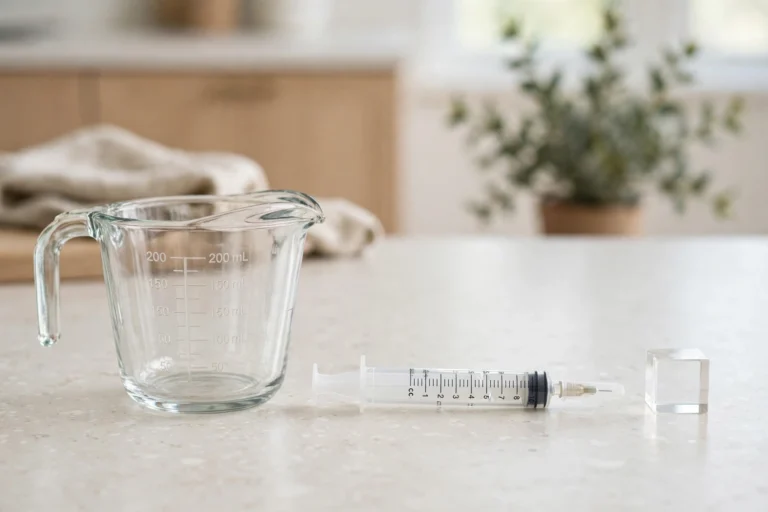
Medicine is where accuracy matters most. Liquid medicines are usually measured in milliliters because the amounts are small and need to be precise. A doctor might prescribe 5 mL, 10 mL, or 15 mL per dose. A larger bottle might contain 0.2 liters, which is 200 mL. Always follow the dose on the label, and use the measuring cup or syringe that comes with the medicine. Do not use a kitchen spoon.
Aquariums and Pets
A small tank might hold 20 liters, which is 20,000 milliliters. A water treatment product might say to add 5 mL per 10 liters of water. To treat a 20-liter tank, you would need 10 mL. For a 50-liter tank, you would need 25 mL. The same idea applies to plant food and cleaning products mixed in a set ratio.
The Reverse Check: Milliliters Back to Liters
To convert milliliters back to liters, do the opposite: divide by 1,000, or move the decimal point three places to the left.
Formula: liters = milliliters ÷ 1,000
If you converted 2.5 liters to 2,500 milliliters, check it like this: 2,500 ÷ 1,000 = 2.5 liters. You are back where you started, so your first answer was correct. Try it with 750 milliliters. Divide by 1,000 and you get 0.75 liters. This check takes two seconds and can catch a slip before it becomes a mistake.
Common Mistakes to Avoid
1. Multiplying by 100 instead of 1,000. People remember that there are 100 centimeters in a meter, and they use 100 by mistake. There are 1,000 milliliters in a liter, not 100. If you multiply 2 liters by 100, you get 200 mL, which is wrong. The correct answer is 2,000 mL.
2. Moving the decimal point the wrong way. When you go from liters to milliliters, the number gets bigger, so the decimal moves to the right. If you move it to the left, you will make the number smaller. For example, 1.5 liters should become 1,500 milliliters, not 0.015 liters.
3. Dropping or adding a zero. With 1.25 liters, it is easy to write 125 mL or 12,500 mL by mistake. Take a moment to count the places. 1.25 liters is 1,250 milliliters. As a sense-check, liters to milliliters should always give you a bigger number.
Practice Questions With Answers
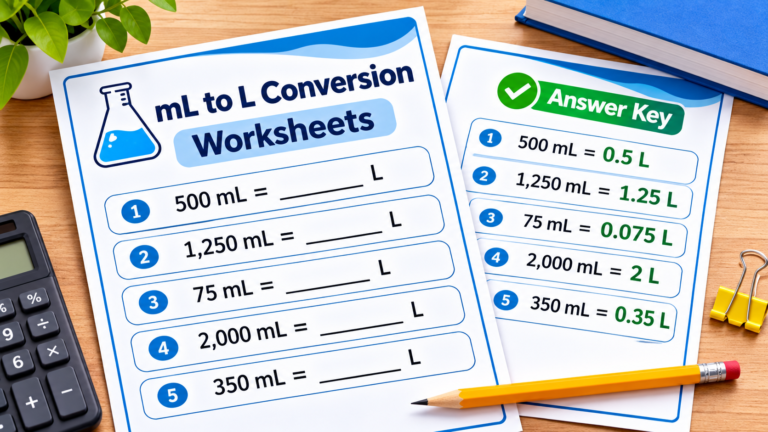
1. Convert 0.6 L to mL. Answer: 0.6 × 1,000 = 600 mL.
2. Convert 1.8 L to mL. Answer: 1.8 × 1,000 = 1,800 mL.
3. Convert 0.35 L to mL. Answer: 0.35 × 1,000 = 350 mL.
4. Convert 6 L to mL. Answer: 6 × 1,000 = 6,000 mL.
5. A recipe needs 2.25 L of water. How many milliliters is that? Answer: 2.25 × 1,000 = 2,250 mL.
If you got all five right, you have the method down. If you missed one, go back to the worked examples and try again.
Frequently Asked Questions
How do I convert liters to ml without a calculator?
Multiply by 1,000, or move the decimal point three places to the right. For 3 liters, add three zeros to get 3,000 mL. For 1.75 liters, move the point to get 1,750 mL.
Is 1 liter equal to 1,000 milliliters?
Yes. One liter is always equal to 1,000 milliliters. This is true for water, milk, juice, oil, and any other liquid.
How many milliliters are in half a liter?
Half a liter is 500 milliliters. Half of 1,000 is 500, so 0.5 × 1,000 = 500 mL.
How do I convert 1.5 liters to milliliters?
Multiply 1.5 by 1,000 to get 1,500 milliliters.
What is the easiest way to remember the conversion?
Remember one sentence: “A liter is a thousand milliliters.” If you can remember that, you can work out any conversion by multiplying by 1,000. For the reverse, divide by 1,000.
Conclusion
Once you know how to convert liters to ml, the rest is simple. Multiply by 1,000, or move the decimal point three places to the right. One liter is 1,000 milliliters, half a liter is 500 milliliters, and 2.5 liters is 2,500 milliliters.
Use the table and examples when you need a quick answer, and use the reverse check to make sure you are right. With a little practice, you will switch between liters and milliliters without thinking about it.