Understanding Milliliters to Liters Ratios
A ratio helps you compare two quantities and understand how they relate to each other. When comparing milliliters (mL) and liters (L), you must first express both measurements in the same unit.
For example, 500 mL and 2 L use different units. Convert 2 L into 2,000 mL before writing the ratio.
500 : 2,000 = 1 : 4
This means 500 mL is one-quarter of 2 L.
In this guide, you will learn how to compare milliliters and liters, simplify volume ratios, and identify equivalent ratios. You will also find worked examples and practice questions.
Quick ratio rules:
- Convert both measurements into the same unit.
- Write the ratio in the order given.
- Divide both terms by their greatest common factor.
- Remove the units after they cancel.
- Check that the simplified ratio represents the same relationship.
What Is a Ratio in Liquid Measurements?
A ratio is a way to compare two or more quantities by division. It shows how much of one quantity relates to another.
You can write a ratio using a colon (:).
For example:
500 mL : 1,000 mL
Both measurements are in milliliters. Divide both numbers by 500.
500 ÷ 500 : 1,000 ÷ 500
Simplified ratio = 1 : 2
This means the first amount is half the second amount.
The order of a ratio matters. A ratio of 1 : 2 does not mean the same thing as 2 : 1.
When comparing liquid measurements, the units must match before you simplify the ratio.
Why Must Both Measurements Use the Same Unit?
Milliliters and liters measure the same type of quantity, but they use different units.
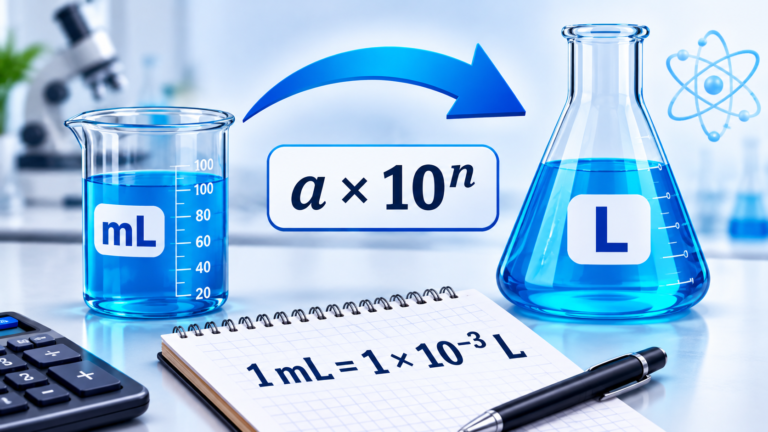
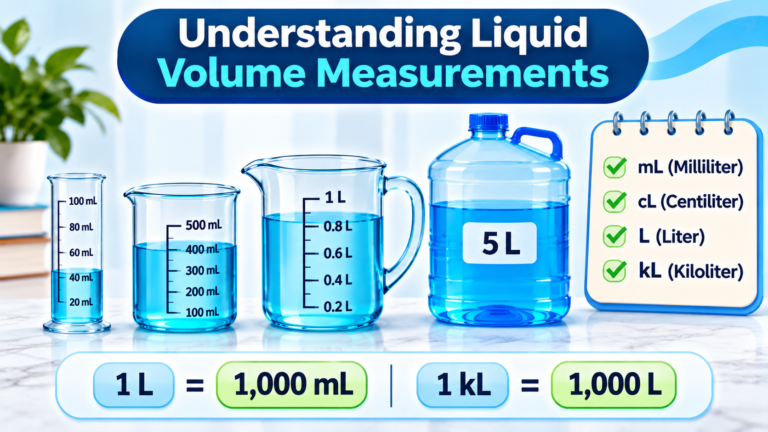
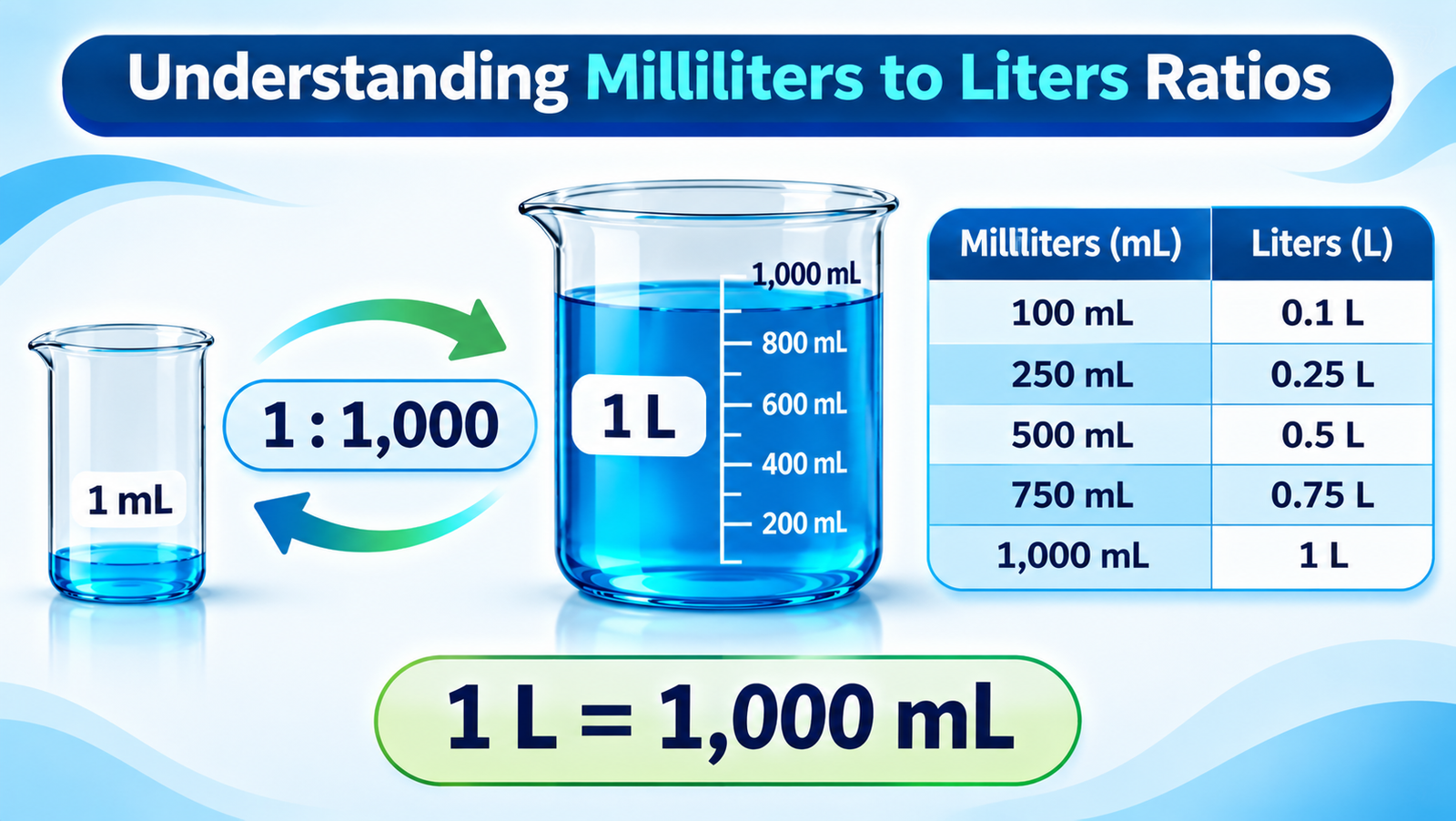
One liter contains 1,000 milliliters.
1 L = 1,000 mL
You cannot simplify a ratio correctly by treating a liter value and a milliliter value as if they were the same unit.
For example:
500 mL : 2 L
The first quantity is in milliliters. The second is in liters.
Convert 2 L into milliliters:
2 × 1,000 = 2,000 mL
Now write the ratio:
500 mL : 2,000 mL
Remove the matching units:
500 : 2,000
Divide both numbers by 500:
Final ratio = 1 : 4
This process ensures that both quantities are compared fairly.
Convert Liters into Milliliters
To convert liters into milliliters, multiply the liter value by 1,000.
Formula:
mL = L × 1,000
| Liters | Calculation | Milliliters |
|---|---|---|
| 0.25 L | 0.25 × 1,000 | 250 mL |
| 0.5 L | 0.5 × 1,000 | 500 mL |
| 1 L | 1 × 1,000 | 1,000 mL |
| 1.5 L | 1.5 × 1,000 | 1,500 mL |
| 2 L | 2 × 1,000 | 2,000 mL |
| 3 L | 3 × 1,000 | 3,000 mL |
This conversion makes it easier to compare measurements that use different units.
Understand the Conversion Factor
The conversion factor between liters and milliliters is 1,000.
- To convert L to mL, multiply by 1,000.
- To convert mL to L, divide by 1,000.
Remember that unit conversion changes the way a measurement is written. It does not change the amount of liquid.
How to Compare Milliliters and Liters in a Ratio
Follow three simple steps when comparing a milliliter measurement with a liter measurement.
Step 1: Convert Both Measurements
Choose one unit for both quantities. Milliliters are often a convenient choice.
Example:
300 mL and 1.2 L
Convert 1.2 L into milliliters:
1.2 × 1,000 = 1,200 mL
Now both quantities use milliliters.
Step 2: Write the Ratio
Place the first quantity before the second quantity.
300 : 1,200
The original order must remain unchanged.
Step 3: Simplify the Ratio
Find the greatest common factor of 300 and 1,200.
GCF = 300
Divide both terms by 300:
300 ÷ 300 : 1,200 ÷ 300
Final ratio = 1 : 4
This means the first measurement is one part for every four parts of the second measurement.
How to Simplify an mL to L Ratio
Simplifying a ratio means reducing its numbers to the smallest whole-number values that represent the same relationship.
You can use the greatest common factor (GCF) to simplify both terms.
Find the Greatest Common Factor
The greatest common factor is the largest whole number that divides both values without leaving a remainder.
For example, consider the ratio:
600 : 1,200
The GCF of 600 and 1,200 is 600.
Divide both terms by 600:
600 ÷ 600 = 1
1,200 ÷ 600 = 2
Therefore:
600 : 1,200 = 1 : 2
Divide Both Terms by the Same Number
You must divide both parts of a ratio by the same factor.
For example:
800 : 2,000
Divide both numbers by 200:
800 ÷ 200 = 4
2,000 ÷ 200 = 10
The ratio becomes:
4 : 10
It can be simplified further by dividing both terms by 2.
4 ÷ 2 : 10 ÷ 2
Final ratio = 2 : 5
Do not divide only one part. Both terms must change by the same factor to preserve the original relationship.
Worked Milliliters to Liters Ratio Examples
These examples demonstrate how to convert different liquid measurements and simplify their ratios.
Example 1: 500 mL to 2 L Ratio
Step 1: Original measurements
500 mL : 2 L
Step 2: Convert liters into milliliters
2 × 1,000 = 2,000 mL
Step 3: Write the ratio
500 : 2,000
Step 4: Simplify
Divide both terms by 500.
500 ÷ 500 : 2,000 ÷ 500
Final answer: 1 : 4
This means 500 mL is one part compared with four parts of 2 L.
Example 2: 250 mL to 1 L Ratio
Step 1: Original measurements
250 mL : 1 L
Step 2: Convert liters into milliliters
1 × 1,000 = 1,000 mL
Step 3: Write the ratio
250 : 1,000
Step 4: Simplify
Divide both terms by 250.
250 ÷ 250 : 1,000 ÷ 250
Final answer: 1 : 4
This means 250 mL is one-quarter of 1 L.
Example 3: 750 mL to 1.5 L Ratio
Step 1: Original measurements
750 mL : 1.5 L
Step 2: Convert liters into milliliters
1.5 × 1,000 = 1,500 mL
Step 3: Write the ratio
750 : 1,500
Step 4: Simplify
Divide both terms by 750.
750 ÷ 750 : 1,500 ÷ 750
Final answer: 1 : 2
This means 750 mL is half of 1.5 L.
Example 4: 1 L to 2,000 mL Ratio
Step 1: Original measurements
1 L : 2,000 mL
Step 2: Convert liters into milliliters
1 × 1,000 = 1,000 mL
Step 3: Write the ratio
1,000 : 2,000
Step 4: Simplify
Divide both terms by 1,000.
1,000 ÷ 1,000 : 2,000 ÷ 1,000
Final answer: 1 : 2
This means 1 L is half of 2,000 mL.
Example 5: 1,500 mL to 3 L Ratio
Step 1: Original measurements
1,500 mL : 3 L
Step 2: Convert liters into milliliters
3 × 1,000 = 3,000 mL
Step 3: Write the ratio
1,500 : 3,000
Step 4: Simplify
Divide both terms by 1,500.
1,500 ÷ 1,500 : 3,000 ÷ 1,500
Final answer: 1 : 2
This means 1,500 mL is half of 3 L.
Summary of Worked Ratio Examples
| Original ratio | Same-unit ratio | Simplified ratio |
|---|---|---|
| 500 mL : 2 L | 500 : 2,000 | 1 : 4 |
| 250 mL : 1 L | 250 : 1,000 | 1 : 4 |
| 750 mL : 1.5 L | 750 : 1,500 | 1 : 2 |
| 1 L : 2,000 mL | 1,000 : 2,000 | 1 : 2 |
| 1,500 mL : 3 L | 1,500 : 3,000 | 1 : 2 |
What Are Equivalent Volume Ratios?
Equivalent ratios are different numerical ratios that show the same relationship.
You can make an equivalent ratio by multiplying or dividing both terms by the same non-zero number.
For example:
1 : 4
Multiply both terms by 2:
2 : 8
Multiply both terms by 3:
3 : 12
Therefore:
1 : 4 = 2 : 8 = 3 : 12
All three ratios represent the same relationship.
Equivalent Ratio Example Using Liquid Measurements
Suppose a drink uses 250 mL of concentrate for every 1 L of water.
Convert the water into milliliters:
1 L = 1,000 mL
Write the ratio:
250 : 1,000
Simplify by dividing both terms by 250:
1 : 4
You can double the recipe by multiplying both terms by 2:
2 : 8
This means 500 mL of concentrate is used with 2,000 mL of water.
Both recipes maintain the same ratio.
Ratio vs Unit Conversion: What Is the Difference?
A ratio and a unit conversion are related, but they do different jobs.
A conversion expresses the same measurement using another unit. A ratio compares two quantities and shows their relative sizes.
| Feature | Unit conversion | Ratio |
|---|---|---|
| Purpose | Express one measurement in another unit | Compare two or more quantities |
| Example | 500 mL = 0.5 L | 500 mL : 2 L = 1 : 4 |
| Calculation | Multiply or divide by a conversion factor | Convert units, then simplify |
| Result | Equivalent measurement | Relative relationship |
Example of Unit Conversion
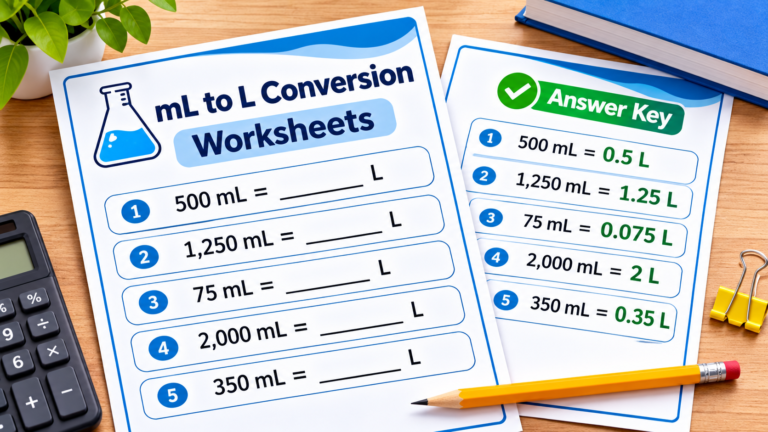
Convert 500 mL into liters.
500 ÷ 1,000 = 0.5 L
The amount of liquid stays the same.
Example of Ratio Comparison
Compare 500 mL with 2 L.
Convert 2 L into milliliters:
2 × 1,000 = 2,000 mL
Write and simplify the ratio:
500 : 2,000 = 1 : 4
The result compares two different amounts.
Important distinction: The unit relationship is 1 L = 1,000 mL. That is a conversion equality. A ratio such as 500 mL : 2 L compares two separate quantities. Do not confuse the conversion factor with the ratio between those quantities.
Common mL to L Ratio Mistakes
Understanding common errors can help you simplify volume ratios correctly.
Comparing Different Units Directly
Do not simplify 500 mL : 2 L as 500 : 2.
The units are different.
First convert 2 L into 2,000 mL.
The correct ratio is:
500 : 2,000 = 1 : 4
Reversing the Ratio Order
The order of the quantities matters.
For example:
500 mL : 2,000 mL = 1 : 4
But:
2,000 mL : 500 mL = 4 : 1
These ratios describe different comparisons.
Dividing Only One Term
Always divide both terms by the same number.
Correct:
600 : 1,200
= 600 ÷ 600 : 1,200 ÷ 600
= 1 : 2
Changing only one term would produce an incorrect relationship.
Adding Instead of Dividing
Ratios are simplified by dividing both terms by a common factor. Do not subtract or add the same number to each term.
For example:
12 : 20
Divide both by 4:
3 : 5
This is the correct simplified ratio.
Forgetting the Conversion Factor
Remember that 1 L contains 1,000 mL.
When converting liters to milliliters, multiply by 1,000. When converting milliliters to liters, divide by 1,000.
Real-Life Applications of Volume Ratios
Ratios are useful when comparing liquids in recipes, drink mixtures, and containers.
Juice Concentrate and Water
A drink recipe uses 250 mL of concentrate and 1 L of water.
Convert 1 L into 1,000 mL.
250 : 1,000 = 1 : 4
The concentrate-to-water ratio is 1 : 4.
Comparing Water Containers
One container holds 500 mL, while another holds 1.5 L.
Convert 1.5 L into 1,500 mL.
500 : 1,500 = 1 : 3
The first container holds one-third as much liquid as the second.
Comparing Milk Quantities
A small milk container holds 250 mL, while a larger container holds 2 L.
Convert 2 L into 2,000 mL.
250 : 2,000 = 1 : 8
The smaller container holds one-eighth as much milk as the larger one.
Comparing Two Water Samples
One sample contains 750 mL of water, and another contains 1 L.
Convert 1 L into 1,000 mL.
750 : 1,000 = 3 : 4
The ratio of the first sample to the second is 3 : 4.
mL to L Ratio Practice Questions
Try these questions to test your understanding of volume ratios.
Convert the measurements into the same unit before writing and simplifying each ratio.
- Simplify the ratio of 300 mL to 1.2 L.
- Simplify the ratio of 400 mL to 1 L.
- Find the ratio of 900 mL to 1.2 L in its simplest form.
- Simplify the ratio of 1.5 L to 500 mL.
- Find the simplest ratio of 2 L to 750 mL.
- Simplify the ratio of 750 mL to 1 L.
Practice Questions: Answers and Explanations
| Question | Conversion and simplification | Answer |
|---|---|---|
| 1 | 300 : 1,200 ÷ 300 | 1 : 4 |
| 2 | 400 : 1,000 ÷ 200 | 2 : 5 |
| 3 | 900 : 1,200 ÷ 300 | 3 : 4 |
| 4 | 1,500 : 500 ÷ 500 | 3 : 1 |
| 5 | 2,000 : 750 ÷ 250 | 8 : 3 |
| 6 | 750 : 1,000 ÷ 250 | 3 : 4 |
Detailed solutions:
Question 1: 300 mL to 1.2 L
1.2 × 1,000 = 1,200 mL
300 : 1,200 = 1 : 4
Question 2: 400 mL to 1 L
1 × 1,000 = 1,000 mL
400 : 1,000 = 2 : 5
Question 3: 900 mL to 1.2 L
1.2 × 1,000 = 1,200 mL
900 : 1,200 = 3 : 4
Question 4: 1.5 L to 500 mL
1.5 × 1,000 = 1,500 mL
1,500 : 500 = 3 : 1
Question 5: 2 L to 750 mL
2 × 1,000 = 2,000 mL
2,000 : 750 = 8 : 3
Question 6: 750 mL to 1 L
1 × 1,000 = 1,000 mL
750 : 1,000 = 3 : 4
Frequently Asked Questions About mL to L Ratios
What is an mL to L ratio?
An mL to L ratio compares two liquid measurements expressed in milliliters and liters. Before simplifying it, convert both quantities into the same unit.
For example:
500 mL : 2 L = 500 : 2,000 = 1 : 4.
How do you compare mL and L?
Convert the liter measurement into milliliters by multiplying it by 1,000. Then write both measurements as a ratio and simplify them using a common factor.
Why must units match in a ratio?
The units must match so both measurements represent comparable numerical quantities. When the units match, they cancel and the ratio can be simplified correctly.
How do you simplify a volume ratio?
First convert both measurements into the same unit. Then find their greatest common factor and divide both terms by it.
For example:
600 mL : 1,200 mL = 1 : 2.
What is the difference between a ratio and a conversion?
A conversion changes the unit used to express one measurement. A ratio compares two quantities and describes their relationship.
For example, 500 mL = 0.5 L is a conversion, while 500 mL : 2 L = 1 : 4 is a ratio.
What is the ratio of 500 mL to 2 L?
The ratio is 1 : 4.
Convert 2 L into 2,000 mL.
500 : 2,000 = 1 : 4.
What is the ratio of 250 mL to 1 L?
The ratio is 1 : 4.
Convert 1 L into 1,000 mL.
250 : 1,000 = 1 : 4.
What are equivalent volume ratios?
Equivalent volume ratios have the same relative relationship, even when their numbers differ.
For example:
1 : 4, 2 : 8 and 3 : 12 are equivalent ratios.
Does the order of a ratio matter?
Yes. The first number represents the first quantity, and the second number represents the second quantity.
For example, 1 : 4 is different from 4 : 1.
Can I use a calculator to simplify an mL to L ratio?
Yes. A calculator can help convert liters into milliliters and divide both values by their greatest common factor. However, always check that both measurements use the same unit before simplifying.
Explore More Measurement and Conversion Resources
Understanding ratios becomes easier when you know how metric units relate to each other.
Use our mL to L conversion calculator to convert milliliters into liters and check individual measurements.