Understanding Liquid Volume Measurements and Metric Units
Liquid volume measurements tell us how much space a liquid occupies. They help us measure water, milk, juice, cooking oil, and many other liquids.
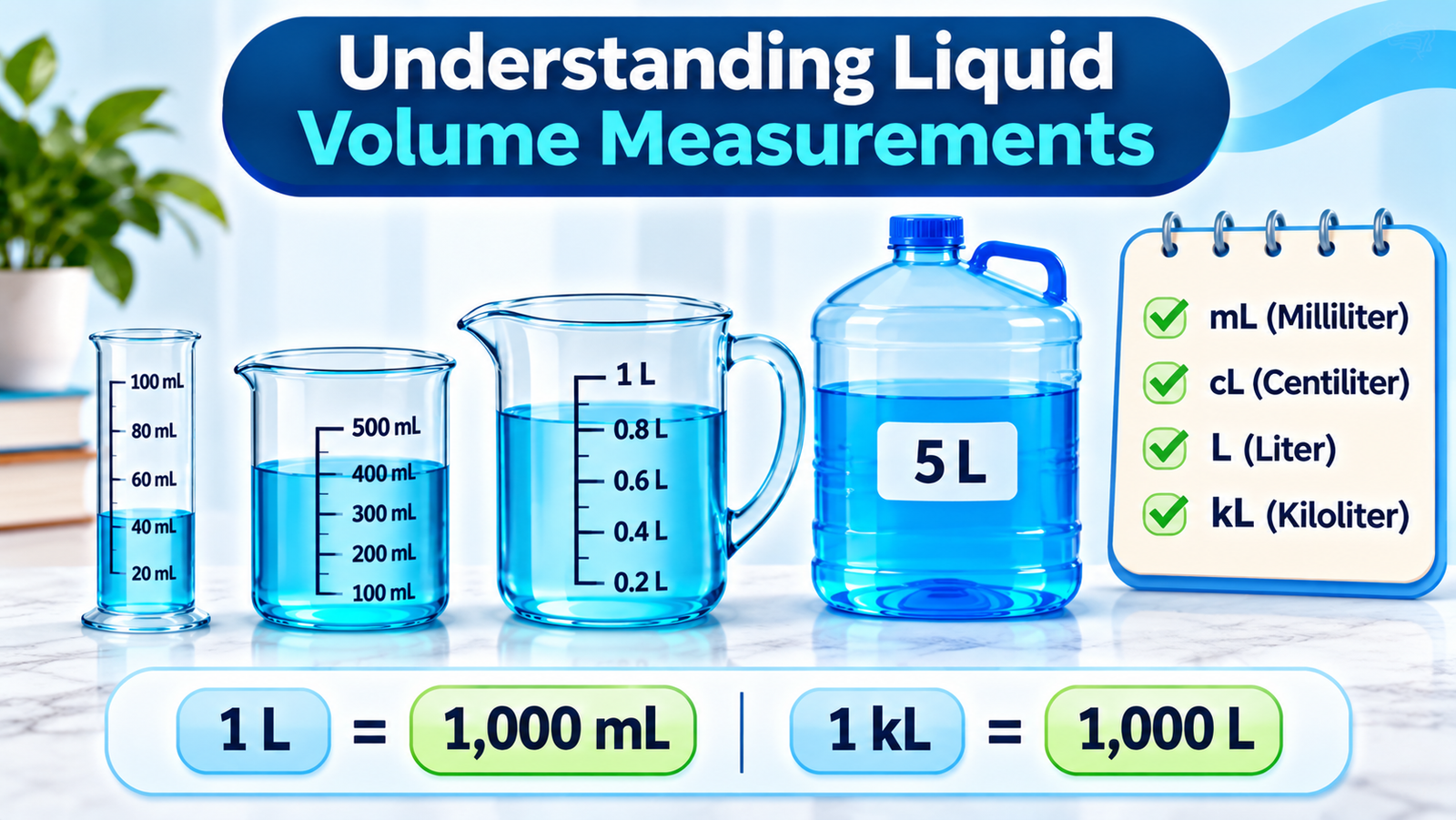
The metric system uses units such as milliliters (mL), liters (L), and kiloliters (kL) to describe liquid volume. The right unit depends on the amount being measured. A small amount of medicine may need milliliters, while a large water tank may need kiloliters.
Understanding liquid volume also means knowing how to use measuring tools and read their scales. This guide explains the main units, common tools, and simple ways to measure liquids accurately.
What Is Liquid Volume?
Liquid volume is the amount of three-dimensional space occupied by a liquid. It tells us how much liquid is present in a container or another space.
For example, a bottle may contain 500 mL of water. The 500 mL figure describes the volume of water inside the bottle.
Liquid volume is measured in units such as:
- Milliliters (mL)
- Liters (L)
- Kiloliters (kL)
The metric system makes it easier to describe both small and large amounts. You can use milliliters for a small drink and liters for a large bottle of water.
What Is Liquid Capacity?
Liquid capacity is the maximum amount of liquid that a container can hold.
For example, a water bottle may have a capacity of 1 liter. This means it can hold up to 1 liter of liquid when filled to its intended maximum level.
Capacity describes the container. The volume describes the amount of liquid inside it.
A container may be partly full, completely full, or empty. Its capacity does not change just because the amount of liquid changes.
Volume vs Capacity: What Is the Difference?
Volume and capacity are related, but they describe different things.
- Volume tells you how much space a substance occupies.
- Capacity tells you how much a container can hold.
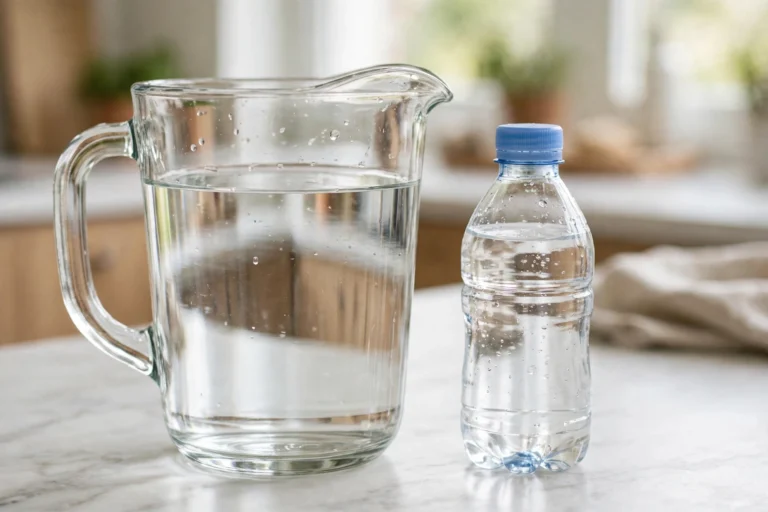
Consider a bottle with a capacity of 1 liter. If it contains only 400 mL of water, its capacity is still 1 liter. The actual volume of water inside is 400 mL.
| Feature | Volume | Capacity |
|---|---|---|
| Meaning | Space occupied by a substance or object | Maximum amount a container can hold |
| Applies to | Liquids, solids, and gases | Containers and spaces that can hold something |
| Example | 400 mL of water inside a bottle | A bottle that can hold 1 L |
| Can it change? | Yes, when the amount of liquid changes | Usually stays the same for the same container |
The units used for liquid volume and container capacity are often the same. Both can be expressed in milliliters or liters.
Which Metric Units Measure Liquid Volume?
The metric system uses units based on powers of ten. This makes it useful for measuring very small and very large amounts.
The most common units for everyday liquid measurements are milliliters, liters, and kiloliters.
Milliliters (mL)
A milliliter is a small metric unit of volume. It is useful when measuring small amounts of liquid.
You may see milliliters used for:
- Medicine doses
- Syrup
- Perfume
- Small drink containers
- Cooking ingredients
For example, a medicine cup may have marks at 5 mL, 10 mL, and 15 mL.
One milliliter is equal to one cubic centimeter (1 cm³).
Liters (L)
A liter is a larger unit than a milliliter. It is commonly used for drinks, milk, cooking liquids, and household containers.
Examples include:
- A 1 L milk carton
- A 2 L drink bottle
- A 5 L water container
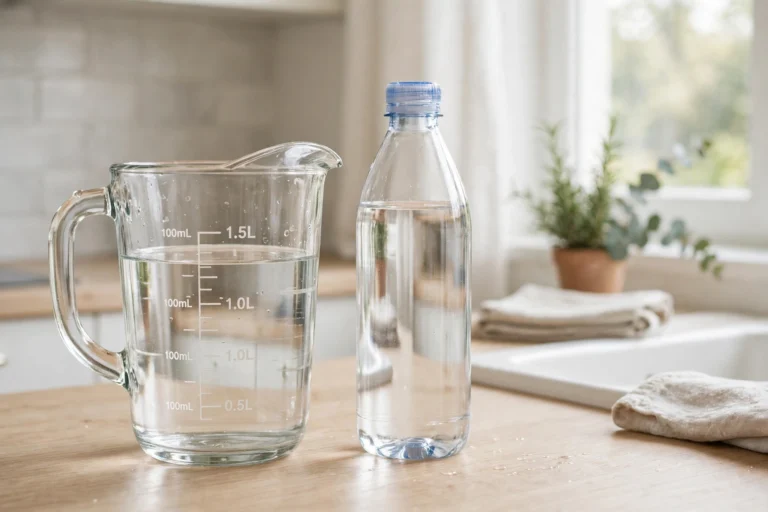
- A jug that holds 1.5 L of water
One liter contains 1,000 milliliters.
Kiloliters (kL)
A kiloliter is used for much larger volumes. It is useful when measuring water storage, tanks, and large supplies of liquid.
Examples include:
- Large water tanks
- Swimming pools
- Water supply systems
- Industrial liquid storage
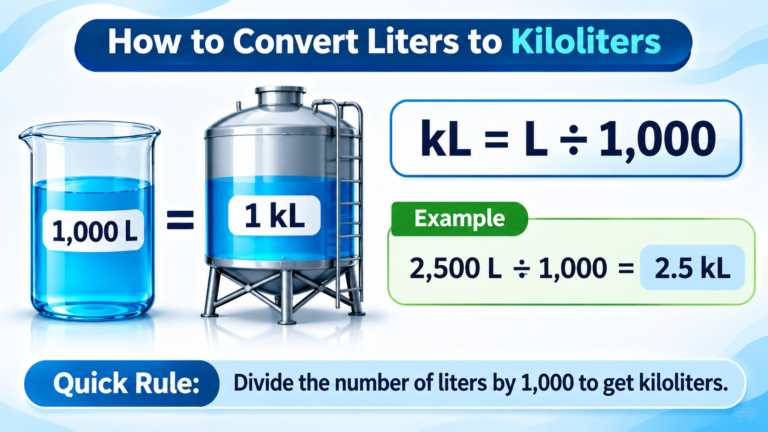
One kiloliter is equal to 1,000 liters.
Other Metric Capacity Units
The metric system also includes centiliters, deciliters, dekaliters, and hectoliters.
These units are less common in everyday household measurements, but they help show how metric volume units relate to one another.
| Unit | Symbol | Relationship to a liter | Common use |
|---|---|---|---|
| Milliliter | mL | 0.001 L | Small liquid amounts |
| Centiliter | cL | 0.01 L | Some drink labels and measurements |
| Deciliter | dL | 0.1 L | Recipes and some food labels |
| Liter | L | 1 L | Bottles, milk, and household liquids |
| Dekaliter | daL | 10 L | Larger liquid quantities |
| Hectoliter | hL | 100 L | Bulk liquid measurements |
| Kiloliter | kL | 1,000 L | Water tanks and large storage |
Important metric relationships:
- 1 L = 1,000 mL
- 1 L = 100 cL
- 1 L = 10 dL
- 1 kL = 1,000 L
For a detailed visual reference, see the metric capacity units conversion chart.
Common Tools Used to Measure Liquid Volume
Different tools are designed for different amounts and levels of accuracy. A kitchen measuring jug is useful for cooking, while a graduated cylinder is better for many laboratory measurements.
| Measuring tool | Main purpose | Best suited for |
|---|---|---|
| Measuring cup | Measures common liquid amounts | Cooking and baking |
| Measuring jug | Measures and pours larger amounts | Water, milk, and juice |
| Graduated cylinder | Measures liquid volume using marked divisions | School and laboratory work |
| Beaker | Holds, mixes, and gives approximate volume readings | Laboratory activities |
| Syringe | Measures and transfers small amounts | Medicine and laboratory work |
| Pipette | Transfers measured small liquid volumes | Laboratory experiments |
| Measuring spoon | Measures small amounts | Recipes and food preparation |
Measuring Cups and Jugs
Measuring cups and jugs are common household tools. They usually have volume markings along the side.
You can use them to measure water, milk, juice, and cooking oil. Choose a jug with a suitable scale for the amount you need.
A jug marked in milliliters is useful for smaller amounts. A larger jug may also show liters.
Graduated Cylinders
A graduated cylinder is a narrow container with measurement markings along its side. It is commonly used in science laboratories.
The markings help you measure liquid volume more precisely than many ordinary kitchen containers.
Graduated cylinders come in different sizes. Select one that can hold the amount you need to measure.
Beakers, Syringes, and Pipettes
A beaker is used to hold, mix, and pour liquids. Its markings can help estimate volume, but it is not usually the best choice when a highly accurate measurement is required.
A syringe can measure and transfer small amounts of liquid. It is useful when working with small volumes.
A pipette is designed to transfer a measured amount of liquid. Some pipettes are made for very precise laboratory work.
How to Measure Liquid Volume Accurately
Accurate measurement depends on using the right tool and reading its scale correctly.
Follow these steps when measuring a liquid with a graduated cylinder or measuring jug:
- Choose a suitable measuring tool. Select one with a scale that matches the amount you need to measure.
- Place it on a level surface. Keep the container upright on a flat table or worktop.
- Pour the liquid carefully. Add enough liquid to reach the required measurement without spilling.
- Wait for the liquid to settle. Allow the surface to become still before taking a reading.
- Read the scale at eye level. Looking from above or below can make the reading appear higher or lower.
- Check the liquid curve. For water in a clear graduated cylinder, read the bottom of the curved surface, called the meniscus.
- Record the value and unit. Write the number with its correct unit, such as 250 mL.
What Is a Meniscus?
A meniscus is the curved surface of a liquid inside a container.
Water usually forms a curve that dips in the middle. When reading water in a clear graduated cylinder, place your eyes level with the surface and read the bottom of this curve.
This helps reduce reading errors.
Everyday Examples of Liquid Volume Measurements
We use liquid volume measurements in homes, schools, shops, farms, and workplaces. The unit depends on how much liquid is being measured.
| Everyday item | Example volume or capacity | Suitable unit |
|---|---|---|
| Small medicine cup | 10 mL | Milliliters |
| Small juice box | 200 mL | Milliliters |
| Water bottle | 500 mL | Milliliters |
| Milk carton | 1 L | Liters |
| Large drink bottle | 2 L | Liters |
| Household water container | 20 L | Liters |
| Large water tank | 5 kL | Kiloliters |
These are illustrative examples. Actual product sizes and tank capacities can vary.
When Should You Use mL, L, and kL?
Choose a unit that makes the measurement easy to read and understand.
- Use milliliters (mL) for small amounts, such as medicine, flavoring, or a small drink.
- Use liters (L) for larger household amounts, such as milk cartons, water bottles, and cooking liquids.
- Use kiloliters (kL) for large amounts, such as water tanks and bulk water storage.
For example, writing 500 mL is more convenient than writing 0.5 L when describing a small drink bottle. Both express the same volume, but the first may be easier to recognize on a product label.
Liquid Volume vs Weight: How Are They Different?
Volume and weight are not the same measurement.
Volume describes how much space a liquid occupies. Weight describes the force caused by gravity acting on an object. In everyday use, people often use the word weight when they mean mass.
Mass is commonly measured in grams (g) and kilograms (kg). Liquid volume is commonly measured in milliliters (mL) and liters (L).
| Measurement | What it tells you | Common units | Measuring method |
|---|---|---|---|
| Volume | How much space a liquid occupies | mL, L, kL | Measuring jug or graduated cylinder |
| Mass | How much matter is present | g, kg | Balance or scale |
| Weight | The force of gravity on an object | Newton (N) | Force meter |
A milliliter is not always equal to a gram. The relationship depends on the liquid’s density and temperature.
For example, 1 mL of water has a mass of about 1 gram under common room-temperature conditions. Other liquids, such as cooking oil or honey, have different densities.
This is why you should not treat milliliters and grams as interchangeable units for every liquid.
Common Mistakes When Measuring Liquids
Small mistakes can lead to incorrect measurements. Watch out for these common problems:
- Reading the scale from above: This can make the liquid level look different. Keep your eyes level with the reading.
- Using the wrong tool: A large beaker may not give the accuracy needed for a small measurement.
- Ignoring the meniscus: Read the correct part of the curved liquid surface when the tool requires it.
- Mixing units: Do not compare values in different units without first expressing them in a common unit.
- Confusing volume with capacity: A container’s maximum capacity is not always the amount of liquid inside it.
- Treating grams as milliliters: Mass and volume measure different properties. Their relationship depends on density.
- Using an unsuitable container: Choose a measuring tool with clear markings and a suitable range.
Frequently Asked Questions
What is liquid volume?
Liquid volume is the amount of three-dimensional space occupied by a liquid. It is commonly measured in milliliters (mL), liters (L), and kiloliters (kL).
What is the difference between volume and capacity?
Volume describes the space occupied by a substance. Capacity describes the maximum amount a container can hold. A 1 L bottle containing 400 mL of water has a capacity of 1 L and a liquid volume of 400 mL.
What units measure liquid volume?
Common metric units include milliliters, centiliters, deciliters, liters, and kiloliters. Milliliters are useful for small amounts, liters for household quantities, and kiloliters for large volumes.
What tool is used to measure liquid volume?
A measuring cup, measuring jug, or graduated cylinder can measure liquid volume. A syringe or pipette is useful for smaller amounts. The best tool depends on the amount and the accuracy required.
How do you measure a liquid accurately?
Use a suitable measuring tool on a level surface. Let the liquid settle, then read the scale at eye level. For water in a graduated cylinder, read the bottom of the meniscus.
Is volume the same as weight?
No. Volume measures the space a substance occupies. Weight is the force of gravity acting on an object. Mass is usually measured in grams or kilograms, while liquid volume is measured in milliliters or liters.
Is 1 mL always equal to 1 gram?
No. Milliliters measure volume, while grams measure mass. One milliliter of water has a mass close to 1 gram under common room-temperature conditions, but other liquids have different densities.
Why are liters used to measure water?
Liters are convenient for everyday amounts of liquid. Water bottles, milk cartons, household containers, and many other products use liters because the unit is easy to read and understand.
What is the best tool for measuring a small amount of liquid?
A syringe or pipette is often suitable for small amounts. A measuring spoon can work for simple household tasks, while a graduated cylinder is useful for many school and laboratory measurements.
Final Thoughts
Liquid volume measurements help us describe how much liquid is present in a container or space. Milliliters, liters, and kiloliters are useful for different amounts, from small doses to large water supplies.
Choosing the right measuring tool also matters. A measuring jug works well for household tasks, while a graduated cylinder offers clearer readings for many science activities.
When you understand the difference between volume and capacity, use the correct metric unit, and read the scale carefully, you can measure liquids with greater confidence.