
Coffee & Barista Ratios: Measuring Espresso, Milk, and Water in mL & L
Great coffee is not guesswork. Behind every balanced espresso and every smooth flat white is a ratio — a measured amount of coffee to a measured amount of water or milk. Baristas weigh and measure everything in grams and milliliters, because a few milliliters either way changes the taste.
This guide covers the ratios that matter: espresso, pour over, French press, and cold brew, plus the milk volumes for the drinks on a cafe menu. All volumes are in milliliters and liters, so the numbers work the same in any country.
The One Rule: Weigh Coffee, Measure Water
Coffee is measured in grams, water in milliliters. The reason is simple: 1 mL of water weighs exactly 1 gram, so the ratio between coffee and water is the same whether you count grams or milliliters of water.
A ratio of 1:15 means 1 gram of coffee for every 15 grams — or 15 mL — of water. So 20 grams of coffee needs 300 mL of water. A ratio of 1:2 means 1 gram of coffee for every 2 grams of water, which is how espresso is measured.
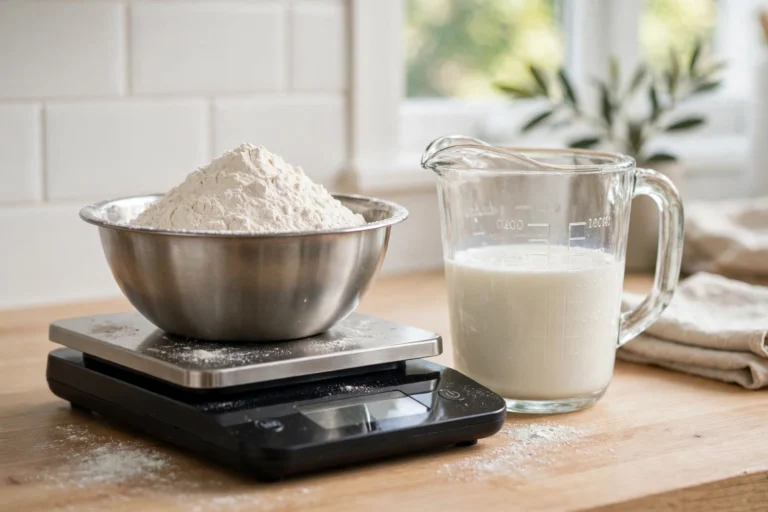
Start with a kitchen scale. Scoops and tablespoons vary too much: a tablespoon of finely ground coffee weighs more than a tablespoon of coarse ground coffee. A scale removes the guesswork, and a measuring jug with milliliter markings handles the water.
Espresso Ratios
Espresso is the most concentrated coffee, and its ratio is the tightest. The standard is a 1:2 ratio of ground coffee to liquid espresso.
A single shot uses about 9 to 10 grams of ground coffee and produces about 18 to 20 mL of espresso. A double shot — the standard in most cafes — uses 18 grams of coffee and produces about 36 mL of espresso. That 36 mL is the base for almost every milk drink on the menu.
Some baristas prefer a slightly shorter or longer shot. A ristretto uses a 1:1.5 ratio, so 18 grams of coffee produces about 27 mL — sweeter and more intense. A lungo uses a 1:3 ratio, so 18 grams produces about 54 mL — thinner and more bitter. The 1:2 double shot is the balanced middle, and it is the best place to start.
| Espresso style | Coffee | Liquid out | Ratio |
|---|---|---|---|
| Single shot | 9–10 g | 18–20 mL | 1:2 |
| Double shot | 18 g | 36 mL | 1:2 |
| Ristretto (double) | 18 g | 27 mL | 1:1.5 |
| Lungo (double) | 18 g | 54 mL | 1:3 |
Espresso extraction takes about 25 to 30 seconds for a double shot. If your shot runs much faster, the grind is too coarse; if it runs much slower, the grind is too fine. The volume tells you as much as the timer — a double shot that produces 60 mL in 30 seconds is over-extracted and will taste bitter.
Pour Over Ratios
Pour over coffee — V60, Chemex, and similar brewers — uses a much higher water ratio than espresso. The standard range is 1:15 to 1:17.
A 1:15 ratio makes a stronger cup. For a single 300 mL serving, use 20 grams of coffee and 300 mL of water. A 1:16 ratio is the most common starting point: 20 grams of coffee to 320 mL of water, or 25 grams to 400 mL. A 1:17 ratio makes a lighter, more delicate cup: 20 grams to 340 mL.
To scale up, just multiply. A 500 mL Chemex brew at 1:16 needs about 31 grams of coffee. A 1 liter batch needs about 62 grams. Always do the division first: divide the water in milliliters by the ratio number to get the coffee in grams. For 500 mL at 1:16, that is 500 divided by 16, which is 31.25 grams.
Water temperature matters too. Use water between 93 and 96 degrees Celsius — just off the boil. Water that is too hot over-extracts and tastes bitter; water that is too cool under-extracts and tastes sour.
French Press Ratios
French press coffee is full immersion brewing, and its usual ratio is 1:14 to 1:15 — slightly stronger than pour over, because the coffee sits in the water for the whole brew.
A standard French press holds about 1 liter, but most people brew 500 to 750 mL at a time. For 500 mL of water at 1:14, use about 36 grams of coffee. For 750 mL, use about 54 grams. For a full liter, use about 71 grams.
The method is simple: add coarse ground coffee, pour in water just off the boil, stir gently, wait four minutes, then press the plunger down slowly and pour the coffee out right away.
Cold Brew Ratios
Cold brew uses the strongest ratio of all, because it is usually served diluted. The concentrate ratio is about 1:5 — one part coffee to five parts water by weight.
To make 1 liter of cold brew concentrate, use 200 grams of coarse ground coffee and 1000 mL of cold water. Steep for 12 to 16 hours at room temperature, then strain. The result is a concentrate you dilute before drinking: mix one part concentrate with one part water or milk for a ready-to-drink cup.
That means 1 liter of concentrate makes about 2 liters of finished cold brew. A single serving is about 100 mL of concentrate plus 100 mL of water or milk, served over ice. Because cold brew is smooth and low in acid, it is easy to drink too much of it — remember that the concentrate is roughly twice as strong as regular coffee.
| Method | Ratio | Coffee for 500 mL water | Strength |
|---|---|---|---|
| Espresso (double) | 1:2 | 18 g for 36 mL out | Very strong |
| Pour over | 1:15–1:17 | 30–33 g | Medium |
| French press | 1:14–1:15 | 33–36 g | Medium-strong |
| Cold brew concentrate | 1:5 | 100 g per 500 mL | Very strong, dilute to serve |
Milk Drinks: How Much Milk per Drink?
Espresso is only 36 mL. The milk is what turns it into a flat white, latte, or cappuccino, and each drink has its own milk volume.
A flat white uses a double shot (36 mL) with about 120 to 150 mL of steamed milk, in a cup of about 150 to 180 mL total. The milk is thin and velvety, with very little foam.
A latte uses a double shot with about 200 to 240 mL of steamed milk, in a cup of about 240 to 300 mL total. It is the milkiest espresso drink, with a thin layer of foam on top.
A cappuccino uses a double shot with about 120 mL of steamed milk and about 60 mL of foam, in a cup of about 180 mL total. The classic rule is thirds: one third espresso, one third steamed milk, one third foam.
When you steam milk, remember it expands. Milk roughly doubles in volume when steamed with foam, and grows by about a third when steamed flat for a latte. Start with less milk than the cup holds: for a 240 mL latte, steam about 180 mL of cold milk.
Common Mistakes to Avoid
Using tablespoons instead of a scale. A tablespoon of coffee can weigh anywhere from 7 to 12 grams depending on the grind. A scale costs little and fixes the problem completely.
Guessing the water volume. Mark your kettle or use a measuring jug. An extra 50 mL in a 300 mL brew changes the ratio from 1:15 to 1:17.5 — enough to taste.
Using the same ratio for every method. Espresso at 1:2 and pour over at 1:16 are completely different drinks. Copying one method’s ratio to another will give you coffee that is far too strong or far too weak.
Forgetting that milk expands when steamed. Fill the steaming jug only to about a third full for foamy milk, or half full for flat milk, or it will overflow.
Brewing with boiling water. Water at 100 degrees Celsius scorches the coffee. Let it cool for 30 seconds after boiling, or use a kettle with temperature control, aiming for 93 to 96 degrees.
Frequently Asked Questions
What is the best coffee to water ratio? For pour over, start at 1:16 — 1 gram of coffee per 16 mL of water. For French press, 1:14 to 1:15. For espresso, 1:2.
How much coffee do I need for 500 mL of water? At 1:16, about 31 grams. At 1:15, about 33 grams. At 1:14, about 36 grams.
How many mL is a double shot of espresso? About 36 mL, from 18 grams of ground coffee at a 1:2 ratio.
How much milk is in a flat white? About 120 to 150 mL of steamed milk with a 36 mL double shot, in a 150 to 180 mL cup.
How do I make cold brew concentrate? Use a 1:5 ratio — 200 grams of coarse coffee per liter of cold water — steep 12 to 16 hours, strain, then dilute one part concentrate with one part water or milk.
Conclusion
Coffee ratios are simple once they are in milliliters. Espresso is 1:2 — 18 grams in, 36 mL out. Pour over is 1:15 to 1:17, French press is 1:14 to 1:15, and cold brew concentrate is 1:5, diluted before serving. Milk drinks build on the same 36 mL double shot: about 120 to 150 mL of milk for a flat white, 200 to 240 mL for a latte, and a third each of espresso, milk, and foam for a cappuccino.
Weigh the coffee, measure the water, and let the ratio do the work. Once the numbers are right, the same recipe will taste the same every morning — and you will know exactly what to change when it does not.