Gardening & Plant Care: Mixing Liquid Fertilizer in mL per Liter
Liquid fertilizer works fast, but only when it is mixed right. Too weak and your plants stay hungry. Too strong and you burn the roots — the leaves turn brown at the edges, the plant wilts even though the soil is wet, and in a bad case the plant dies. The difference between feeding and burning is often a few milliliters per liter.
This guide shows you how to mix liquid fertilizer in mL per liter, how to read a label that gives a ratio instead of a dose, and how to water it in safely for houseplants, vegetables, and garden beds.
What “mL per Liter” Means
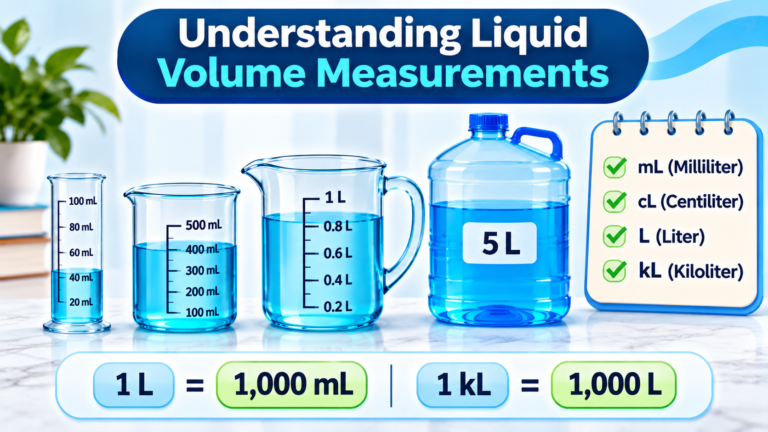
A dose written as “5 mL per liter” means 5 milliliters of fertilizer concentrate for every 1 liter (1,000 mL) of water. The total mixture is then 1,005 mL, but nobody measures it that precisely — you simply add 5 mL to a liter of water.
The same dose can be written in other ways, and it helps to recognize them:
- 5 mL per liter = 5 mL in 1,000 mL of water
- 1:200 ratio = 1 part fertilizer to 200 parts water, which is also 5 mL per liter
- 0.5% solution = 5 mL per liter
- 1 teaspoon per liter = about 5 mL per liter (a level teaspoon is 5 mL)
- 1 capful per liter = check the cap — capfuls vary from 5 mL to 15 mL, so measure the cap once instead of trusting it
To convert any ratio to mL per liter, divide 1,000 by the second number in the ratio. A 1:100 ratio is 1,000 ÷ 100 = 10 mL per liter. A 1:500 ratio is 1,000 ÷ 500 = 2 mL per liter. A 1:50 ratio is 20 mL per liter — a strong dose, used only for some garden feeds.
Common Doses: What the Label Usually Says
Most general-purpose liquid fertilizers for houseplants and garden plants are dosed at 2 to 10 mL per liter. The exact dose depends on the product’s strength and on whether it is a regular feed or a one-off boost.
| Use | Typical dose | Notes |
|---|---|---|
| Houseplants, regular feeding | 2–5 mL per liter | Every 1–2 weeks in the growing season |
| Houseplants, weak weekly feed | 1–2 mL per liter | Safer for sensitive plants |
| Vegetables, regular feeding | 5–10 mL per liter | Every 1–2 weeks while fruiting |
| Seedlings and young plants | 1–2 mL per liter | Half strength until established |
| Lawns, liquid feed | 10–20 mL per liter | Applied with a hose-end sprayer |
| Foliar spray (on leaves) | 1–3 mL per liter | Spray in the evening, never in full sun |
Always read your own product’s label first. These are typical ranges, not a substitute for the manufacturer’s dose — some concentrates are twice as strong as others, and the same number of milliliters can mean a very different amount of actual nutrients.
How to Mix It: The Practical Method
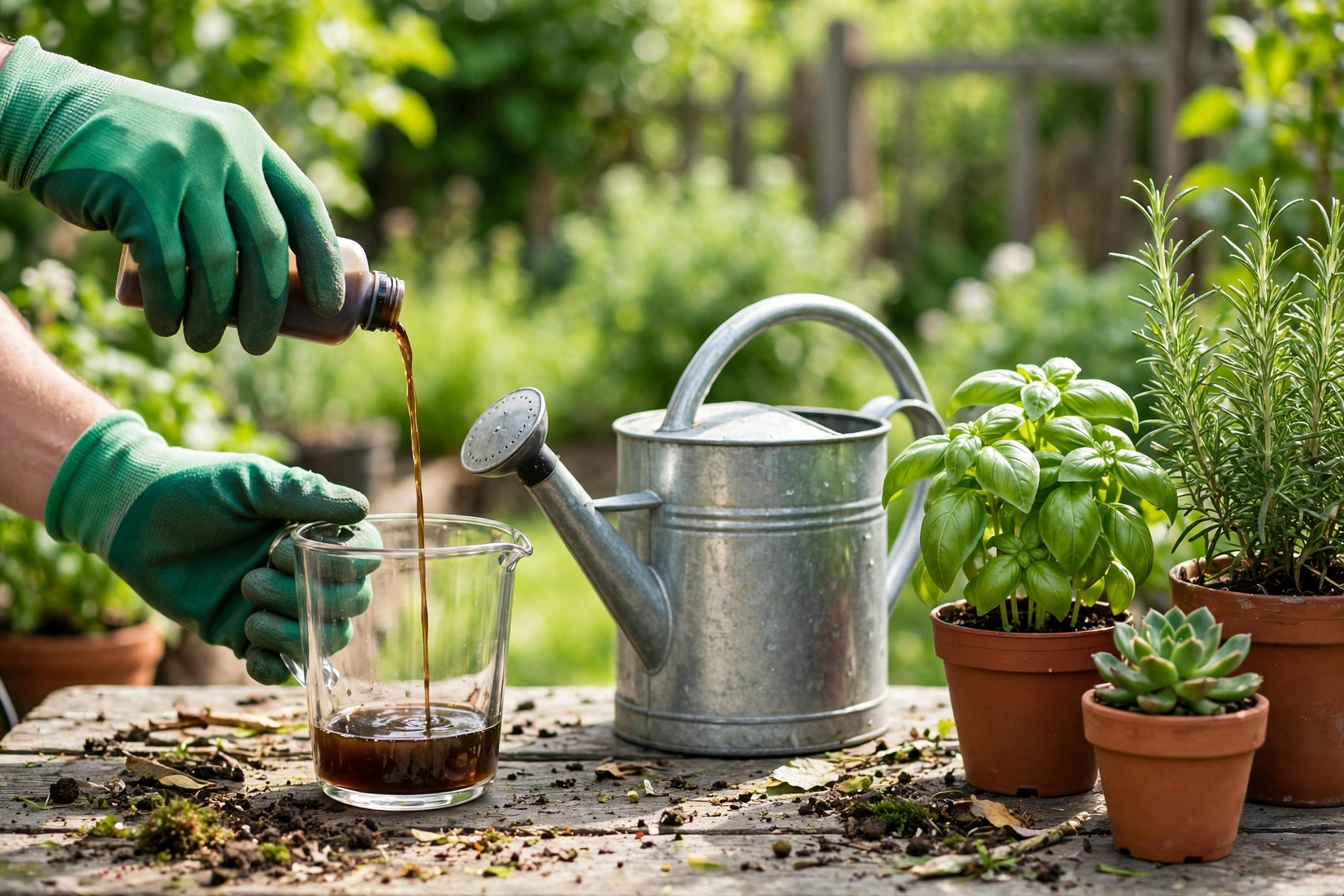
You need three things: a measuring jug marked in milliliters, a syringe or measuring spoon for the concentrate, and a watering can or bucket with a known volume.
Step 1 — Measure the water. Fill your watering can to a known volume. Most cans are 5 liters or 10 liters. If you are not sure, fill it with a 1-liter jug and count.
Step 2 — Work out the dose. Multiply the dose per liter by the liters of water. At 5 mL per liter, a 5-liter can needs 25 mL, and a 10-liter can needs 50 mL. At 2 mL per liter, a 5-liter can needs 10 mL.
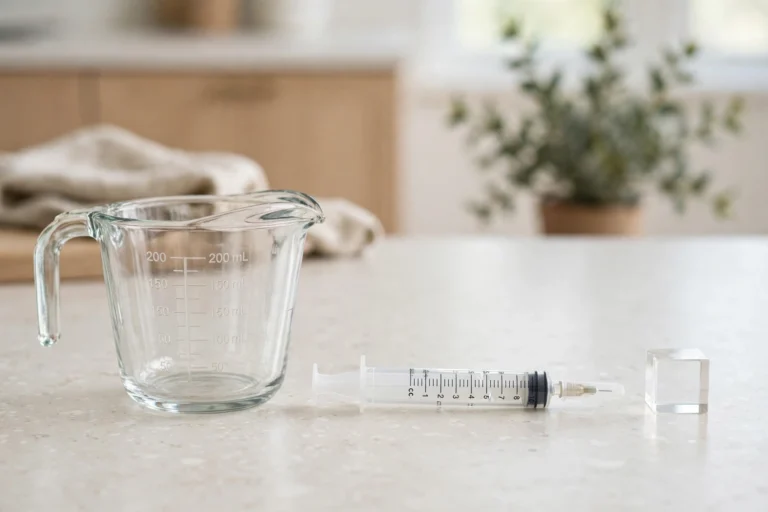
Step 3 — Measure the concentrate. Use a syringe for small amounts — a 10 mL or 20 mL syringe marked in 1 mL steps is ideal. A measuring spoon works too: a level teaspoon is 5 mL, a level tablespoon is 15 mL. Do not pour freehand from the bottle; the difference between 5 mL and 15 mL is the difference between feeding and burning.
Step 4 — Mix well. Add the concentrate to the water, not the other way around, and stir. For a watering can, a few seconds of swirling is enough. For a bucket, stir for ten seconds.
Step 5 — Use it the same day. Mixed fertilizer does not keep well. Use it within a few hours, and do not store a mixed batch for next week — it can go stale, grow algae, and lose strength.
| Water volume | At 2 mL/L | At 5 mL/L | At 10 mL/L |
|---|---|---|---|
| 1 liter | 2 mL | 5 mL | 10 mL |
| 2 liters | 4 mL | 10 mL | 20 mL |
| 5 liters | 10 mL | 25 mL | 50 mL |
| 10 liters | 20 mL | 50 mL | 100 mL |
| 20 liters | 40 mL | 100 mL | 200 mL |
Keep this table near your potting bench. It covers the watering cans and buckets most gardeners actually use.
How Much Mixed Feed Does Each Plant Need?
Mixing the right strength is only half the job — you also need the right amount per plant. Water the soil, not the leaves, and apply enough to wet the root zone.
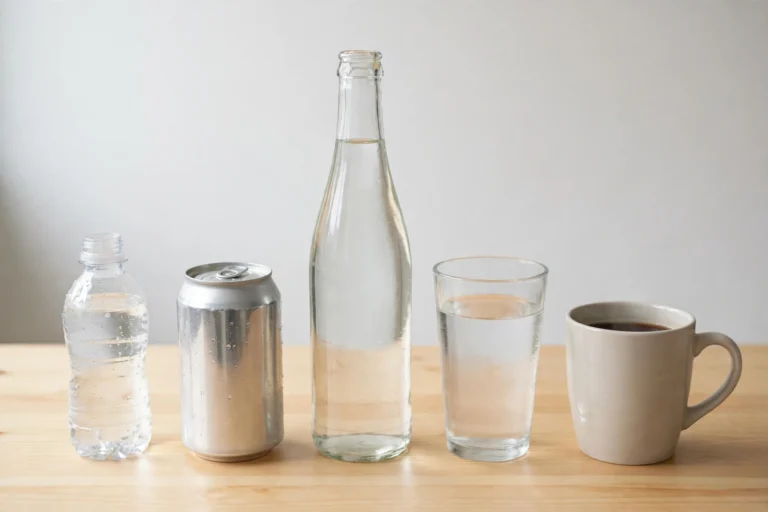
- Small houseplant in a 15 cm pot: about 200 to 300 mL of mixed feed — roughly a mugful.
- Medium houseplant in a 20–25 cm pot: about 500 mL — half a liter.
- Large pot or tub: 1 to 2 liters, until a little runs out of the drainage holes.
- Vegetable plant (tomato, pepper, cucumber): 1 to 2 liters per plant, once or twice a week while fruiting.
- Garden bed: about 5 liters of mixed feed per square meter, watered evenly over the soil.
Always water plants with plain water first if the soil is bone dry. Fertilizer on dry roots is far more likely to burn them. Water lightly, wait ten minutes, then apply the feed. And always make sure the pot has drainage — fertilizer salts build up in soil with nowhere to drain, and that buildup is what scorches roots over time.
NPK: What the Three Numbers Mean
Every fertilizer label carries three numbers, such as 10-10-10 or 5-10-5: the percentages of nitrogen (N), phosphorus (P), and potassium (K). Nitrogen drives leafy growth, so high-nitrogen feeds suit lawns and leafy vegetables. Phosphorus supports roots, flowers, and fruit, so high-phosphorus feeds suit flowering plants and tomatoes. Potassium helps overall health, disease resistance, and fruit quality. A balanced 10-10-10 feed at 5 mL per liter is a reasonable all-purpose choice. The dose in mL per liter still matters most — a high-nitrogen feed at double strength will burn a lawn just as surely as any other.
When and How Often to Feed
Feed in the growing season, when plants are actively making new leaves. For most houseplants and garden plants in temperate climates, that is spring through early autumn. In winter, most plants rest — cut feeding back to once a month or stop entirely, and never feed a dormant plant at full strength.
A good rhythm for houseplants is a weak feed every two weeks in spring and summer: 2 to 5 mL per liter, applied to damp soil. For vegetables in active growth, a feed every one to two weeks at 5 to 10 mL per liter is typical, increasing a little when fruit is setting.
Do not feed a stressed plant — wilted, freshly repotted, or pest-hit — until it recovers, and start seedlings at half strength once they have two or three true leaves.
The Danger: Fertilizer Burn and How to Fix It
Fertilizer burn happens when the salt concentration around the roots gets too high. The salts pull water out of the roots instead of letting it in, so the plant wilts in wet soil. The signs are brown, crispy leaf edges, yellowing leaves, a white crust on the soil surface, and slow or stunted growth.
If you suspect a burn:
- Stop feeding immediately.
- Flush the soil. Water the pot thoroughly with plain water — about three times the pot’s volume — and let it drain freely. For a 5-liter pot, that is about 15 liters of water, applied slowly.
- Remove damaged leaves if they are more than half brown; they will not recover.
- Wait at least two weeks before feeding again, and restart at half strength.
Frequently Asked Questions
How many mL of liquid fertilizer per liter of water?
Most houseplant and garden feeds use 2 to 10 mL per liter. Check your product’s label — typical houseplant doses are 2 to 5 mL per liter, and vegetable feeds are 5 to 10 mL per liter.
How much fertilizer do I need for a 5-liter watering can?
At 5 mL per liter, a 5-liter can needs 25 mL. At 2 mL per liter it needs 10 mL, and at 10 mL per liter it needs 50 mL.
Can I use a teaspoon to measure liquid fertilizer?
Yes. A level teaspoon is 5 mL, so one teaspoon per liter is a 5 mL per liter dose. A level tablespoon is 15 mL. A syringe is more accurate for doses under 5 mL.
Conclusion
Liquid fertilizer is simple once you think in milliliters per liter. Read the label’s dose, convert any ratio by dividing 1,000 by the second number, and measure the concentrate with a syringe or spoon — never freehand. A 5-liter can at 5 mL per liter needs 25 mL; at 2 mL per liter it needs 10 mL. Water the soil first if it is dry, apply enough to wet the roots, and use the mix the same day.
Feed weakly and regularly through the growing season, rest the plants in winter, and flush the soil now and then to clear out salts. Your plants will tell you the rest — steady green growth means the dose is right.