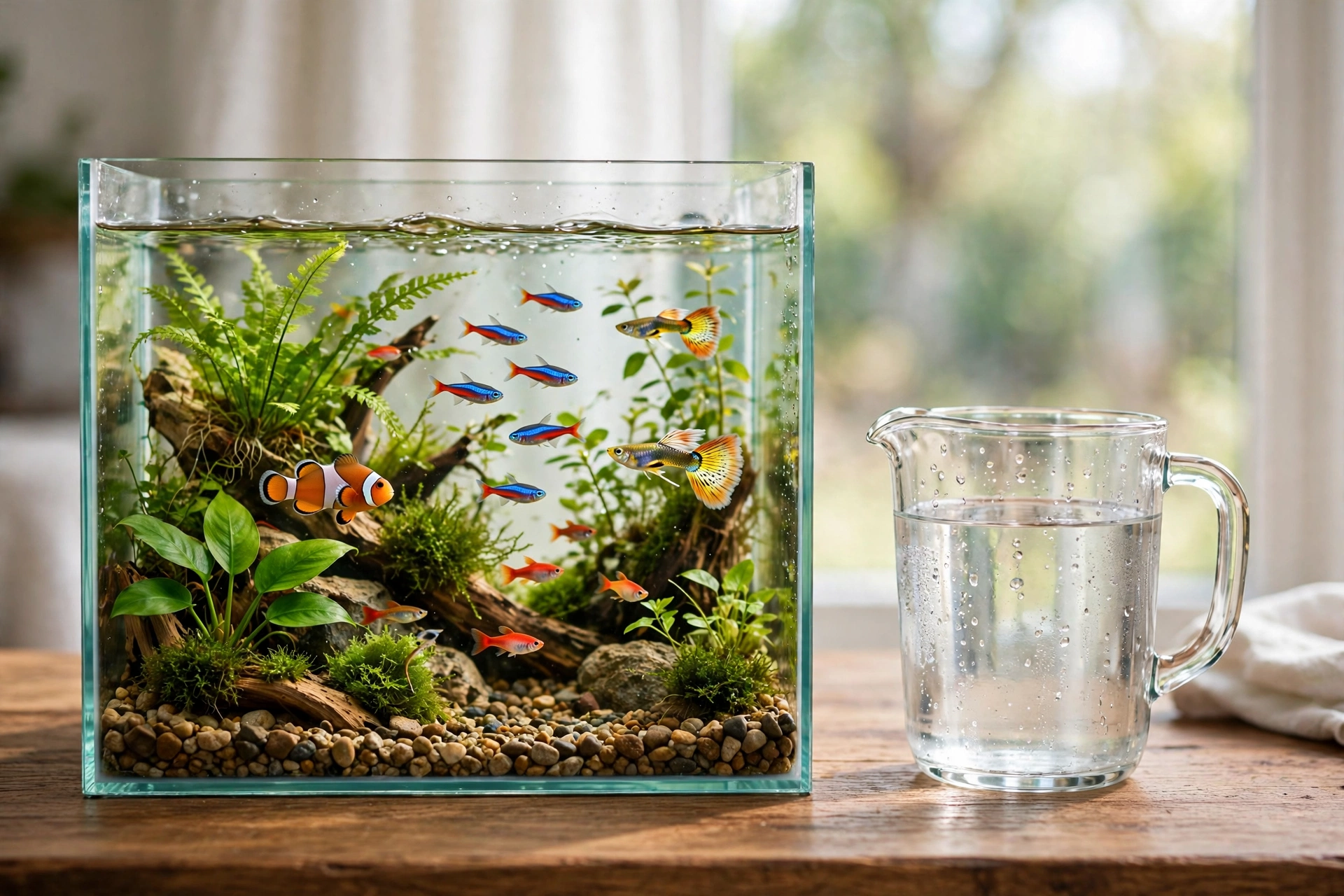
Aquarium Water Volume: Measuring Fish Tank Capacity in mL and Liters
A fish tank sold as “100 liters” rarely holds 100 liters of water. The glass, the substrate, the rocks, the wood, and the fact that you never fill a tank to the very brim all take their share. If you dose medicine, fertilizer, or water conditioner by the tank’s advertised size, you will overdose — and for fish, an overdose can be fatal.
This guide shows you how to measure the real water volume of your aquarium in liters and milliliters, how to allow for everything inside it, and how to use that number for water changes, dosing, and stocking.
The Basic Formula: Length × Width × Height
Aquarium volume comes from a simple box calculation. Measure the inside dimensions of the tank in centimeters, multiply them, and divide by 1,000. The result is liters, because 1 liter is exactly 1,000 cubic centimeters.
Volume in liters = (length in cm × width in cm × height in cm) ÷ 1,000
A tank that is 60 cm long, 30 cm wide, and 30 cm tall holds 60 × 30 × 30 = 54,000 cubic centimeters, which is 54 liters. That is the volume of the empty glass box, filled to the brim.
Measure the inside of the tank, not the outside. Glass thickness of 6 to 10 mm on each side makes a real difference on a small tank: a 30 cm tank measured outside is nearly 2 cm shorter inside, which is about 6 percent less volume. Measure from the inner glass on one side to the inner glass on the other, and measure the height to the water line you actually use, not to the top rim.
The Real Volume: Subtract Substrate, Decor, and the Air Gap
Three things reduce the water your tank actually holds.
The air gap. You never fill a tank to the rim. Most tanks run 2 to 5 cm below the top, to leave room for the filter outlet, surface movement, and to stop fish jumping out. On a 60 × 30 cm tank, 3 cm of air gap is 60 × 30 × 3 = 5,400 cubic centimeters, or 5.4 liters — about 10 percent of the tank.
Substrate. Gravel or sand on the bottom displaces water. A 5 cm layer of gravel in a 60 × 30 cm tank covers 9,000 cubic centimeters, but gravel is about 40 percent empty space between the stones, so it displaces roughly 60 percent of that — about 5.4 liters. Sand packs tighter and displaces more, closer to 70 percent of its volume.
Decor and equipment. Rocks, wood, and ornaments displace their full volume below the water line — a large piece of driftwood 2 to 5 liters, a pile of rocks 10 liters or more in a big tank.
A practical rule: after filling, your real water volume is usually 85 to 90 percent of the empty-box volume for a lightly decorated tank, and 80 to 85 percent for a heavily aquascaped one.
Worked example: a 60 × 30 × 36 cm tank has an empty volume of 64.8 liters. With a 3 cm air gap (5.4 liters lost), 5 cm of gravel (about 5.4 liters displaced), and a piece of wood and a few rocks (about 3 liters), the real water volume is roughly 64.8 − 5.4 − 5.4 − 3 = 51 liters. If you dosed medicine for 65 liters, you would overdose by more than 25 percent.
The Bucket Method: Measure It Directly
If you want the exact number, measure it with a bucket when you first set the tank up — or at the next water change, by counting what you take out and put back.
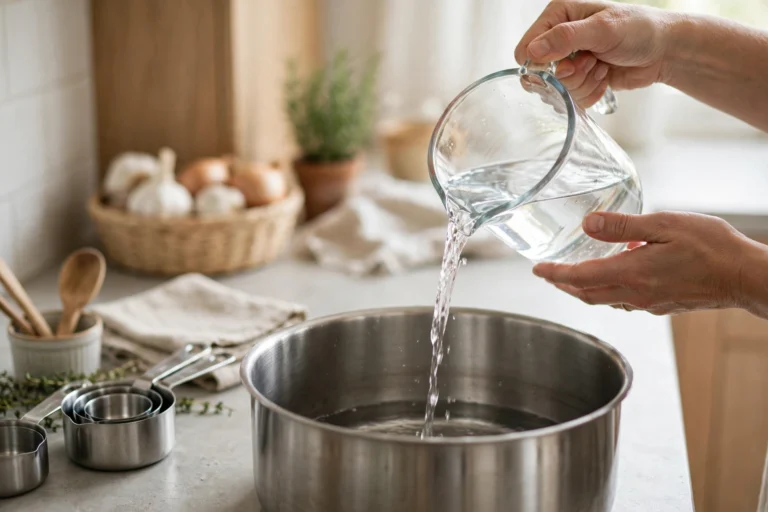
Use a bucket or jug with a known volume, marked in liters. Fill the tank to your normal water line, counting each bucket. A 10-liter bucket makes the counting easy: five buckets is 50 liters. Mark the water line on the glass with a small piece of tape, so you can return to the same level every time.
For a tank that is already running, you can work it out at a water change. Drain the tank into counted buckets until it is empty, or drain a known fraction — for example, drain it to half, count the liters removed, and double it. The bucket method beats the formula, because it automatically accounts for substrate, decor, and the air gap.
Write the real volume on a label stuck to the back of the tank, with the date. Everyone who doses the tank — including future you — will use the right number.
Liters to Gallons, and Back
Aquarium products come from all over the world, and some give doses in US gallons or UK gallons — which are different sizes. One US gallon is 3.785 liters; one UK (imperial) gallon is 4.546 liters. A “50-gallon tank” in the US is 189 liters, but the same label in the UK is 227 liters — a difference of 38 liters, enough to overdose medicine badly. Always check which gallon a product means, and convert to liters before dosing.
Using Your Volume: Water Changes
Water changes are measured as a percentage of the real water volume, not the advertised size. A 25 percent water change on a tank with 51 liters of real water is 12.75 liters — call it 13 liters. A 50 percent change is 25.5 liters.
| Real water volume | 10% change | 25% change | 50% change |
|---|---|---|---|
| 25 L | 2.5 L | 6.25 L | 12.5 L |
| 50 L | 5 L | 12.5 L | 25 L |
| 100 L | 10 L | 25 L | 50 L |
| 200 L | 20 L | 50 L | 100 L |
| 300 L | 30 L | 75 L | 150 L |
Most freshwater tanks do well with a 25 percent change every week, or 10 to 20 percent twice a week for heavily stocked tanks. Always treat the new water with dechlorinator before it goes in, and match the temperature roughly to the tank — within 2 °C is a good guide.
Using Your Volume: Dosing Medicine and Conditioner
This is where the real volume matters most. Doses are given per liter — for example, 1 mL of water conditioner per 20 liters, or 5 mL of medicine per 10 liters. The dose is calculated on the water actually in the tank.
For a 51-liter tank and a conditioner dosed at 1 mL per 20 liters, the dose is 51 ÷ 20 = 2.55 mL — call it 2.5 mL. If you had used the advertised 65 liters, you would dose 3.25 mL, an overdose of nearly 30 percent. For conditioner that is usually harmless, but for medicine it can be dangerous.
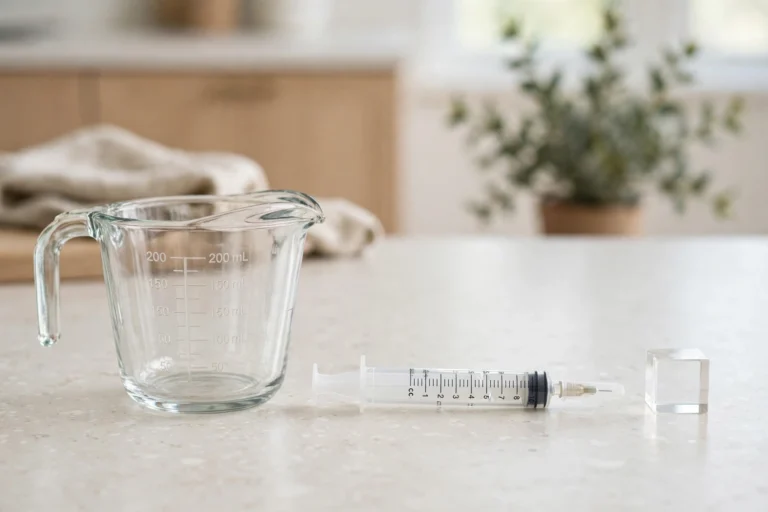
Measure small doses with a syringe, not a cap. A 5 mL syringe, marked in 0.1 mL steps, costs very little and is far more accurate than a bottle cap. For very small tanks, doses get tiny: a 12-liter nano tank at 1 mL per 20 liters needs only 0.6 mL. A syringe is the only way to measure that reliably.
Always dose for the water volume after a water change if you are replacing water, and dose for the full tank volume if you are treating the whole tank. Write the dose on the label with the volume, so you do not have to recalculate it every time.
Using Your Volume: Stocking Levels
The old rule of “1 cm of fish per liter” is a rough guide at best, and it breaks for large or messy fish. A better use of your volume is to think in terms of total adult size and waste. Small, slim fish such as neon tetras (about 3 cm adult) can be stocked more densely than the same length of goldfish, which produce far more waste.
As a starting guide for a filtered, cycled tropical community tank, allow about 1 cm of adult fish per 1 liter of real water volume for small slim fish such as neon tetras, about 1 cm per 1.5 liters for medium fish such as platies and corydoras, and about 1 cm per 3 liters or more for large or messy fish such as goldfish and cichlids — goldfish need far larger tanks than their size suggests, because they grow big and produce a lot of waste.
These are starting points. Filtration capacity, plants, feeding, and water-change frequency all move the real limit. Add fish gradually, a few at a time, and test the water for ammonia and nitrite before adding more. If either reads above zero, the tank is overstocked for its current filtration, whatever the volume calculation says.
Frequently Asked Questions
How many liters of water does a 60 cm fish tank hold?
A standard 60 × 30 × 30 cm tank holds 54 liters empty. Filled to a normal water line with substrate and decor, it holds about 45 to 48 liters of water.
How do I calculate my aquarium volume in liters?
Multiply the inside length, width, and water height in centimeters, then divide by 1,000. For example, 80 × 35 × 35 cm is 98 liters empty. Then subtract about 10 to 15 percent for substrate, decor, and the air gap.
How much water do I change in a 100-liter tank?
A 25 percent weekly change on 100 liters of real water is 25 liters. Measure it with a marked bucket rather than guessing.
Conclusion
Aquarium volume is a measurement, not a label. Multiply the inside dimensions in centimeters and divide by 1,000 to get the empty volume, then take off 10 to 20 percent for the air gap, substrate, and decor — or measure it directly with a counted bucket, which is the most accurate method of all. Write that real number on the tank.
Every dose, every water change, and every stocking decision follows from that one number. Get it right in liters, and your fish get the right amount of medicine, the right amount of clean water, and the right amount of space.