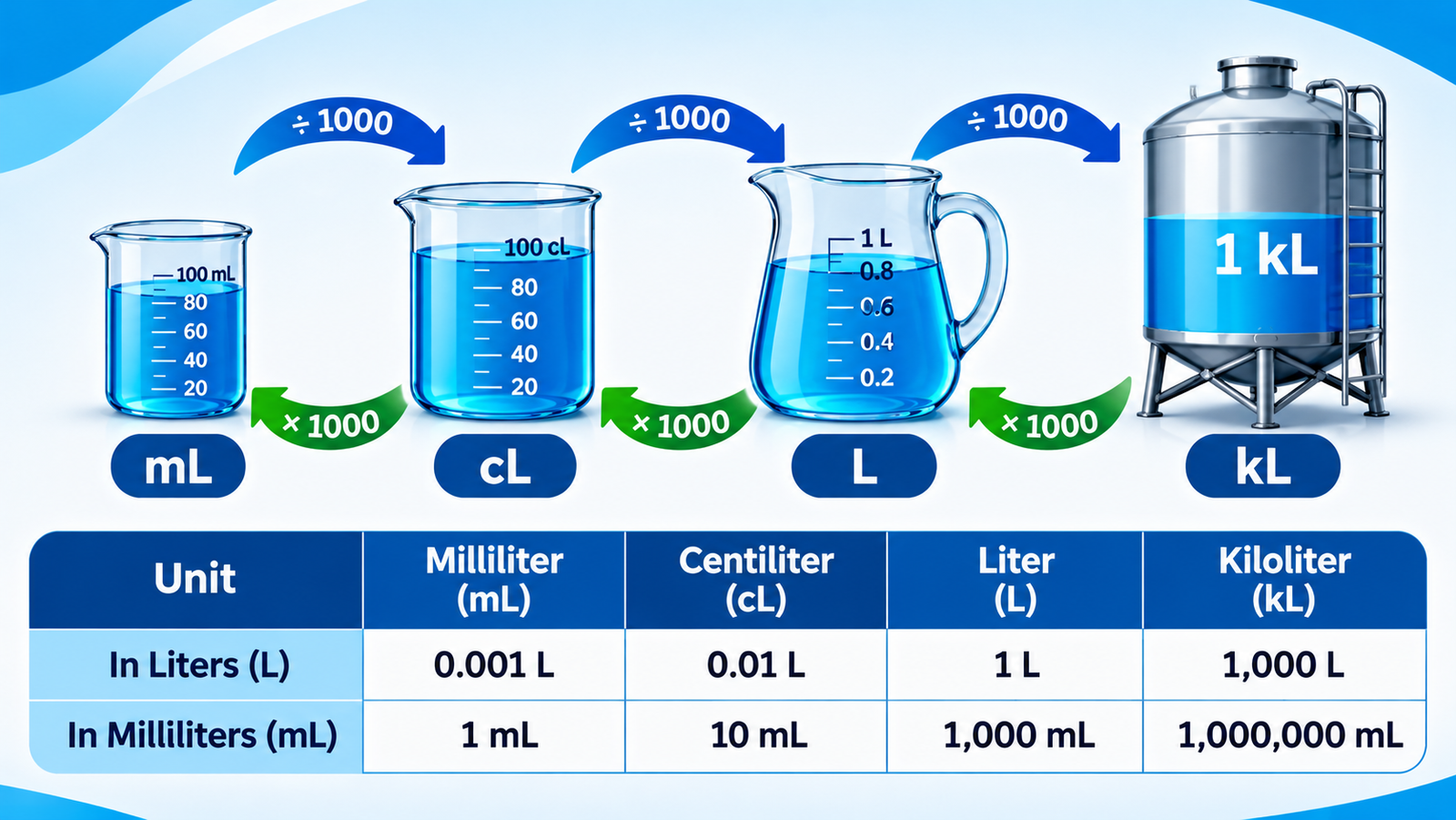
Metric Capacity Conversion Chart: mL, cL, L and kL
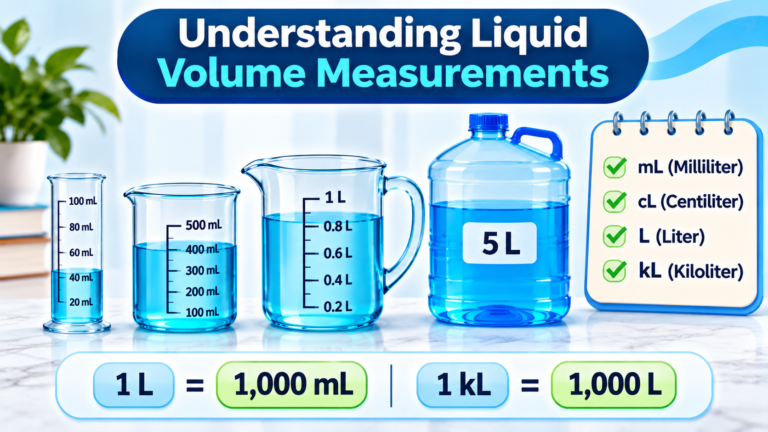
The metric system uses different units to measure liquid capacity. Four useful units are milliliters (mL), centiliters (cL), liters (L), and kiloliters (kL).
Each unit represents a different amount of liquid. A milliliter measures a small quantity, while a kiloliter measures a much larger amount.
A metric capacity conversion chart makes it easier to understand how these units relate to each other. It also helps you convert measurements without making calculation errors.
Quick conversion facts:
- 10 mL = 1 cL
- 100 cL = 1 L
- 1,000 mL = 1 L
- 1,000 L = 1 kL
Use the chart below as a quick reference before working through the conversion examples.
Metric Capacity Conversion Chart
The following table shows how milliliters, centiliters, liters, and kiloliters are related.
| Unit | Abbreviation | Equivalent in other units |
|---|---|---|
| Milliliter | mL | 1 mL = 0.1 cL = 0.001 L = 0.000001 kL |
| Centiliter | cL | 1 cL = 10 mL = 0.01 L = 0.00001 kL |
| Liter | L | 1 L = 100 cL = 1,000 mL = 0.001 kL |
| Kiloliter | kL | 1 kL = 100,000 cL = 1,000 L = 1,000,000 mL |
Quick Metric Capacity Reference
Remember these four important relationships:
1 liter:
1 L = 100 cL = 1,000 mL
1 kiloliter:
1 kL = 1,000 L = 100,000 cL = 1,000,000 mL
1 centiliter:
1 cL = 10 mL
1 milliliter:
1 mL = 0.001 L
These relationships form the basis of metric capacity conversions.
What Are Metric Units of Capacity?
Metric units of capacity measure how much liquid a container can hold. They are based on the metric system, which uses powers of 10 to connect different measurements.
A liter is a commonly used reference unit for everyday capacity measurements. Smaller and larger units are formed using metric prefixes.
Four useful units are milliliters, centiliters, liters, and kiloliters.
Milliliters (mL)
A milliliter is a small metric unit of capacity. The prefix milli- means one-thousandth.
One milliliter equals one-thousandth of a liter.
1 mL = 0.001 L
Milliliters are useful for measuring small amounts of liquid.
Examples include:
- Small amounts of medicine.
- Liquid ingredients in recipes.
- Perfume and cosmetic products.
- Small laboratory samples.
Centiliters (cL)
A centiliter is a metric unit equal to one-hundredth of a liter. The prefix centi- means one-hundredth.
1 cL = 0.01 L
One centiliter also equals 10 milliliters.
1 cL = 10 mL
Centiliters can be found in some drink labels, recipes, and liquid measurements. Milliliters and liters are more common in many everyday measurement situations.
Liters (L)
A liter is a standard everyday metric unit for measuring liquid capacity.
1 L = 1,000 mL
A liter also contains 100 centiliters.
1 L = 100 cL
Liters are useful for measuring larger amounts of liquid.
Examples include:
- Water bottles.
- Milk cartons.
- Fuel.
- Cooking liquids.
- Household containers.
Kiloliters (kL)
A kiloliter is a much larger metric unit of capacity.
The prefix kilo- means one thousand.
1 kL = 1,000 L
One kiloliter contains one thousand liters. It is useful when measuring large volumes of liquid.
Examples include:
- Large water storage tanks.
- Swimming pool capacity.
- Water supply systems.
- Industrial liquid storage.
A kiloliter is also equal to one cubic meter.
1 kL = 1 m³
How Are mL, cL, L and kL Related?
These four units are connected through fixed conversion factors.
Understanding their relationships makes it easier to convert measurements in both directions.
Milliliters to Centiliters
One centiliter contains 10 milliliters.
1 cL = 10 mL
To convert milliliters into centiliters, divide by 10.
Formula:
cL = mL ÷ 10
Example:
250 mL ÷ 10 = 25 cL
Therefore, 250 mL equals 25 cL.
Centiliters to Liters
One liter contains 100 centiliters.
1 L = 100 cL
To convert centiliters into liters, divide by 100.
Formula:
L = cL ÷ 100
Example:
350 cL ÷ 100 = 3.5 L
Therefore, 350 cL equals 3.5 L.
Liters to Kiloliters
One kiloliter contains 1,000 liters.
1 kL = 1,000 L
To convert liters into kiloliters, divide by 1,000.
Formula:
kL = L ÷ 1,000
Example:
2,500 L ÷ 1,000 = 2.5 kL
Therefore, 2,500 L equals 2.5 kL.
Complete Unit Relationship Table
| Conversion | Multiply by | Divide by |
|---|---|---|
| mL to cL | 0.1 | 10 |
| cL to mL | 10 | 0.1 |
| cL to L | 0.01 | 100 |
| L to cL | 100 | 0.01 |
| L to kL | 0.001 | 1,000 |
| kL to L | 1,000 | 0.001 |
| mL to L | 0.001 | 1,000 |
| L to mL | 1,000 | 0.001 |
| mL to kL | 0.000001 | 1,000,000 |
| kL to mL | 1,000,000 | 0.000001 |
The multiplication and division columns show equivalent operations. For example, dividing by 10 is the same as multiplying by 0.1.
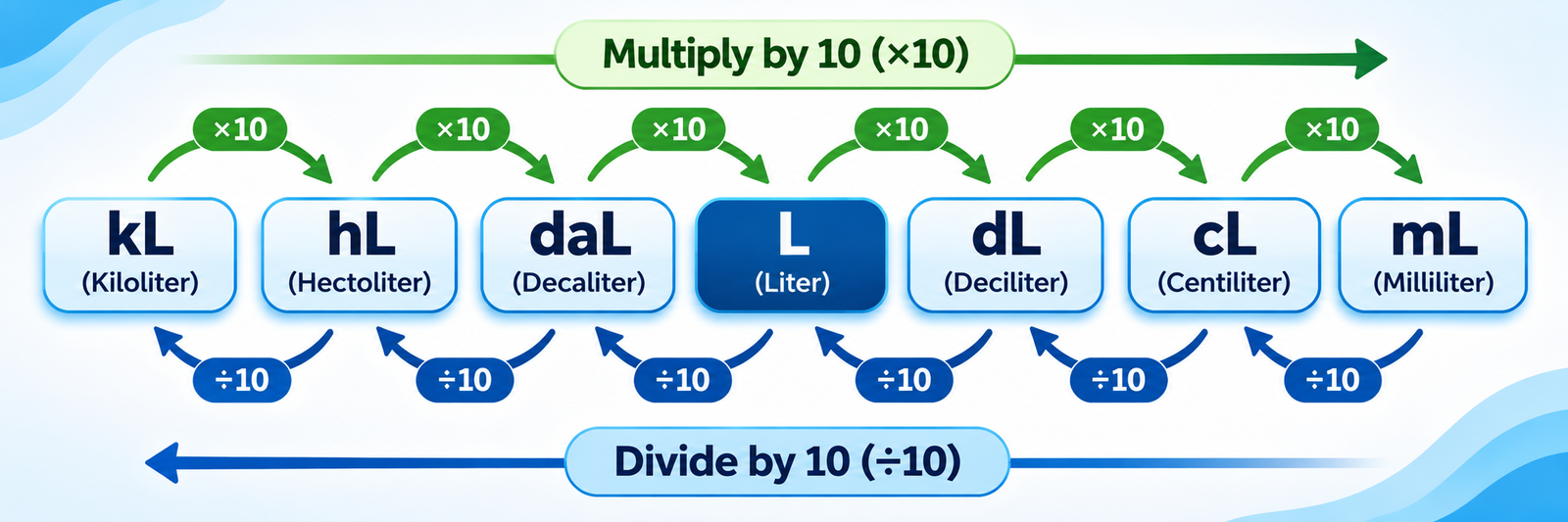
Metric Capacity Conversion Ladder
A metric conversion ladder helps you understand how units move from larger to smaller measurements.
The complete order of common metric capacity units is:
kL → hL → daL → L → dL → cL → mL
Each step changes the value by a factor of 10.
| Unit | Full name | Value in liters |
|---|---|---|
| kL | Kiloliter | 1,000 L |
| hL | Hectoliter | 100 L |
| daL | Decaliter | 10 L |
| L | Liter | 1 L |
| dL | Deciliter | 0.1 L |
| cL | Centiliter | 0.01 L |
| mL | Milliliter | 0.001 L |
Understanding the Metric Unit Order
The prefixes show the size of each unit compared with a liter.
- Kilo means 1,000.
- Hecto means 100.
- Deca means 10.
- The base unit is 1.
- Deci means one-tenth.
- Centi means one-hundredth.
- Milli means one-thousandth.
Moving one step to the right changes to a smaller unit. Moving one step to the left changes to a larger unit.
Moving from Larger Units to Smaller Units
Multiply by 10 for each step to the right.
For example, convert 3 L into mL.
Starting unit: L
Target unit: mL
The movement is:
L → dL → cL → mL
That is three steps.
3 × 10 × 10 × 10 = 3,000
Therefore:
3 L = 3,000 mL
Moving from Smaller Units to Larger Units
Divide by 10 for each step to the left.
For example, convert 750 mL into liters.
Starting unit: mL
Target unit: L
The movement is:
mL → cL → dL → L
That is three steps.
750 ÷ 10 ÷ 10 ÷ 10 = 0.75
Therefore:
750 mL = 0.75 L
How to Convert Between Metric Capacity Units
You can convert metric capacity measurements by using multiplication or division.
First, identify the starting unit. Then identify the unit you need. Finally, choose the correct conversion factor.
How to Convert mL to L
Divide the milliliter value by 1,000 to get liters.
Formula:
L = mL ÷ 1,000
Example:
4,500 mL ÷ 1,000 = 4.5 L
Therefore, 4,500 mL equals 4.5 L.
How to Convert mL to cL
Divide the milliliter value by 10.
Formula:
cL = mL ÷ 10
Example:
680 mL ÷ 10 = 68 cL
Therefore, 680 mL equals 68 cL.
How to Convert cL to L
Divide the centiliter value by 100.
Formula:
L = cL ÷ 100
Example:
425 cL ÷ 100 = 4.25 L
Therefore, 425 cL equals 4.25 L.
How to Convert L to kL
Divide the liter value by 1,000.
Formula:
kL = L ÷ 1,000
Example:
8,500 L ÷ 1,000 = 8.5 kL
Therefore, 8,500 L equals 8.5 kL.
How to Convert Between Non-Adjacent Units
Some conversions require more than one step.
You can use the full conversion ladder or convert through a common unit.
For example, to convert centiliters into kiloliters:
- Convert centiliters into liters by dividing by 100.
- Convert liters into kiloliters by dividing by 1,000.
The combined conversion factor is 100,000.
Formula:
kL = cL ÷ 100,000
Example:
250,000 cL ÷ 100,000 = 2.5 kL
Therefore, 250,000 cL equals 2.5 kL.
Another example is converting milliliters into kiloliters.
There are 1,000,000 milliliters in one kiloliter.
Formula:
kL = mL ÷ 1,000,000
Example:
3,500 mL ÷ 1,000,000 = 0.0035 kL
Therefore, 3,500 mL equals 0.0035 kL.
Worked Examples of Metric Capacity Conversions
The following examples show common conversions between milliliters, centiliters, liters, and kiloliters.
Example 1: Convert 1,000 mL to L
Given:
1,000 mL
Formula:
L = mL ÷ 1,000
Calculation:
1,000 ÷ 1,000 = 1
Answer: 1,000 mL = 1 L
Example 2: Convert 250 mL to cL
Given:
250 mL
Formula:
cL = mL ÷ 10
Calculation:
250 ÷ 10 = 25
Answer: 250 mL = 25 cL
Example 3: Convert 5 L to mL
Given:
5 L
Formula:
mL = L × 1,000
Calculation:
5 × 1,000 = 5,000
Answer: 5 L = 5,000 mL
Example 4: Convert 2 L to kL
Given:
2 L
Formula:
kL = L ÷ 1,000
Calculation:
2 ÷ 1,000 = 0.002
Answer: 2 L = 0.002 kL
Example 5: Convert 3,500 mL to kL
Given:
3,500 mL
Formula:
kL = mL ÷ 1,000,000
Calculation:
3,500 ÷ 1,000,000 = 0.0035
Answer: 3,500 mL = 0.0035 kL
Example 6: Convert 4.5 kL to L
Given:
4.5 kL
Formula:
L = kL × 1,000
Calculation:
4.5 × 1,000 = 4,500
Answer: 4.5 kL = 4,500 L
Everyday Applications of Metric Capacity Units
Different metric units are useful for different amounts of liquid.
Choosing the right unit makes measurements easier to read and compare.
| Everyday situation | Suitable unit | Example |
|---|---|---|
| Small medicine dose | mL | 5 mL |
| Liquid recipe ingredient | mL or cL | 250 mL |
| Drink bottle | L | 1.5 L |
| Milk container | L | 2 L |
| Large water tank | kL | 5 kL |
| Swimming pool capacity | kL | 50 kL |
These examples show how metric capacity units work in everyday situations. The most suitable unit depends on the amount being measured.
Common Metric Capacity Conversion Mistakes
Students sometimes make errors when converting between metric capacity units. Understanding these mistakes can help prevent incorrect answers.
Using the Wrong Conversion Factor
Not every conversion uses the same number.
For example:
- mL to cL: divide by 10.
- cL to L: divide by 100.
- L to kL: divide by 1,000.
Always identify both units before calculating.
Multiplying Instead of Dividing
When converting to a larger unit, divide the starting value.
For example:
2,000 mL ÷ 1,000 = 2 L.
Do not multiply 2,000 by 1,000.
Dividing Instead of Multiplying
When converting to a smaller unit, multiply the starting value.
For example:
3 L × 1,000 = 3,000 mL.
Moving the Decimal Point the Wrong Way
Moving to a larger unit makes the numerical value smaller. Moving to a smaller unit makes it larger.
For example:
- 500 mL = 0.5 L.
- 0.5 L = 500 mL.
Forgetting the Unit
Always write the correct abbreviation after the answer.
For example, 2.5 is incomplete. Write 2.5 L or 2.5 kL, depending on the question.
Printable Metric Capacity Conversion Chart
Use this reference table when solving metric capacity questions or reviewing unit relationships.
| Kiloliters (kL) | Liters (L) | Centiliters (cL) | Milliliters (mL) |
|---|---|---|---|
| 0.001 | 1 | 100 | 1,000 |
| 0.01 | 10 | 1,000 | 10,000 |
| 0.1 | 100 | 10,000 | 100,000 |
| 1 | 1,000 | 100,000 | 1,000,000 |
| 2 | 2,000 | 200,000 | 2,000,000 |
| 5 | 5,000 | 500,000 | 5,000,000 |
The table shows equivalent amounts in each unit. You can print this page using your browser’s print option and keep it as a study reference.
Metric Capacity Conversion Practice Questions
Test your understanding with these original practice questions.
Try to solve each question before looking at the answers.
- Convert 75 mL into cL.
- Convert 640 cL into L.
- Convert 2.75 L into cL.
- Convert 0.008 kL into L.
- Convert 125,000 mL into kL.
- Convert 3.2 kL into mL.
- Convert 0.45 L into mL.
- Convert 4,500 cL into kL.
Practice Question Answers
| Question | Calculation | Answer |
|---|---|---|
| 1 | 75 ÷ 10 | 7.5 cL |
| 2 | 640 ÷ 100 | 6.4 L |
| 3 | 2.75 × 100 | 275 cL |
| 4 | 0.008 × 1,000 | 8 L |
| 5 | 125,000 ÷ 1,000,000 | 0.125 kL |
| 6 | 3.2 × 1,000,000 | 3,200,000 mL |
| 7 | 0.45 × 1,000 | 450 mL |
| 8 | 4,500 ÷ 100,000 | 0.045 kL |
Check each answer by converting it back into the original unit. The result should match the starting measurement.
Frequently Asked Questions About Metric Capacity Units
What are metric capacity units?
Metric capacity units measure how much liquid a container can hold. Common units include milliliters, centiliters, liters, and kiloliters. Each unit represents a different amount of liquid.
How many milliliters are in a liter?
There are exactly 1,000 milliliters in one liter.
1 L = 1,000 mL
How many liters are in a kiloliter?
One kiloliter contains 1,000 liters.
1 kL = 1,000 L
How many centiliters are in a liter?
There are 100 centiliters in one liter.
1 L = 100 cL
How do you convert mL to kL?
Divide the milliliter measurement by 1,000,000 to get kiloliters.
Formula:
kL = mL ÷ 1,000,000
For example:
500,000 mL ÷ 1,000,000 = 0.5 kL.
How many milliliters are in a kiloliter?
One kiloliter contains 1,000,000 milliliters.
1 kL = 1,000,000 mL
Which unit is best for measuring large liquid volumes?
Kiloliters are useful for measuring large liquid volumes. They are commonly suitable for describing the capacity of large storage tanks, swimming pools, and water supply systems.
Is a centiliter bigger than a milliliter?
Yes. One centiliter is equal to 10 milliliters.
1 cL = 10 mL
What is the difference between capacity and volume?
Capacity describes how much a container can hold. Volume describes the three-dimensional space occupied by an object or substance.
Both terms are often used when discussing liquid measurements.
Explore More Metric Conversions
Understanding metric capacity becomes easier when you practise with different units and examples.
Use our mL to L conversion calculator to convert milliliters into liters and check your calculations.
You can also explore our mL to L conversion worksheets for additional practice with measurement questions and answer keys.