How to Convert Liters to Kiloliters
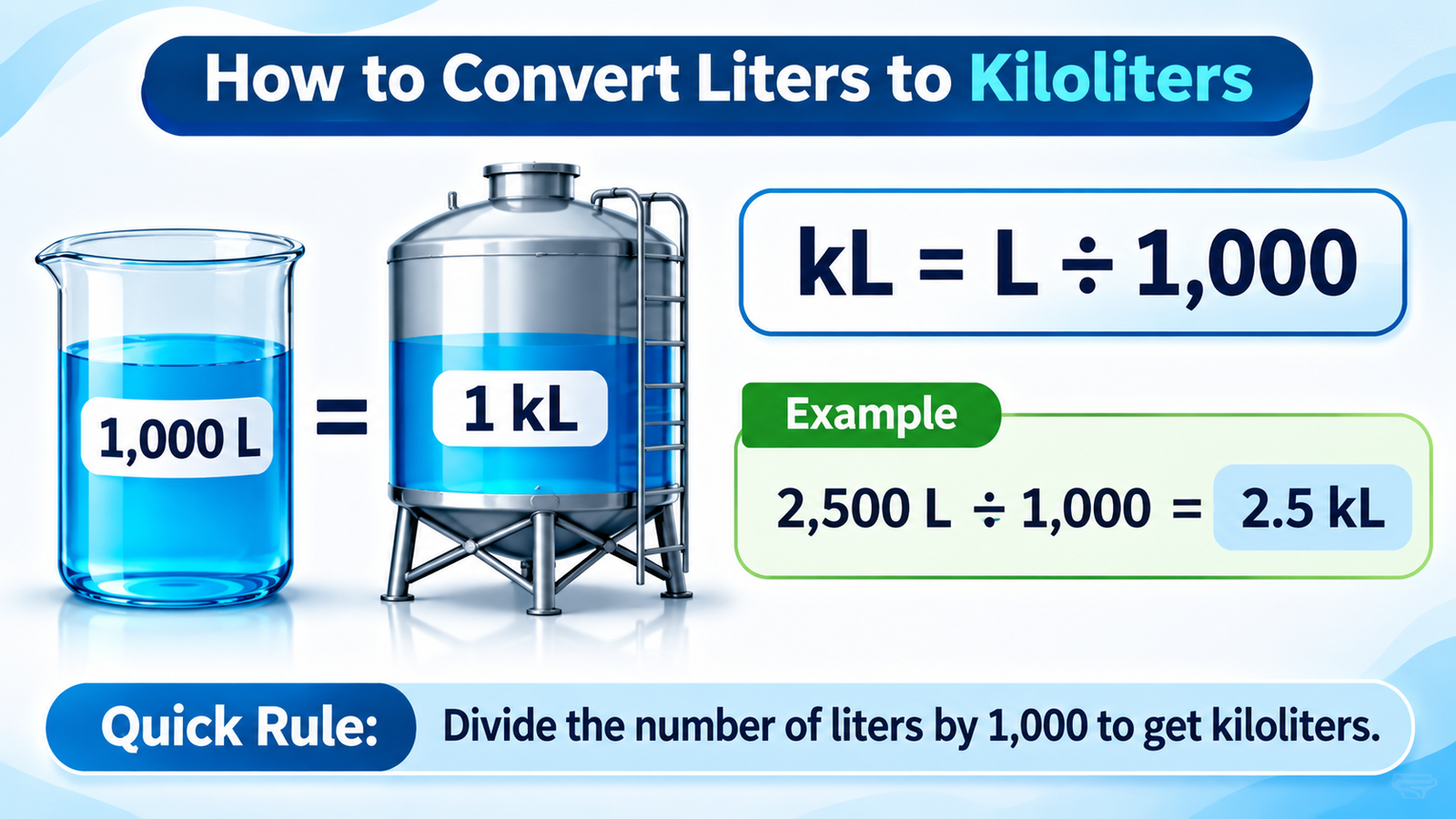
Converting liters to kiloliters is simple when you know the correct conversion factor. One kiloliter contains 1,000 liters. Therefore, you divide the number of liters by 1,000 to get kiloliters.
For example, 350 liters equals 0.35 kiloliters.
This guide explains the liters to kiloliters conversion formula, shows step-by-step examples, and provides a reference table. You will also learn how to convert kiloliters back into liters.
Quick conversion facts:
- 1 kL = 1,000 L
- 1 L = 0.001 kL
- L to kL: Divide by 1,000.
- kL to L: Multiply by 1,000.
How Many Liters Are in One Kiloliter?
There are exactly 1,000 liters in one kiloliter.
1 kL = 1,000 L
A kiloliter is a larger metric unit used to measure liquid capacity and volume. A liter is a smaller unit used for everyday measurements.
For example:
- 1,000 L = 1 kL
- 2,000 L = 2 kL
- 5,000 L = 5 kL
- 10,000 L = 10 kL
You can use this relationship whenever you need to convert a liter measurement into kiloliters.
Liter to Kiloliter Converter
Convert liters to kiloliters instantly with this free conversion calculator.
Quick Conversion Examples
1 kiloliter (kL) = 1,000 liters (L)
What Are Liters and Kiloliters?
Liters and kiloliters are metric units used to measure liquid capacity and volume. They belong to the same measurement system, but they represent different amounts.
What Is a Liter (L)?
A liter is a metric unit commonly used to measure liquids. Its symbol is L.
Liters are useful for measuring everyday quantities of liquid.
Common examples include:
- Drinking water.
- Milk and juice.
- Cooking ingredients.
- Fuel.
- Household liquid containers.
For example, a water container with a capacity of 20 liters can hold 20 L of water.
What Is a Kiloliter (kL)?
A kiloliter is a larger metric unit equal to 1,000 liters. Its symbol is kL.
The prefix kilo- means one thousand.
Kiloliters are useful when measuring large amounts of liquid. They help express large values without writing many digits.
Common examples include:
- Water storage tanks.
- Swimming pools.
- Large liquid containers.
- Water supply systems.
- Industrial liquid storage.
For example, a tank with a capacity of 5,000 L has a capacity of 5 kL.
Liters to Kiloliters Conversion Formula
The liters to kiloliters conversion formula is simple.
Formula:
kL = L ÷ 1,000
You can also multiply the liter value by 0.001.
Equivalent formula:
kL = L × 0.001
Both formulas give the same result.
Why Do You Divide by 1,000?
A kiloliter is 1,000 times larger than a liter. Therefore, the numerical value becomes smaller when you convert liters into kiloliters.
For example:
3,000 L ÷ 1,000 = 3 kL
The original amount is still the same. Only the measurement unit changes.
Decimal Point Rule
You can also move the decimal point three places to the left.
For example:
350.0 → 0.350
Therefore:
350 L = 0.35 kL
This shortcut works because dividing by 1,000 is equivalent to moving the decimal point three places to the left.
How to Convert L to kL Step by Step
Follow these three steps to convert liters into kiloliters.
Step 1: Identify the starting value.
Find the number of liters given in the question.
Example: 750 L.
Step 2: Divide the value by 1,000.
750 ÷ 1,000 = 0.75
Step 3: Write the correct unit.
The result is measured in kiloliters.
Final answer: 750 L = 0.75 kL
Always include the correct unit after your calculation.
Liters to Kiloliters Worked Examples
The following examples show how to convert different liter measurements into kiloliters.
Example 1: Convert 100 L to kL
Given: 100 L
Formula:
kL = L ÷ 1,000
Calculation:
100 ÷ 1,000 = 0.1
Answer: 100 L = 0.1 kL
Example 2: Convert 350 L to kL
Given: 350 L
Formula:
kL = L ÷ 1,000
Calculation:
350 ÷ 1,000 = 0.35
Answer: 350 L = 0.35 kL
Example 3: Convert 500 L to kL
Given: 500 L
Formula:
kL = L ÷ 1,000
Calculation:
500 ÷ 1,000 = 0.5
Answer: 500 L = 0.5 kL
Example 4: Convert 750 L to kL
Given: 750 L
Formula:
kL = L ÷ 1,000
Calculation:
750 ÷ 1,000 = 0.75
Answer: 750 L = 0.75 kL
Example 5: Convert 1,000 L to kL
Given: 1,000 L
Formula:
kL = L ÷ 1,000
Calculation:
1,000 ÷ 1,000 = 1
Answer: 1,000 L = 1 kL
Example 6: Convert 2,500 L to kL
Given: 2,500 L
Formula:
kL = L ÷ 1,000
Calculation:
2,500 ÷ 1,000 = 2.5
Answer: 2,500 L = 2.5 kL
How to Convert Kiloliters to Liters
Converting kiloliters back into liters uses the opposite operation.
Since one kiloliter contains 1,000 liters, multiply the kiloliter value by 1,000.
kL to L Conversion Formula
Formula:
L = kL × 1,000
For example, if a water tank holds 2.5 kL, multiply 2.5 by 1,000.
2.5 × 1,000 = 2,500
Answer: 2.5 kL = 2,500 L
Reverse Conversion Examples
Example 1: Convert 0.5 kL to L
Given: 0.5 kL
Calculation:
0.5 × 1,000 = 500
Answer: 0.5 kL = 500 L
Example 2: Convert 1.25 kL to L
Given: 1.25 kL
Calculation:
1.25 × 1,000 = 1,250
Answer: 1.25 kL = 1,250 L
The reverse formula is useful when a large liquid measurement needs to be expressed in liters.
Liters to Kiloliters Conversion Table
Use this table to find the kiloliter equivalent of common liter measurements.
| Liters (L) | Kiloliters (kL) |
|---|---|
| 1 L | 0.001 kL |
| 10 L | 0.01 kL |
| 25 L | 0.025 kL |
| 50 L | 0.05 kL |
| 75 L | 0.075 kL |
| 100 L | 0.1 kL |
| 200 L | 0.2 kL |
| 250 L | 0.25 kL |
| 350 L | 0.35 kL |
| 400 L | 0.4 kL |
| 500 L | 0.5 kL |
| 600 L | 0.6 kL |
| 750 L | 0.75 kL |
| 800 L | 0.8 kL |
| 900 L | 0.9 kL |
| 1,000 L | 1 kL |
| 1,500 L | 1.5 kL |
| 2,000 L | 2 kL |
| 2,500 L | 2.5 kL |
| 5,000 L | 5 kL |
| 10,000 L | 10 kL |
Quick Reference: L to kL and kL to L
| Starting value | Conversion | Result |
|---|---|---|
| 100 L | ÷ 1,000 | 0.1 kL |
| 350 L | ÷ 1,000 | 0.35 kL |
| 500 L | ÷ 1,000 | 0.5 kL |
| 1,000 L | ÷ 1,000 | 1 kL |
| 2 kL | × 1,000 | 2,000 L |
| 5 kL | × 1,000 | 5,000 L |
Real-Life Uses of Kiloliters
Kiloliters make it easier to express large amounts of liquid. Instead of writing thousands of liters, you can use a smaller numerical value.
Water Storage Tanks
Large water tanks can hold hundreds or thousands of liters.
For example, a tank with a capacity of 2,500 L can also be described as 2.5 kL.
This makes large storage measurements easier to read.
Swimming Pools
Swimming pools can hold large amounts of water. Kiloliters are useful for expressing their capacity.
For example, a pool holding 50,000 L contains 50 kL of water.
Large Liquid Containers
Factories and storage facilities may use large containers to store liquids.
A container holding 8,000 L has a capacity of 8 kL.
Water Supply Measurements
Water supply systems may record large amounts of water in kiloliters.
For example, a supply of 12,000 L can be expressed as 12 kL.
Industrial Liquid Storage
Industrial facilities may store water or other liquids in large tanks.
If a storage tank holds 15,000 L, its capacity is 15 kL.
These are illustrative examples. The most suitable unit depends on the amount being measured and the way the information needs to be reported.
Common L to kL Conversion Mistakes
Students can make simple errors when converting liters into kiloliters. Understanding these mistakes makes calculations easier.
Multiplying Instead of Dividing
To convert liters into kiloliters, you must divide by 1,000.
Incorrect:
350 × 1,000 = 350,000
Correct:
350 ÷ 1,000 = 0.35 kL
Dividing by the Wrong Number
Remember that one kiloliter contains exactly 1,000 liters.
Do not divide by 10 or 100 when converting L to kL.
Moving the Decimal in the Wrong Direction
When converting liters into kiloliters, move the decimal point three places to the left.
For example:
750.0 → 0.750
Therefore:
750 L = 0.75 kL
Forgetting the Unit
A numerical answer without a unit is incomplete.
Instead of writing 0.35, write 0.35 kL.
This makes the final measurement clear.
How to Check Your Conversion
You can check an L to kL answer by converting it back into liters.
For example, suppose you convert 350 L into kiloliters.
First calculation:
350 ÷ 1,000 = 0.35 kL
Now convert the result back into liters:
0.35 × 1,000 = 350 L
The result matches the original value.
Therefore, the conversion is correct.
This reverse-check method works for any liters-to-kiloliters calculation.
L to kL Conversion Practice Questions
Try these questions to test your understanding of liters and kiloliters.
Use the formula:
kL = L ÷ 1,000
- Convert 250 L to kL.
- Convert 625 L to kL.
- Convert 1,500 L to kL.
- Convert 3,800 L to kL.
- Convert 0.75 kL to L.
- Convert 2.5 kL to L.
- Convert 4,500 L to kL.
- Convert 6.25 kL to L.
Practice Question Answers
| Question | Calculation | Answer |
|---|---|---|
| 1 | 250 ÷ 1,000 | 0.25 kL |
| 2 | 625 ÷ 1,000 | 0.625 kL |
| 3 | 1,500 ÷ 1,000 | 1.5 kL |
| 4 | 3,800 ÷ 1,000 | 3.8 kL |
| 5 | 0.75 × 1,000 | 750 L |
| 6 | 2.5 × 1,000 | 2,500 L |
| 7 | 4,500 ÷ 1,000 | 4.5 kL |
| 8 | 6.25 × 1,000 | 6,250 L |
Check your answers by applying the reverse conversion formula. This will help you identify calculation errors.
Frequently Asked Questions About L to kL Conversion
How many liters are in one kiloliter?
One kiloliter contains exactly 1,000 liters.
1 kL = 1,000 L.
How do you convert liters to kiloliters?
Divide the number of liters by 1,000 to convert it into kiloliters.
For example:
500 L ÷ 1,000 = 0.5 kL.
What is the formula for L to kL?
The formula is:
kL = L ÷ 1,000.
You can also multiply the liter value by 0.001.
How do you convert kL back to L?
Multiply the kiloliter value by 1,000.
For example:
1.25 kL × 1,000 = 1,250 L.
What is 350 L in kL?
350 liters equals 0.35 kiloliters.
Calculation:
350 ÷ 1,000 = 0.35 kL.
What is 500 L in kL?
500 liters equals 0.5 kiloliters.
Calculation:
500 ÷ 1,000 = 0.5 kL.
When is a kiloliter used?
A kiloliter is useful for measuring large amounts of liquid. It can describe the capacity of water tanks, swimming pools, and industrial liquid storage containers.
Is 1 L equal to 0.001 kL?
Yes. One liter equals 0.001 kiloliters.
This is because 1,000 liters make one kiloliter.
Is a kiloliter bigger than a liter?
Yes. A kiloliter is 1,000 times larger than a liter.
1 kL = 1,000 L.
Explore More Metric Conversions
Understanding metric units becomes easier when you practise different conversion methods.
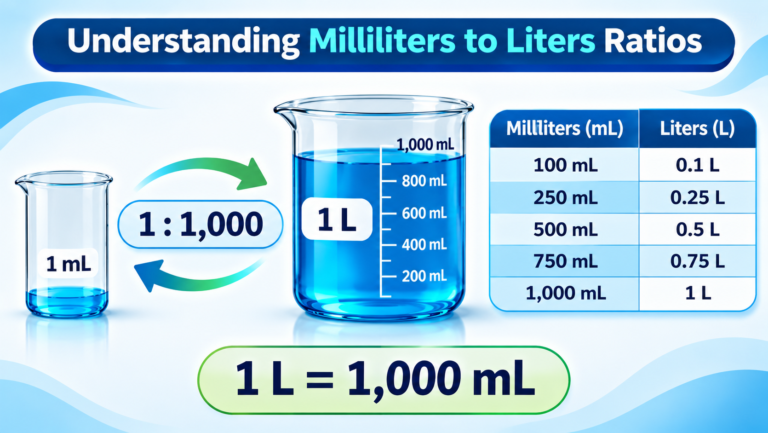
Use our mL to L conversion calculator to convert milliliters into liters and check your calculations.
For a broader explanation of metric capacity units, explore our metric capacity conversion chart covering milliliters, centiliters, liters, and kiloliters.