Daily Water Intake Guide: Tracking Hydration in mL and Liters
How much water should you drink in a day? You have probably heard “eight glasses,” but that simple rule hides a lot of detail. Your real target depends on your body size, the weather, how active you are, and how much water you get from food. This guide works it out in milliliters and liters, so you can track it with an ordinary bottle instead of guessing.
The Short Answer: About 2 to 3 Liters a Day
For most healthy adults, total daily water intake — from drinks and food together — lands around 2.7 liters for women and 3.7 liters for men, according to the U.S. National Academies’ adequate intake figures. That is 2,700 mL and 3,700 mL. About 20 percent of that usually comes from food, especially fruit, vegetables, soups, and yogurt, so the amount you need to actually drink is roughly 2.2 liters (2,200 mL) for women and 3 liters (3,000 mL) for men on an ordinary day.
That is the starting point, not a prescription. A small person sitting in an air-conditioned office in winter needs less than a large person working outdoors in summer. The rest of this guide shows you how to adjust the number to your own day — and how to track it without thinking about it all day.
Why the “Eight Glasses” Rule Is Only Half Right
Eight glasses of 250 mL is 2 liters (2,000 mL). That is a reasonable floor for many adults, and it is easy to remember, which is why it survives. But it ignores three things.
First, a “glass” is not a standard size. A small tumbler holds 200 mL, a large one 350 mL, and a mug can hold 400 mL. Eight mugs is 3.2 liters — a very different day from eight small glasses at 1.6 liters. If you track in milliliters, the confusion disappears.
Second, food counts. A day with watermelon, cucumber, soup, and tea is not the same as a day of dry bread and coffee. On average, food supplies around 500 to 700 mL of water a day, but on a soup-and-salad day it can be closer to 1 liter.
Third, your losses change. You lose water through urine, sweat, breathing, and even through your skin. Hot weather, exercise, a fever, or a long flight all raise those losses, and your intake has to rise to match.
So keep the eight-glass idea as a habit, but measure your real intake in milliliters and adjust it to the day you are actually having.
How to Work Out Your Own Target
A practical way to estimate your drinking target is to start from body weight. A commonly used rule of thumb is 30 to 35 mL of water per kilogram of body weight per day, from all drinks. For a 70 kg adult, that is 2,100 to 2,450 mL of drinks a day. For a 55 kg adult, it is 1,650 to 1,925 mL. For a 90 kg adult, it is 2,700 to 3,150 mL.
| Body weight | Drinks target (30 mL/kg) | Drinks target (35 mL/kg) |
|---|---|---|
| 50 kg | 1,500 mL (1.5 L) | 1,750 mL (1.75 L) |
| 60 kg | 1,800 mL (1.8 L) | 2,100 mL (2.1 L) |
| 70 kg | 2,100 mL (2.1 L) | 2,450 mL (2.45 L) |
| 80 kg | 2,400 mL (2.4 L) | 2,800 mL (2.8 L) |
| 90 kg | 2,700 mL (2.7 L) | 3,150 mL (3.15 L) |
| 100 kg | 3,000 mL (3.0 L) | 3,500 mL (3.5 L) |
This table gives you a personal baseline. Then adjust it for the day:
- Hot weather or a heated room: add 500 mL to 1 liter.
- Exercise: add about 500 mL per hour of moderate exercise, and more for an hour of hard sweating. A good check is to weigh yourself before and after a long workout: each 500 grams lost is roughly 500 mL of fluid to replace, plus a little extra.
- Illness with fever, vomiting, or diarrhea: losses rise sharply — replace fluids steadily in small sips, and seek medical advice if you cannot keep fluids down.
- High altitude or a long flight: dry air increases water lost through breathing. Add an extra 500 mL on a travel day and sip regularly rather than drinking a liter at once.
- Pregnancy and breastfeeding: needs rise. Pregnant women are generally advised to aim for about 2.3 liters of total water a day, and breastfeeding women about 3.1 liters — and to drink to thirst on top of that.
These are general guides for healthy adults. If you have kidney disease, heart failure, or you take medication that affects fluid balance, your doctor may set a very different target — follow that instead.
What Counts Toward Your Total?
Almost every drink counts. Water is the simplest, but tea, coffee, milk, juice, and soft drinks all contribute fluid. The old idea that coffee dehydrates you is overstated: caffeine is a mild diuretic, but a cup of coffee still leaves you with a net gain of fluid. A 250 mL cup of coffee counts as roughly 200 to 250 mL toward your day, not zero.
Food counts too, and some foods count a lot. Alcohol is the exception. It increases urine output, so a 330 mL beer does not hydrate you the way 330 mL of water does — and a night of drinking is one of the fastest ways to wake up dehydrated. If you drink alcohol, add a glass of water between drinks and another before bed.
How to Track It Without an App
You do not need a tracking app, though one can help for a week while you learn your pattern. The simplest system is a bottle with a known size.
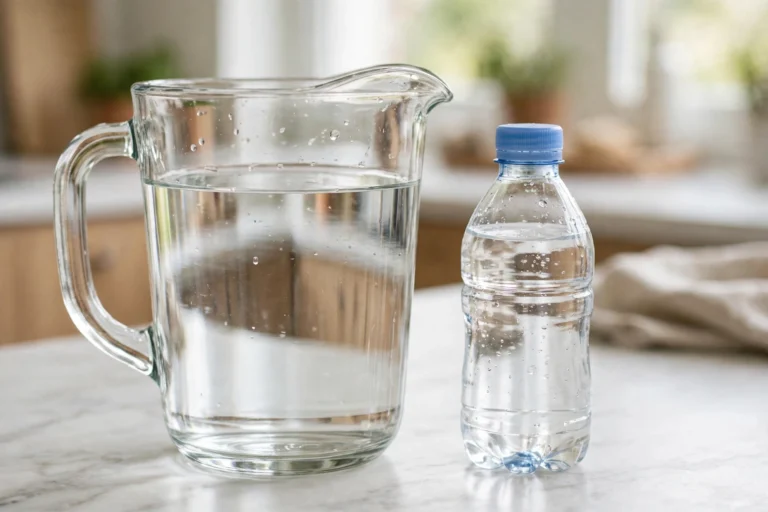
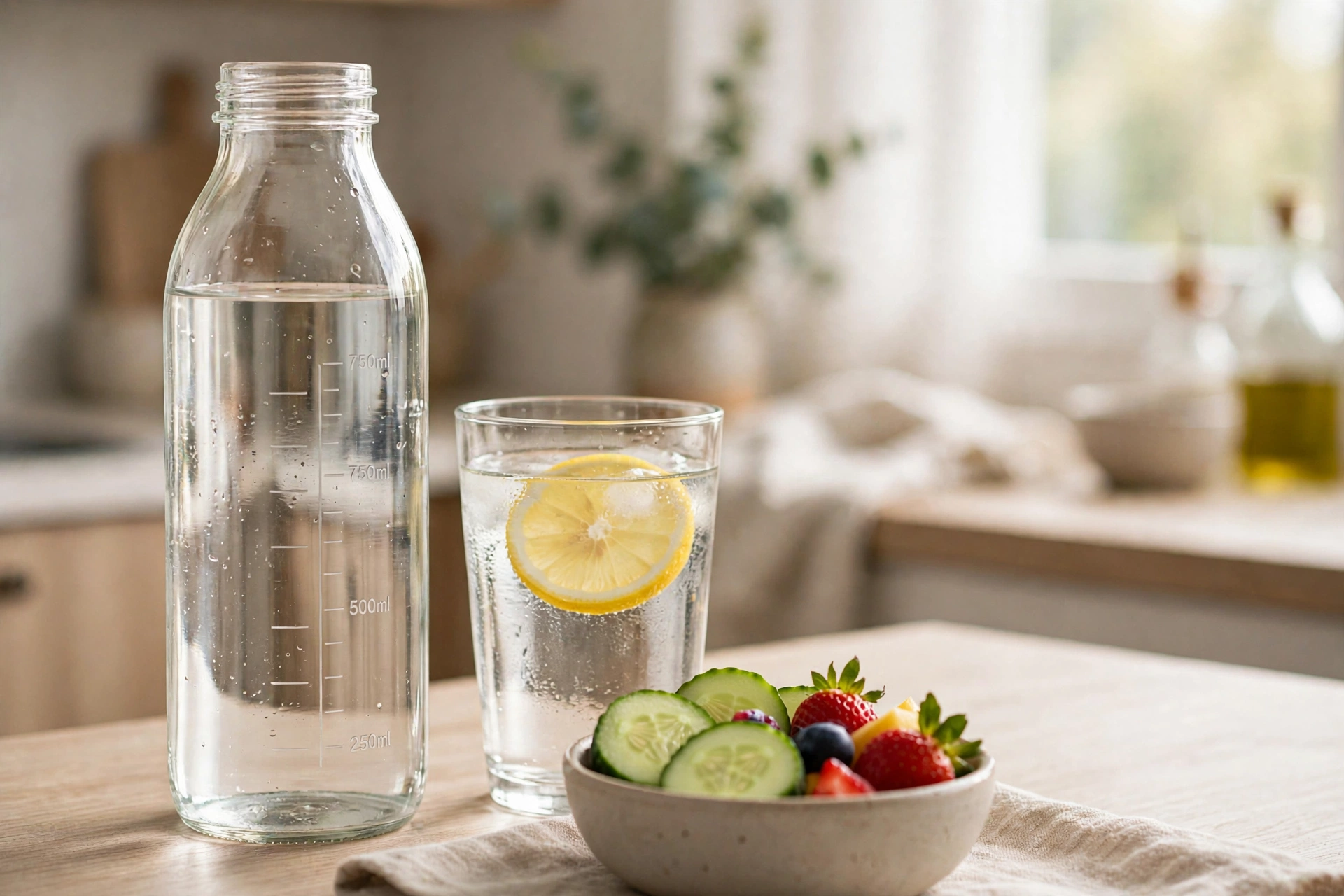
Pick a bottle and learn its volume. A standard small bottle is 500 mL, a large one is 1 liter, and many reusable bottles are 750 mL. Then count refills:
- Target 2 liters: four 500 mL bottles, or two 1-liter bottles.
- Target 2.5 liters: five 500 mL bottles, or two 1-liter bottles plus one 500 mL bottle.
- Target 3 liters: six 500 mL bottles, or three 1-liter bottles.
Some people fill a 2-liter jug in the morning and aim to finish it by evening — whatever is left at bedtime is what they missed.
Spread the drinking through the day. Your body absorbs water best in steady amounts. A glass (250 mL) with each meal, one mid-morning, one mid-afternoon, and one in the evening gets most people to 1.5 liters before counting anything else. Gulping a liter at once after forgetting all day is less effective and will just send you to the bathroom.
Are You Drinking Enough? The Simple Checks
The most useful check is the color of your urine. Pale straw yellow means you are well hydrated. Dark yellow means drink more. Completely clear every time can mean you are drinking more than you need — not dangerous for most people, but a sign to ease off a little.
Thirst is a reasonable guide for most healthy adults, but it is a late signal. By the time you feel properly thirsty, you are already mildly dehydrated. Older adults feel thirst less reliably, so a routine — a glass with every meal and one between meals — matters more with age.
A Worked Example: A Day at 2.5 Liters
Here is what a 2,500 mL drinking day can look like for a 70 kg office worker: a 250 mL glass on waking, a mug of tea with breakfast, a 500 mL bottle at the desk by late morning, a glass with lunch plus soup, another 500 mL bottle in the afternoon, a glass with dinner, and a final glass in the evening — with about 250 mL from snacks and fruit through the day. Nothing in that day is heroic — it is just a glass or a bottle at each natural break.
Frequently Asked Questions
How many mL of water should I drink a day?
Most healthy adults need about 2,200 to 3,000 mL of drinks a day, plus 500 to 700 mL from food — roughly 2.7 liters total for women and 3.7 liters for men. A good personal estimate is 30 to 35 mL per kilogram of body weight from drinks.
Does tea and coffee count as water intake?
Yes. Tea and coffee contribute almost as much fluid as the same volume of water. Caffeine is only mildly diuretic, so a mug of tea counts at nearly full value.
How do I know if I am dehydrated?
Pale straw-colored urine, steady energy, and no strong thirst are good signs. Dark yellow urine, a headache, dry mouth, and tiredness suggest you need more fluid.
Conclusion
Your daily water target is not a mystery number. Start with 30 to 35 mL per kilogram of body weight from drinks — about 2.1 to 2.5 liters for a 70 kg adult — then add 500 mL for heat or an hour of exercise, and count the 500 mL or so that food gives you on top. Track it with a bottle you know the size of: four 500 mL bottles is 2 liters, six is 3 liters, and the count is honest in a way “eight glasses” never is.
Spread it through the day, let pale yellow urine confirm you are on track, and adjust for the day you are actually having. Hydration is a daily habit measured in milliliters, not a rule you memorize once.