5 Common Mistakes People Make When Converting mL to Liters
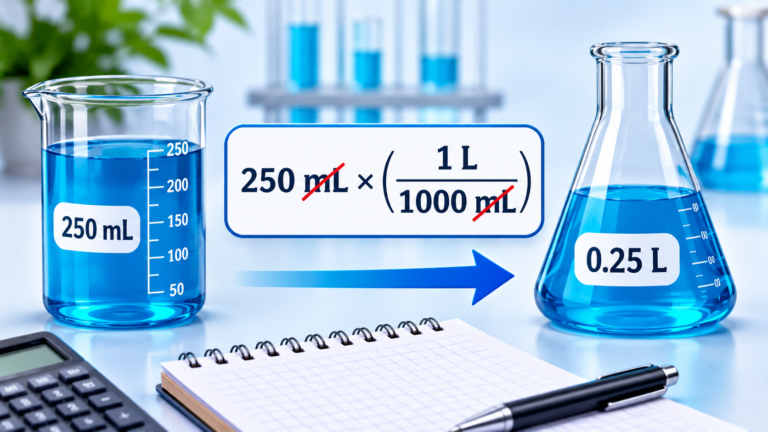
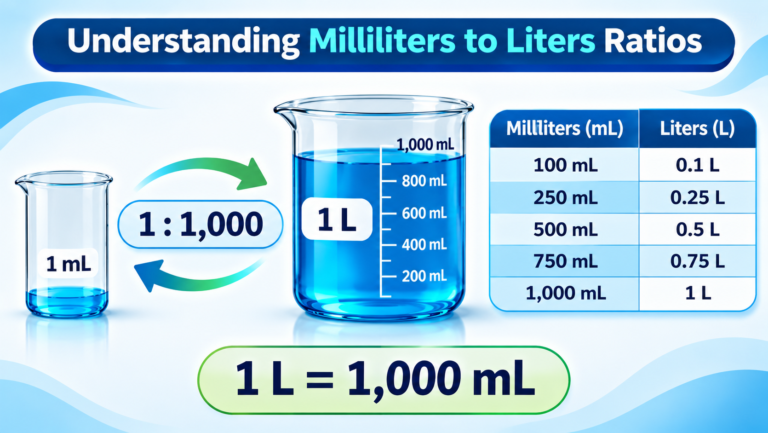
Converting milliliters to liters is one of the simplest calculations you will ever do in a kitchen, a classroom, or a pharmacy. The rule never changes: 1 liter equals 1,000 milliliters, so you divide by 1,000. And yet people get it wrong all the time.
The problem is rarely the math. It is the small habits that creep in when you are in a hurry: a decimal point that drifts the wrong way, a 100 where a 1,000 should be, or a unit that looks almost identical to the one you need.
The good news is that ml to l conversion mistakes follow a pattern. The same five errors show up again and again. In this guide, we walk through each one with a real example and show you how to fix it.
Mistake 1: Moving the Decimal Point the Wrong Way
People remember the trick but forget the direction. To convert mL to L, move the decimal point three places to the left. Move it right instead, and 750 mL of milk becomes 750,000 L, roughly the volume of a small swimming pool.
Both directions feel like the same move: your hand remembers “three places” and forgets “left.” The error is not small, either: it makes your answer wrong by a factor of one million.
Here is the fix. Ask yourself: should the number get bigger or smaller? A liter is a much bigger unit than a milliliter, so the number must always get smaller going from mL to L. If your answer is bigger than the number you started with, you moved the decimal the wrong way.
Try it with 2,500 mL: moving left three places gives 2.5 L, and 2.5 is smaller than 2,500, so it passes the test.
Mistake 2: Dividing by 100 Instead of 1000
We divide by 100 constantly: percentages, centimeters to meters, cents to dollars. Your brain reaches for 100 out of habit, and the answer comes out ten times too big.
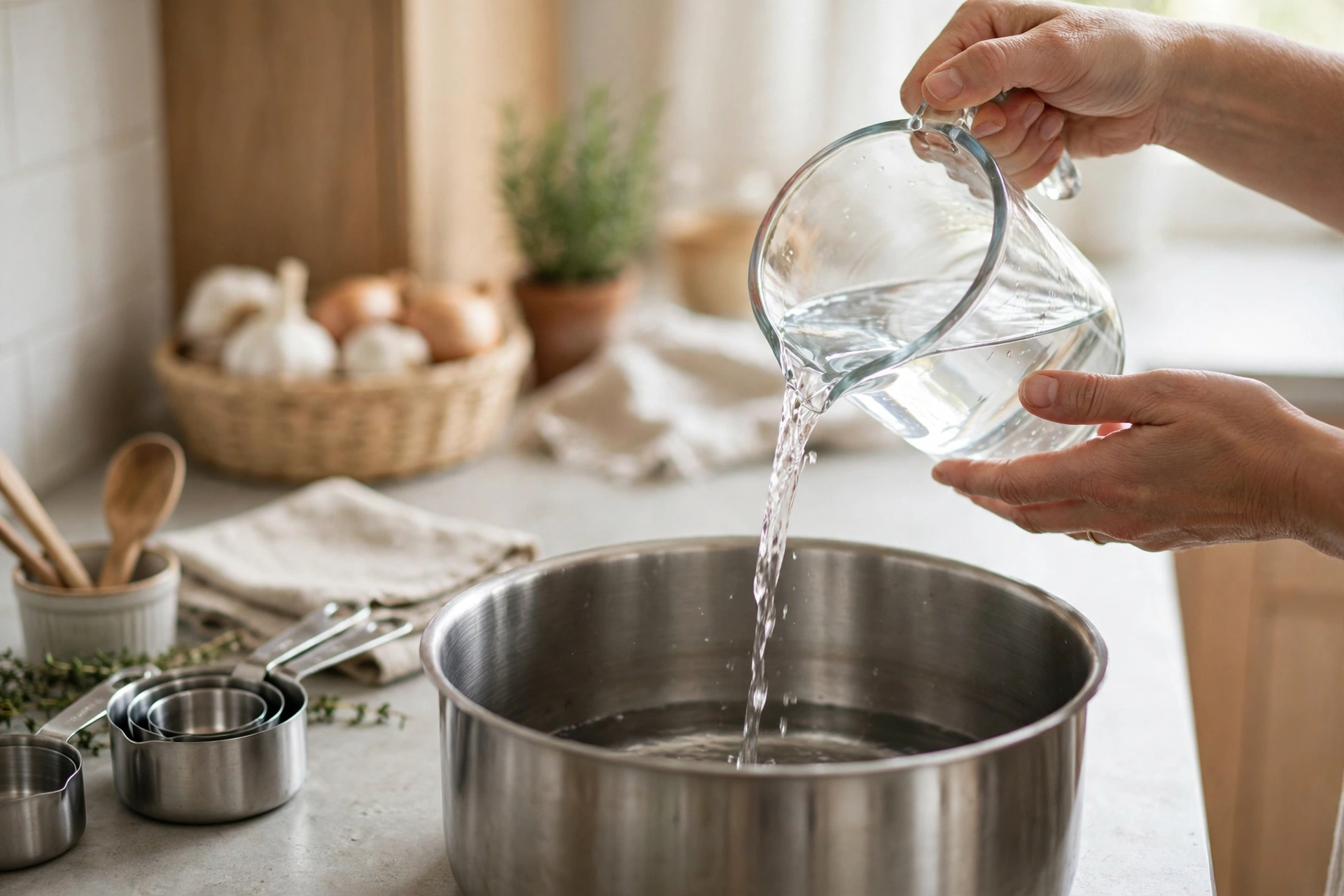
A recipe calls for 400 mL of stock. Divide by 100 and you get 4 L. Divide by 1,000, the correct way, and you get 0.4 L. The wrong answer is a full pot of stock instead of a modest jug.
The fix is to tie the number 1,000 to the word “milli” itself. “Milli” means one-thousandth, so one milliliter is one-thousandth of a liter. There are a thousand of them in every liter, not a hundred.
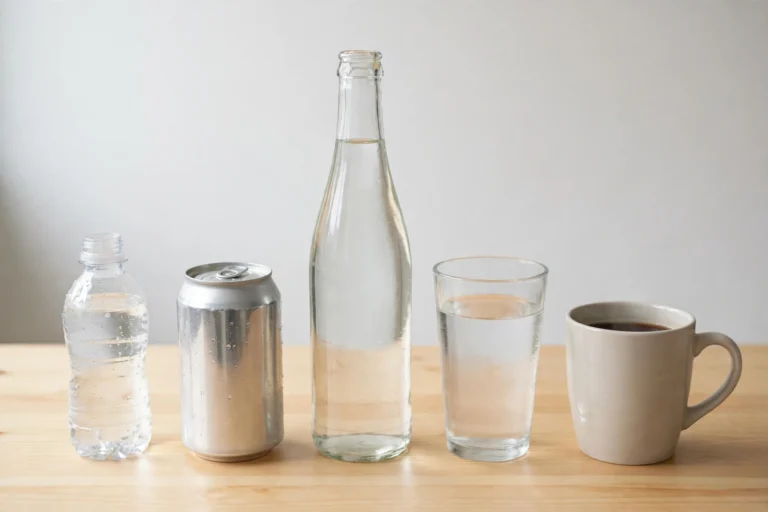
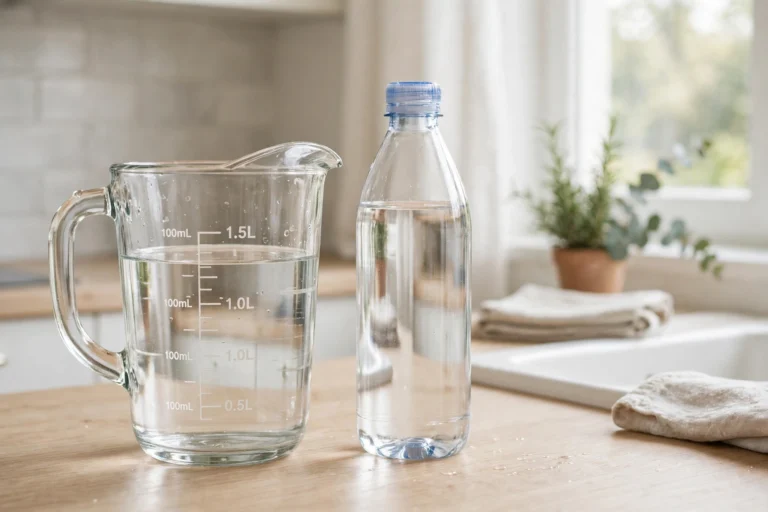
Keep a standard 500 mL water bottle in mind as your reference point. You know it holds half a liter, or 0.5 L. Test your method on it: 500 divided by 1,000 is 0.5, which matches. But 500 divided by 100 is 5, and nobody would call a half-liter bottle five liters.
Mistake 3: Confusing Milliliters (mL) with Milligrams (mg)
This is the most dangerous mistake on the list, because it mixes up two different things: volume and mass. Milliliters measure how much space a liquid takes up; milligrams measure how heavy something is. Swapping them matters a great deal with medicine.
The abbreviations look almost identical: mL and mg differ by a single letter. A cough syrup dose of 5 mL is a volume, about one teaspoon of liquid. Read it as 5 mg, and you have lost the actual instruction.
For water, 5 mL weighs about 5 grams, because one milliliter of water weighs about one gram. But that only holds for water: syrup is denser, oil is lighter, and there is no universal rule that turns milliliters into milligrams.
The fix is to read the unit, not just the number. If the instructions say mL, reach for a measuring spoon marked in mL. If they say mg, you need a scale. Never guess at a medicine dose: ask a pharmacist if a label is unclear.
Mistake 4: Mixing Up US Cups and Fluid Ounces with Metric Cups and Liters
The same words, “cup” and “ounce,” mean different amounts depending on which system you are using.
A US cup holds 236.6 mL; a metric cup holds 250 mL. The difference is only about 13 mL per cup, but a cake needing four cups of milk would take 946 mL with US cups and 1,000 mL with metric cups.
A US fluid ounce is 29.57 mL, and an imperial fluid ounce is 28.41 mL. A fluid ounce is also not the same as an ounce by weight, which is about 28.35 grams.
Check which system your recipe uses before you convert. Grams or Celsius on the page mean it is metric, so use the 250 mL cup. Fahrenheit and pounds mean it is American, so use the 236.6 mL cup.
| Unit | Milliliters |
|---|---|
| 1 US cup | 236.6 mL |
| 1 metric cup | 250 mL |
| 1 US fluid ounce | 29.57 mL |
| 1 imperial fluid ounce | 28.41 mL |
Mistake 5: Rounding Too Early or Dropping the Leading Zero
The last mistake is a quiet one. It does not come from misunderstanding the conversion, but from tidying up the answer too soon, or writing it down in a way that is easy to misread.
Imagine adding 125 mL, 340 mL, and 265 mL. Converted exactly, those are 0.125 L, 0.34 L, and 0.265 L, which add up to 0.73 L. Round each one to one decimal place first, and you get 0.1 L, 0.3 L, and 0.3 L, which add up to only 0.7 L.
The rule is simple: keep the full number through every step, and round only at the very end.
Dropping the leading zero is the second half of the problem. Written as .025 L, the number 0.025 L is easy to misread: a faint decimal point can turn .025 into 25, a thousand times too big. Write 0.5 L, not .5 L.
Quick-Check Checklist
Run through this list every time you convert mL to L:
- Did I divide by 1,000, not 100?
- Did the number get smaller? If it got bigger, the decimal went the wrong way.
- Am I reading mL (volume), not mg (mass)?
- If the recipe uses cups or fluid ounces, do I know whether they are US or metric?
- Did I keep full precision until the final step, and round only at the end?
- Does my answer have a leading zero, as in 0.025 L rather than .025 L?
If every box is ticked, your conversion is almost certainly right.
Practice Questions
Try these without a calculator, then check your answers below.
1. A jug holds 1,750 mL of juice. How many liters is that?
Answer: 1.75 L. Move the decimal three places left: 1,750 becomes 1.750, which is 1.75 L.
2. A recipe needs 0.6 L of cream, but your measuring jug is marked in milliliters. How many mL do you need?
Answer: 600 mL. Going from liters to milliliters, multiply by 1,000, so 0.6 × 1,000 = 600 mL.
3. A medicine spoon holds 2.5 mL. A patient needs three spoonfuls. How many liters is the total dose?
Answer: 0.0075 L. Three spoonfuls are 7.5 mL in total, and 7.5 divided by 1,000 is 0.0075 L.
4. A recipe calls for 2 US cups of water. About how many milliliters is that?
Answer: about 473 mL. One US cup is 236.6 mL, so two cups are 473.2 mL.
FAQ
What is the most common ml to l conversion mistake?
Moving the decimal point the wrong way. Your answer must be smaller than the number you started with.
Why do I keep dividing by 100 instead of 1000?
Because dividing by 100 is the rule for centimeters to meters and for percentages, so your brain reaches for it out of habit. But liquid volume steps by thousands: 1,000 mL in a liter.
Can I convert milliliters to milligrams directly?
No. Milliliters measure volume and milligrams measure mass. To go between them, you need the density of the substance. For water, 1 mL weighs about 1 gram, but other liquids differ.
How many mL are in a US cup?
One US cup is 236.6 mL. A metric cup is 250 mL, so the two are not the same. Always check which system your recipe uses before you convert.
Is it wrong to write .5 L instead of 0.5 L?
It is the same value, but it is a bad habit. Without the leading zero, .5 can look like 5, which is ten times too much. Always write the zero: 0.5 L.
Conclusion
Converting milliliters to liters will never be complicated. The rule is one line long: divide by 1,000, or move the decimal point three places to the left. What makes it go wrong is never the rule itself. It is the small slips around it.
All five mistakes share one cure: slow down for five seconds and check your answer. Is the number smaller than the one you started with? Did you divide by 1,000?
Keep the checklist somewhere handy, and the next time a recipe, a label, or a homework problem asks you to convert mL to L, you will get it right the first time.