
mL to L Conversion Using Dimensional Analysis
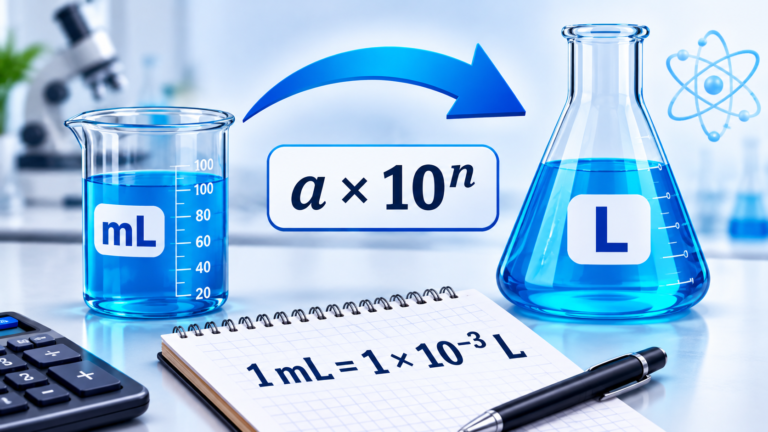
To convert milliliters to liters using dimensional analysis, multiply the mL value by the conversion factor 1 L / 1,000 mL. The milliliter units cancel, leaving your answer in liters. For example, 250 mL × (1 L / 1,000 mL) = 0.25 L. This method works for any mL value and guarantees the correct units every time.
This guide explains the complete method. You will learn how to set up the conversion factor, cancel units, solve problems step by step, and apply this skill to chemistry calculations.
What Is Dimensional Analysis?
Dimensional analysis is a problem-solving method that uses conversion factors to change one unit of measurement into another. You multiply your starting measurement by one or more fractions (conversion factors) that equal 1. The unwanted units cancel out, and you are left with the unit you need.
This method works because multiplying by 1 does not change the value of a number. It only changes how the number is expressed.
Here is the general formula:
Starting measurement × Conversion factor = Converted measurement
Dimensional analysis is used throughout science, medicine, and engineering. It prevents unit errors and keeps calculations organized, especially when multiple conversions are needed in a single problem.
Another Name: The Factor-Label Method
Dimensional analysis goes by several names. You may hear it called:
- Factor-label method (because you label every number with its unit)
- Unit analysis (because you analyse which units cancel)
- Unit-factor method
All these names describe the same process: multiplying by conversion factors so the units guide you to the correct answer.
The mL to L Conversion Factor
A conversion factor is a fraction that equals 1. It expresses the same quantity in two different units.
Since 1 liter equals exactly 1,000 milliliters, you can write two conversion factors:
1 L / 1,000 mL = 1
1,000 mL / 1 L = 1
Both fractions equal 1 because the top and bottom represent the same volume. The first form converts mL to L. The second converts L to mL.
Why the Conversion Factor Equals 1
The fraction 1 L / 1,000 mL equals 1 because 1 L and 1,000 mL are the same volume. When you multiply a measurement by this fraction, you change its unit without changing its actual size. The physical quantity stays the same. Only the label changes.
This is the core idea behind dimensional analysis. Every conversion factor is a disguised form of the number 1.
Choosing the Right Form of the Conversion Factor
Students often ask: “Which fraction do I use?” The rule is simple.
Place the unit you want to remove in the denominator (bottom). Place the unit you want to keep in the numerator (top).
For mL to L conversion:
- You want to remove mL, so mL goes on the bottom.
- You want to keep L, so L goes on the top.
This gives you: 1 L / 1,000 mL
If you accidentally flip it (1,000 mL / 1 L), the mL units will not cancel. You will get an answer in mL², which makes no sense. That is your signal to flip the fraction.
How to Convert mL to L Using Dimensional Analysis (Step by Step)
Follow these four steps for any mL to L conversion.
Step 1 — Write the Starting Measurement
Write the mL value as a fraction over 1. This makes it easy to multiply with the conversion factor.
Example: 500 mL → write as 500 mL / 1
Step 2 — Multiply by the Conversion Factor
Place the conversion factor next to your starting measurement. Make sure mL is in the denominator so it will cancel.
500 mL / 1 × 1 L / 1,000 mL
Step 3 — Cancel the Units
The mL in the numerator of the first fraction and the mL in the denominator of the conversion factor are the same unit. They cancel each other out. Cross them out.
500 mL / 1 × 1 L / 1,000 mL = ? L
The only unit left is L (liters). This confirms the setup is correct.
Step 4 — Calculate and Verify
Multiply the numbers across the top. Multiply the numbers across the bottom. Then divide.
- Top: 500 × 1 = 500
- Bottom: 1 × 1,000 = 1,000
- Answer: 500 / 1,000 = 0.5 L
Verify: Does the answer make sense? 500 mL is half a liter, and 0.5 L is half a liter. ✓
Verify the unit: The remaining unit is L (liters). ✓
Solved Examples
250 mL to L
Setup:
250 mL × (1 L / 1,000 mL)
Cancel units: mL cancels with mL.
Calculate: 250 × 1 / 1,000 = 250 / 1,000
Answer: 250 mL = 0.25 L
Check: 250 is one-quarter of 1,000, so 0.25 L (one-quarter of a liter) is correct. ✓
500 mL to L
Setup:
500 mL × (1 L / 1,000 mL)
Cancel units: mL cancels with mL.
Calculate: 500 / 1,000
Answer: 500 mL = 0.5 L
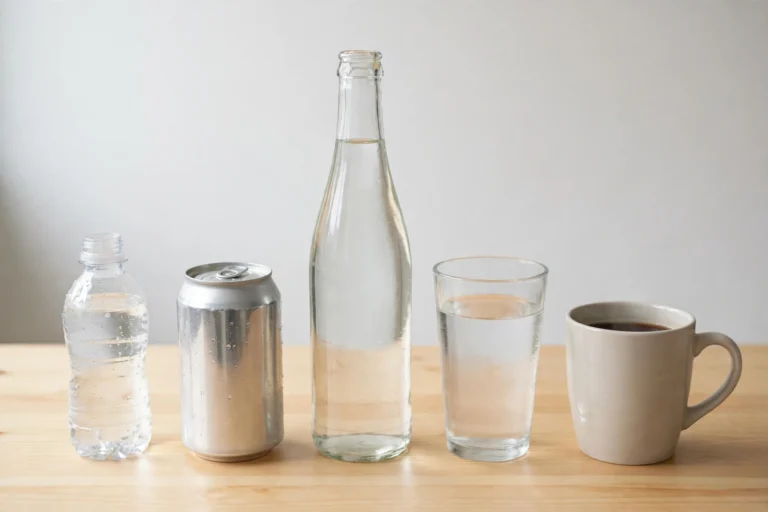
Check: 500 mL is a standard water bottle, which is half a liter. ✓
750 mL to L
Setup:
750 mL × (1 L / 1,000 mL)
Cancel units: mL cancels with mL.
Calculate: 750 / 1,000
Answer: 750 mL = 0.75 L
Check: 750 is three-quarters of 1,000, and 0.75 is three-quarters of 1. ✓
1,250 mL to L
Setup:
1,250 mL × (1 L / 1,000 mL)
Cancel units: mL cancels with mL.
Calculate: 1,250 / 1,000
Answer: 1,250 mL = 1.25 L
Check: 1,250 mL is more than 1,000 mL, so the answer should be greater than 1 L. It is. ✓
45.5 mL to L
Setup:
45.5 mL × (1 L / 1,000 mL)
Cancel units: mL cancels with mL.
Calculate: 45.5 / 1,000
Answer: 45.5 mL = 0.0455 L
Check: 45.5 mL is a small volume, so the liter value should be a small decimal. It is. ✓
mL to L Dimensional Analysis Reference Table
| Starting Value (mL) | Dimensional Analysis Setup | Unit Cancellation | Answer (L) |
|---|---|---|---|
| 1 mL | 1 mL × (1 L / 1,000 mL) | mL cancels | 0.001 L |
| 10 mL | 10 mL × (1 L / 1,000 mL) | mL cancels | 0.01 L |
| 25 mL | 25 mL × (1 L / 1,000 mL) | mL cancels | 0.025 L |
| 50 mL | 50 mL × (1 L / 1,000 mL) | mL cancels | 0.05 L |
| 100 mL | 100 mL × (1 L / 1,000 mL) | mL cancels | 0.1 L |
| 250 mL | 250 mL × (1 L / 1,000 mL) | mL cancels | 0.25 L |
| 500 mL | 500 mL × (1 L / 1,000 mL) | mL cancels | 0.5 L |
| 750 mL | 750 mL × (1 L / 1,000 mL) | mL cancels | 0.75 L |
| 1,000 mL | 1,000 mL × (1 L / 1,000 mL) | mL cancels | 1 L |
| 1,500 mL | 1,500 mL × (1 L / 1,000 mL) | mL cancels | 1.5 L |
| 2,000 mL | 2,000 mL × (1 L / 1,000 mL) | mL cancels | 2 L |
| 5,000 mL | 5,000 mL × (1 L / 1,000 mL) | mL cancels | 5 L |
Chemistry Applications of mL to L Conversion
In chemistry, volumes measured in milliliters often need to be converted to liters before plugging into formulas. Two common situations require this conversion.
Converting Solution Volume for Molarity
Molarity (M) measures concentration. The formula is:
M = moles of solute / liters of solution
The denominator must be in liters, not milliliters. If you measure a solution volume in mL, you must convert it to L before calculating molarity.
Example: A student dissolves 0.5 moles of NaCl in 250 mL of water. What is the molarity?
Step 1: Convert 250 mL to L using dimensional analysis.
250 mL × (1 L / 1,000 mL) = 0.25 L
Step 2: Calculate molarity.
M = 0.5 mol / 0.25 L = 2 M (2 moles per liter)
Without converting mL to L first, a student might divide 0.5 by 250 and get 0.002. That answer is wrong by a factor of 1,000.
Laboratory Measurement Example
A lab procedure asks you to add 75 mL of hydrochloric acid (HCl) to a reaction. Your lab notebook records all volumes in liters. Convert the measurement.
75 mL × (1 L / 1,000 mL) = 0.075 L
Record 0.075 L in your lab notebook. The dimensional analysis setup guarantees the unit conversion is correct before you write it down.
Why this matters: Chemistry calculations often chain multiple conversion factors together. For example, converting mL to L, then using molarity to find moles, then using molar mass to find grams. Dimensional analysis keeps every step organized and every unit accounted for.
How to Spot an Incorrect Setup
Dimensional analysis has a built-in error check: if your units do not cancel correctly, the setup is wrong.
Incorrect setup (common student error):
500 mL × (1,000 mL / 1 L) = 500,000 mL²/L
The mL units do not cancel. Instead, you get mL² in the numerator, which is not a real unit. This means the conversion factor is upside down.
How to fix it: Flip the conversion factor so the unit you want to remove is in the denominator.
Correct setup:
500 mL × (1 L / 1,000 mL) = 0.5 L ✓
Three signs your setup is wrong:
- Units do not cancel. You have leftover units that should not be there.
- The answer is unreasonably large. If converting mL to L gives a number bigger than your starting value, you likely multiplied instead of dividing.
- The answer has strange units. Something like mL²/L or mL·L means the factors are arranged incorrectly.
Always write out the units at every step. Let the units guide you to the answer.
Practice Problems with Solutions
Try each problem before reading the solution.
Problem 1: Convert 350 mL to liters using dimensional analysis.
Solution:
350 mL × (1 L / 1,000 mL) = 350 / 1,000 = 0.35 L
Problem 2: Convert 125 mL to liters using dimensional analysis.
Solution:
125 mL × (1 L / 1,000 mL) = 125 / 1,000 = 0.125 L
Problem 3: Convert 2,500 mL to liters using dimensional analysis.
Solution:
2,500 mL × (1 L / 1,000 mL) = 2,500 / 1,000 = 2.5 L
Problem 4: Convert 8.5 mL to liters using dimensional analysis.
Solution:
8.5 mL × (1 L / 1,000 mL) = 8.5 / 1,000 = 0.0085 L
Problem 5: A chemist measures 600 mL of a sulfuric acid solution. Express this volume in liters.
Solution:
600 mL × (1 L / 1,000 mL) = 600 / 1,000 = 0.6 L
Problem 6: You have 1,750 mL of saline solution. Convert to liters, then calculate the molarity if the solution contains 0.35 moles of NaCl.
Solution:
Step 1: 1,750 mL × (1 L / 1,000 mL) = 1.75 L
Step 2: M = 0.35 mol / 1.75 L = 0.2 M
Problem 7: A student writes: 400 mL × (1,000 mL / 1 L) = 400,000 mL²/L. Identify and correct the error.
Solution:
The conversion factor is upside down. The student placed mL on top and L on the bottom, so the mL units multiplied instead of cancelling.
Correct setup: 400 mL × (1 L / 1,000 mL) = 0.4 L
Frequently Asked Questions
What is dimensional analysis?
Dimensional analysis is a method that uses conversion factors to change one unit into another. You write each conversion factor as a fraction equal to 1, multiply it by the starting measurement, and cancel matching units. The result has only the unit you need. It is also called the factor-label method or unit analysis.
What is the conversion factor for mL to L?
The conversion factor is 1 L / 1,000 mL. This fraction equals 1 because 1 liter and 1,000 milliliters are the same volume. You multiply any mL value by this fraction to convert it to liters.
How do units cancel in dimensional analysis?
Units cancel the same way numbers cancel in fractions. When the same unit appears in both the numerator and the denominator, you cross it out. For example, in 500 mL × (1 L / 1,000 mL), the mL on top and the mL on the bottom cancel each other. Only L remains.
Why is dimensional analysis used in chemistry?
Chemistry formulas often require specific units. Molarity needs liters, not milliliters. Molar mass needs grams, not kilograms. Dimensional analysis ensures every measurement is in the correct unit before you plug it into a formula. It also catches errors, because incorrect setups produce nonsense units.
What is the difference between dimensional analysis and just dividing by 1,000?
The final arithmetic is the same. The difference is in the method. Dividing by 1,000 requires you to remember which direction to convert. Dimensional analysis uses the conversion factor as a guide. You write out the units, and they cancel automatically. This is especially helpful when you chain multiple conversions in one problem.
How do you convert L to mL using dimensional analysis?
Flip the conversion factor. Use 1,000 mL / 1 L instead of 1 L / 1,000 mL. For example, 2.5 L × (1,000 mL / 1 L) = 2,500 mL. The liter units cancel, leaving milliliters.
Can dimensional analysis handle more than one conversion at a time?
Yes. You can chain multiple conversion factors in a single equation. For example, to convert 500 mL to cubic meters: 500 mL × (1 L / 1,000 mL) × (1 m³ / 1,000 L) = 0.0005 m³. Each factor cancels one unit and introduces the next.