Milliliters to Liters in Cooking & Baking: Complete Kitchen Guide
You are halfway through a recipe when you hit a line that stops you cold: “Add 750 mL of stock.” Your jug is marked in liters, your cups are marked in cups, and the recipe uses milliliters. This guide fixes that. Once you understand ml to l cooking conversion, you will never stop mid-recipe to search for a converter again.
The One Rule
Everything here comes from one fact:
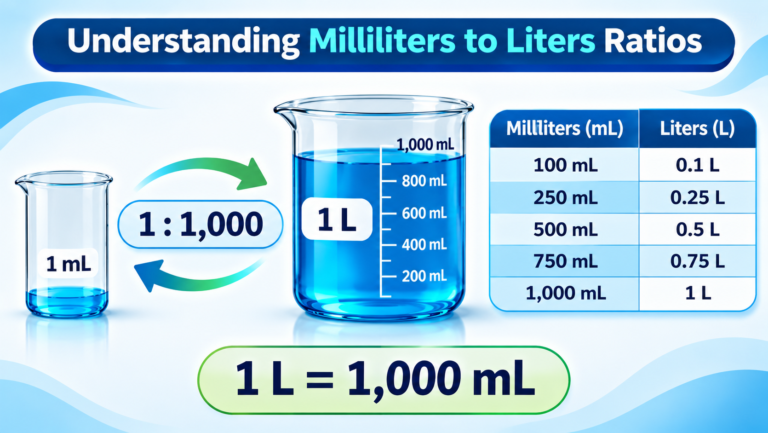
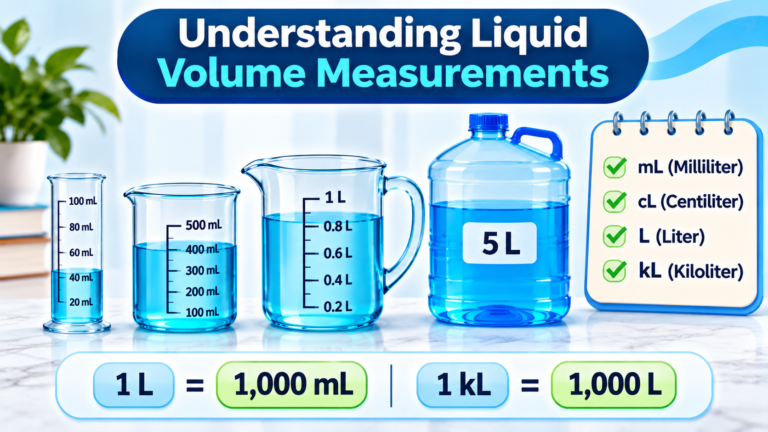
1 liter = 1,000 milliliters
To convert mL to L, divide by 1,000 — or move the decimal point three places left. So 750 mL is 0.75 L, and 250 mL is 0.25 L. To go the other way, multiply by 1,000: 0.5 L is 500 mL. That is the whole system.
Quick-Reference Kitchen Conversion Table
| Kitchen measure | Milliliters (mL) | Liters (L) |
|---|---|---|
| 1 teaspoon | 5 mL | 0.005 L |
| 1 tablespoon | 15 mL | 0.015 L |
| 1/4 cup (US) | 60 mL | 0.06 L |
| 1/4 cup (metric) | 62.5 mL | 0.0625 L |
| 1/2 cup | 125 mL | 0.125 L |
| 3/4 cup | 180 mL | 0.18 L |
| 1 cup (US) | 236.6 mL | 0.237 L |
| 1 cup (metric) | 250 mL | 0.25 L |
| 2 cups | 500 mL | 0.5 L |
| 4 cups (metric) | 1,000 mL | 1 L |
Stick this table inside a cupboard door and you will use it for years.
Metric Cup vs. US Cup
A “cup” is not the same everywhere, and the difference matters in baking.
1 metric cup = 250 mL = 0.25 L. This is the standard in Australia, New Zealand, and most metric recipes worldwide.
1 US cup = 236.6 mL, usually rounded to 237 mL. This is the American standard. The gap is about 13 mL per cup — small alone, but over four cups it is more than 50 mL, roughly a quarter of a cup.
Follow the recipe’s origin: American source, US cups; metric source, metric cups. If the recipe is written in milliliters, skip cups entirely and measure the milliliters directly. Many recipes list “1 cup (250 mL)” or “1 cup (237 mL)” — that number tells you which cup the author meant.
Tablespoons and Teaspoons
Spoon measures are the same in metric and US cooking: 1 teaspoon = 5 mL and 1 tablespoon = 15 mL. One tablespoon equals 3 teaspoons. So 1 tablespoon is 0.015 L and 1 teaspoon is 0.005 L — tiny fractions of a liter, which is why recipes write them as spoons, not liters.
A handy shortcut: four tablespoons make a quarter cup (60 mL), and sixteen tablespoons make one US cup. Without a measuring cup, you can measure a cup one tablespoon at a time. Slow, but accurate.
Worked Examples
Example 1: A soup needs 1.5 L of stock. Multiply by 1,000: 1.5 × 1,000 = 1,500 mL. That is six metric cups, or three 500 mL jugfuls.
Example 2: A cake needs 375 mL of milk. Divide by 1,000: 375 ÷ 1,000 = 0.375 L. That is one and a half metric cups (250 + 125 mL).
Example 3: A sauce needs 60 mL of cream. That is a quarter of a US cup, or four tablespoons. No quarter-cup measure? Four level tablespoons will do.
How to Read a Measuring Jug
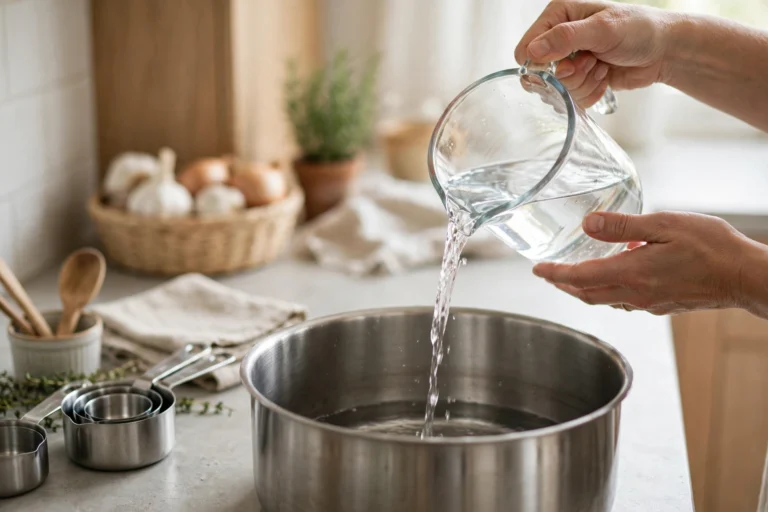
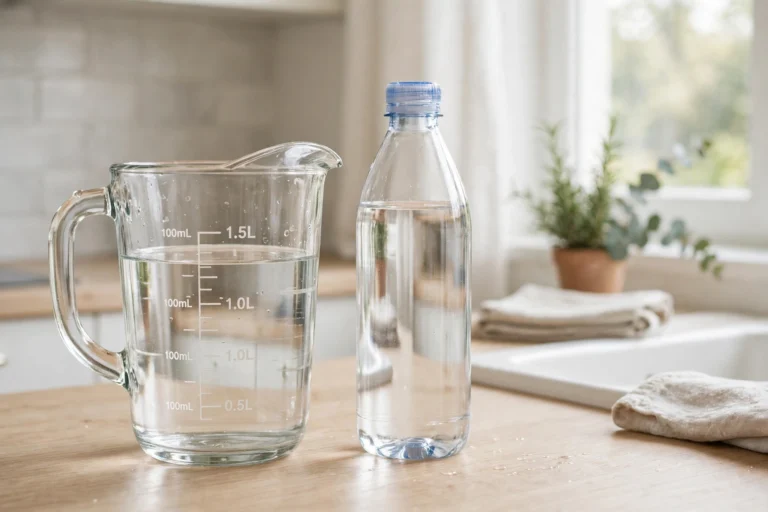
Place the jug on a flat surface — never hold it in the air. Crouch down so your eyes are level with the markings, and read the bottom of the curved surface of the liquid, called the meniscus. Reading from above makes the level look higher than it is, so you add too little.
Pour slowly near the mark; if you overshoot, spoon the excess out.
Wet Cups vs. Dry Cups
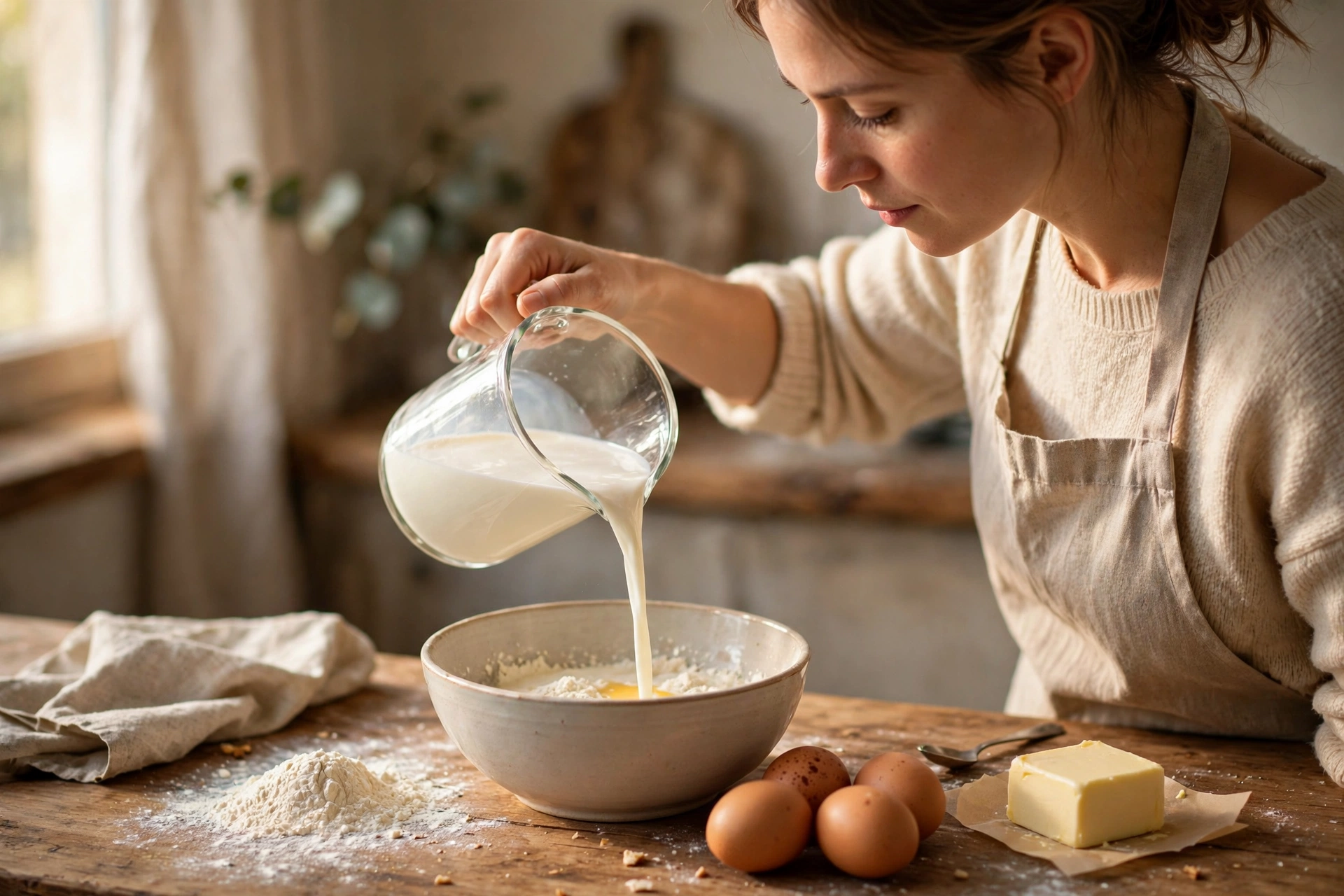
Wet measuring cups are jugs with a spout and markings on the side, made for liquids: water, milk, oil, stock. Fill to the line and read at eye level.
Dry measuring cups are flat-topped cups you fill to the brim and level off with a knife. They are made for flour, sugar, and rice. You cannot read a liquid level in them, and you cannot level off a liquid with a knife.
Using the wrong type causes real errors: flour scooped into a wet jug packs down and overfills, while milk in a dry cup spills on the way to the bowl.
Why Dry Ingredients Should Be Weighed
Volume and weight are not the same thing, and for dry ingredients they are not interchangeable. A milliliter measures volume — how much space something takes up. A gram measures mass — how heavy it is. For water they line up: 1 mL of water weighs about 1 gram, so 1 liter weighs about 1 kilogram. That tempts people to treat mL and grams as identical. They are not.
Flour proves it. One metric cup of flour is 250 mL by volume, but weighs only about 120 grams. If a recipe calls for 250 grams of flour and you measure 250 mL instead, you get less than half the flour you need. Your cake turns out flat, wet, and dense.
The rule: measure liquids by volume, and weigh dry ingredients in grams. Good recipes give both — “250 g flour (about 2 cups)” — and the gram figure is the one to trust.
Scaling a Recipe Up or Down
To double a recipe, multiply every liquid amount by two. A sauce using 250 mL of cream becomes 500 mL (0.5 L); a soup using 1 L of stock becomes 2 L. Write the doubled numbers down before you start, so you are not doing math with wet hands.
To halve a recipe, divide every liquid amount by two. 500 mL of milk becomes 250 mL. 375 mL becomes 187.5 mL — round to 190 mL, or use 180 mL plus a tablespoon and a half. Rounding to the nearest 5 mL is fine for almost every dish.
To make one and a half times a recipe, multiply each amount by 1.5. So 200 mL of oil becomes 300 mL, and 1 L of stock becomes 1.5 L. Keep the same multiplier for every ingredient, or the recipe’s balance shifts.
Converting a Cups Recipe to Milliliters
Many older recipes, especially American ones, are written entirely in cups. First, identify the cup: American sources use the US cup (236.6 mL); metric sources use the metric cup (250 mL). Unsure? Butter in grams and Celsius suggests metric; butter in sticks and Fahrenheit suggests American.
Then convert each amount. For a US recipe: 1 cup = 237 mL, 1/2 cup = 118 mL (often rounded to 120 mL), 1/3 cup = 79 mL (often rounded to 80 mL), 1/4 cup = 59 mL (often rounded to 60 mL). For a metric recipe: 1 cup = 250 mL, 1/2 cup = 125 mL, 1/3 cup = 83 mL (often rounded to 80 mL), 1/4 cup = 62.5 mL (often rounded to 60 mL).
Write converted amounts next to the originals: “2 cups milk, 1/2 cup cream” becomes “500 mL milk, 125 mL cream” in metric. Convert once, on paper, and the cooking becomes easy.
Common Mistakes
Mistake 1: Mixing up metric and US cups. A 250 mL metric cup in an American recipe adds about 13 mL per cup — over four cups, more than 50 mL of extra liquid, enough to make a batter too wet.
Mistake 2: Treating mL and grams as the same for dry ingredients. 250 mL of flour is about 120 grams, not 250 grams. This is the single most common cause of failed bakes.
Mistake 3: Reading the jug from above. The level looks higher than it is. Always read at eye level, with the jug on a flat surface.
Mistake 4: Measuring liquids in dry cups. A dry cup has no spout and no room above the brim. Fill it with milk and you spill some on the way to the bowl.
Mistake 5: Guessing small amounts. In baking, the difference between one teaspoon (5 mL) and one tablespoon (15 mL) of baking powder is the difference between a cake that rises and one that tastes bitter. Use real measuring spoons.
Frequently Asked Questions
How many mL are in 1 liter for cooking?
There are 1,000 mL in 1 liter — everywhere, for every liquid. So 0.5 L is 500 mL and 2 L is 2,000 mL.
How many cups is 500 mL?
Exactly 2 metric cups. In US cups, about 2.11 cups — two cups plus roughly two tablespoons. For baking, measure the extra 27 mL properly.
Is 250 mL the same as 1 cup?
250 mL is exactly one metric cup. One US cup is 236.6 mL, so 250 mL is slightly more — about one cup plus one tablespoon.
Can I measure flour in milliliters?
You can, but do not rely on it: 250 mL of flour can weigh anywhere from about 110 to 140 grams depending on packing. Weigh flour in grams instead.
How do I convert tablespoons to milliliters?
Multiply tablespoons by 15: 2 tablespoons is 30 mL, 4 is 60 mL, 8 is 120 mL. For teaspoons, multiply by 5: 2 teaspoons is 10 mL, and 3 teaspoons is 15 mL — exactly one tablespoon.
Conclusion
One liter is 1,000 milliliters. One metric cup is 250 mL. One US cup is about 237 mL. One tablespoon is 15 mL, and one teaspoon is 5 mL. That is the whole toolkit.
From there it is habit: read the jug at eye level, use wet cups for liquids, weigh your flour, and scale every ingredient by the same amount. Keep the table near your stove, and soon you will convert ml to l in cooking without thinking about it at all.